The brass locomotive wheezed to a halt at the platform suspended between three mountain peaks, steam billowing into the thin alpine air. Margot pressed her face against the frosted window, watching passengers disembark with their peculiar luggage—glass orbs that swirled with silver mist, leather satchels that hummed with barely contained whispers, and crystalline bottles that pulsed with warm light.
She clutched her own burden closer: a simple wooden box containing her grandmother’s final memory, harvested moments before death as was the custom in the highland territories. The memory was precious—a recipe for bread that could heal heartbreak, passed down through seven generations of women in her family.
“All aboard for Station Echo-7,” called the conductor, his voice carrying an odd echo as if spoken from the bottom of a well. “Final destination for memory preservation and… redistribution.”
Margot had never heard that pause before. In all the stories her grandmother told about the legendary station, there had never been mention of redistribution.
The train lurched forward, climbing impossible angles along tracks that seemed to twist through dimensions rather than mere geography. Other passengers sat in respectful silence, cradling their precious cargo of bottled remembrances. An elderly man held what appeared to be his first kiss, the glass container blushing pink with teenage embarrassment. A young woman nursed a sphere containing what looked like her mother’s lullabies, musical notes visible as golden threads swimming through the mist.
As they ascended, the landscape below shifted from alpine meadows to something altogether more ethereal. Clouds gathered beneath them in impossible formations, spelling out words in languages Margot didn’t recognize. The air inside the train grew thick with the scent of jasmine and old parchment.
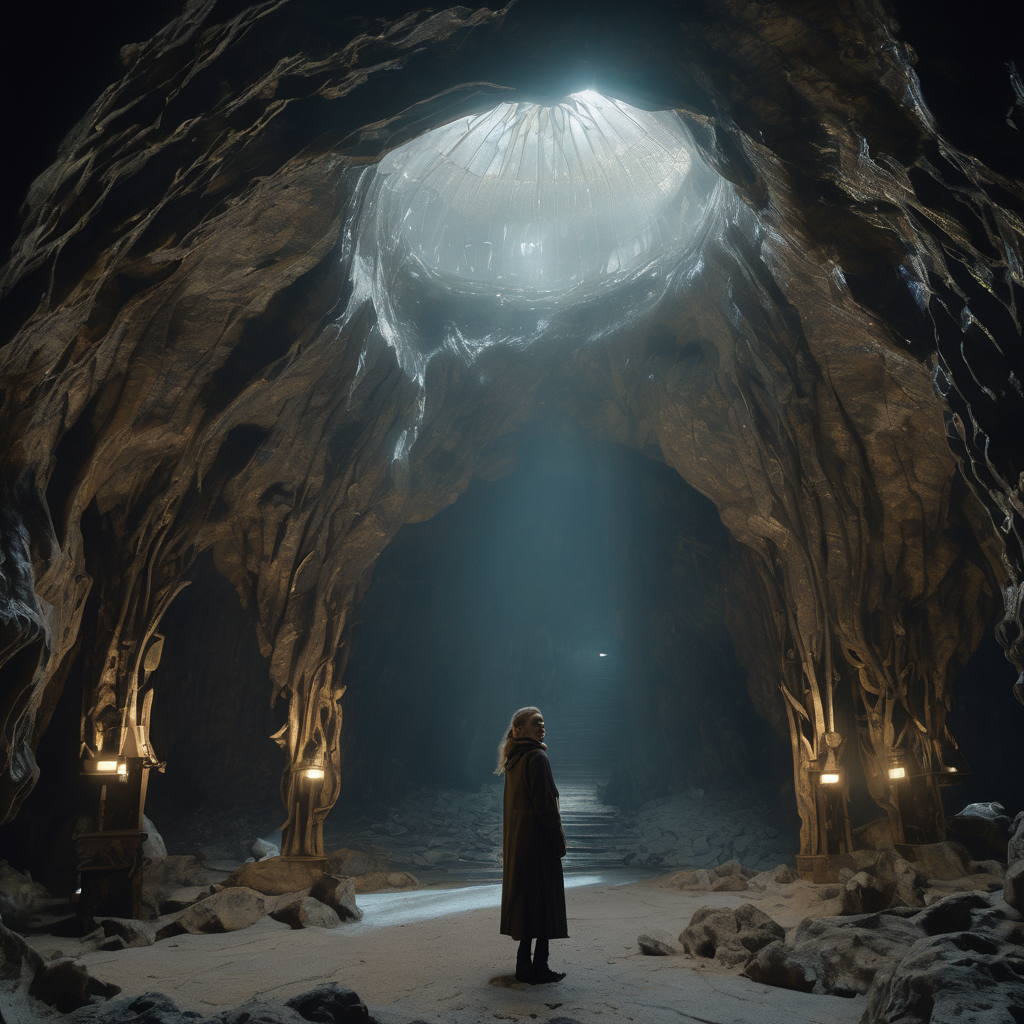
Station Echo-7 materialized gradually, as if emerging from a dream. It was built into the heart of a mountain that definitely hadn’t existed moments before, its Victorian architecture carved directly from living rock. Crystalline veins ran through the stone walls, pulsing with the collected light of thousands upon thousands of memories.
The station master greeted each passenger personally, his eyes the color of forgotten storms. When he reached Margot, his gaze lingered on her wooden box with unusual interest.
“Ah,” he said, his voice that same echoing whisper as the conductor’s. “The Brennan family recipe. We’ve been expecting this one for quite some time.”
“Expecting it?” Margot clutched the box tighter. “This is for preservation, not—”
“Of course, my dear. Right this way.”
He led her through corridors lined with memory repositories—vast halls where thousands of glowing containers sat on shelves that stretched beyond sight. She glimpsed memories of first snowfalls, last words, wedding dances, and childhood summers, each one carefully catalogued and labeled.
But something was wrong. Many of the shelves were empty, dust outlines showing where containers once sat. And the memories that remained seemed… dimmer somehow, as if their essence was being slowly drained away.
“There’s been a mistake,” Margot said, stopping in the middle of a hall dedicated to culinary memories. “These are supposed to be preserved forever. Why are so many missing?”
The station master’s smile never wavered, but his storm-colored eyes grew darker. “Oh, they’re not missing, dear child. They’re being put to much better use. You see, certain memories are simply too valuable to leave sitting on dusty shelves. The healing bread recipe, for instance—imagine how many people we could help if we… shared it more widely.”
Around them, other figures emerged from the shadows between the shelves. They wore the same uniform as the station master, but their eyes held no color at all, just empty white spaces where irises should be. In their hands, they carried devices that looked like twisted versions of butterfly nets, designed for catching something far more ephemeral than insects.
“The memory thieves,” Margot whispered, finally understanding the stories her grandmother never finished, the warnings disguised as fairy tales.
She ran.
The corridors of Station Echo-7 twisted around her like a labyrinth designed by someone who understood the architecture of dreams. Behind her, she could hear the whisper-soft footsteps of the thieves and the station master’s voice calling out in that echoing tone: “There’s nowhere to run, Miss Brennan. This mountain exists between thoughts. The only way out is through us.”
But Margot remembered something else her grandmother had told her—that the most powerful memories were the ones shared freely, given as gifts rather than hoarded or stolen. She stopped running and opened the wooden box.
The memory of the healing bread recipe rose from the container like golden smoke, but instead of trying to capture it, Margot breathed it in deeply and then exhaled it into the air around her. She whispered the recipe aloud, sharing it with the mountain itself, with the stolen memories trapped in their crystalline prison, with anyone and everyone who might need healing.
The effect was immediate. The memory, freely given, blazed with a light that made the thieves shriek and cover their empty eyes. Throughout the station, other containers began to glow brighter as their memories responded to this act of voluntary sharing. The mountain itself seemed to shudder and sigh, as if waking from a long, uneasy sleep.
Margot found herself back on the platform where she’d arrived, but now the train was different—older, warmer, with a conductor whose eyes held the kind light of someone who truly understood the value of remembrance.
“The real Station Echo-7,” he explained as she boarded. “The thieves built their trap around it, but they could never truly destroy it. Thank you for reminding us that memories grow stronger when shared, not weaker.”
As the train pulled away from the mountain, Margot looked back to see the crystalline veins in the rock pulsing with renewed light. Somewhere in there, thousands of memories were flowing back to their rightful places, ready to be preserved and cherished rather than exploited and drained.
In her empty wooden box, she found a single golden crumb—all that remained of her grandmother’s recipe. But when she held it up to the light, she could see that it contained not just the memory of healing bread, but something new: the memory of this day, of choosing courage over safety, of learning that some gifts become more precious the more freely they’re given away.
The train carried her home through landscapes that shifted between memory and reality, and Margot understood that she was now part of an older, truer story—one where the real treasure was never the hoarding of precious things, but the wisdom to know when to let them go.


Leave a Reply