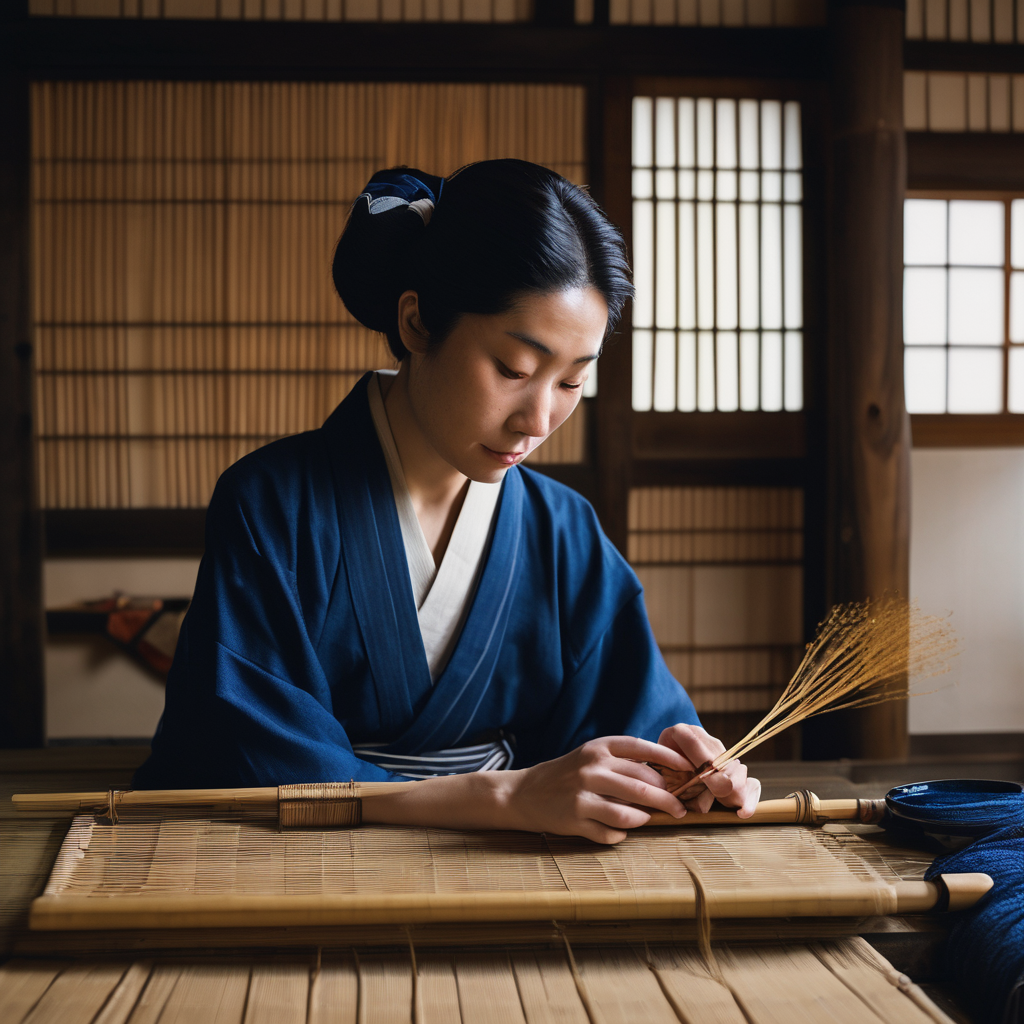
In the heart of Kyoto, where the Gion district’s traditional tea houses whispered secrets to the Kamo River, a young woman named Emiko lived a life woven from the threads of her family’s ancient legacy. As the daughter of a revered silk weaver, she had grown up surrounded by the intricate patterns and vibrant hues that danced across the looms, imbuing her with an intuitive understanding of the subtle language of fabric. Emiko’s own creations were infused with an essence of yūgen, a profound and mysterious sense of the beauty of the world, which she expressed through her innovative use of sustainable, eco-friendly dyes derived from the region’s botanicals.
One evening, as the cherry blossoms were reaching their zenith, Emiko received an enigmatic commission from a stranger who arrived at her family’s workshop, cloaked in the anonymity of a traditional Kyoto summer dress. The client requested a kimono of unexampled beauty, one that would capture the essence of the fleeting hanami moments, when the blossoms seemed to embody the very spirit of mono no aware, the poignant awareness of the transience of life. Intrigued, Emiko accepted the challenge, pouring her heart and soul into the garment, as the threads of silk seemed to come alive under her skilled fingers, weaving a narrative that transcended the fabric itself.
As she worked, Emiko found herself drawn into a world where the boundaries between reality and the mystical realm of folklore began to blur. The silk threads appeared to hold the memories of her ancestors, whispering tales of the city’s storied past, from the Heian era’s courtly intrigues to the Geisha culture’s subtle artistry. The kimono began to take on a life of its own, as if it were a tangible manifestation of the city’s collective unconscious, a true masterpiece of wabi-sabi, where the beauty of imperfection and impermanence was celebrated.
Upon completion, the kimono was a breathtaking embodiment of Emiko’s artistry, a symphony of soft pinks and whites that seemed to evoke the very essence of the cherry blossoms. When the stranger returned to collect the garment, Emiko beheld a woman of otherworldly beauty, her face a mask of serene elegance, as if she were a living embodiment of the yūrei, the spirits that haunted the dreams of Kyoto’s people. The woman’s eyes, however, held a deep sadness, a sense of longing that resonated deeply with Emiko, as she wrapped the kimono around the stranger’s form, watching as it seemed to come alive, the fabric shimmering with an ethereal light that spoke of the mysterious and the unknown.


Leave a Reply