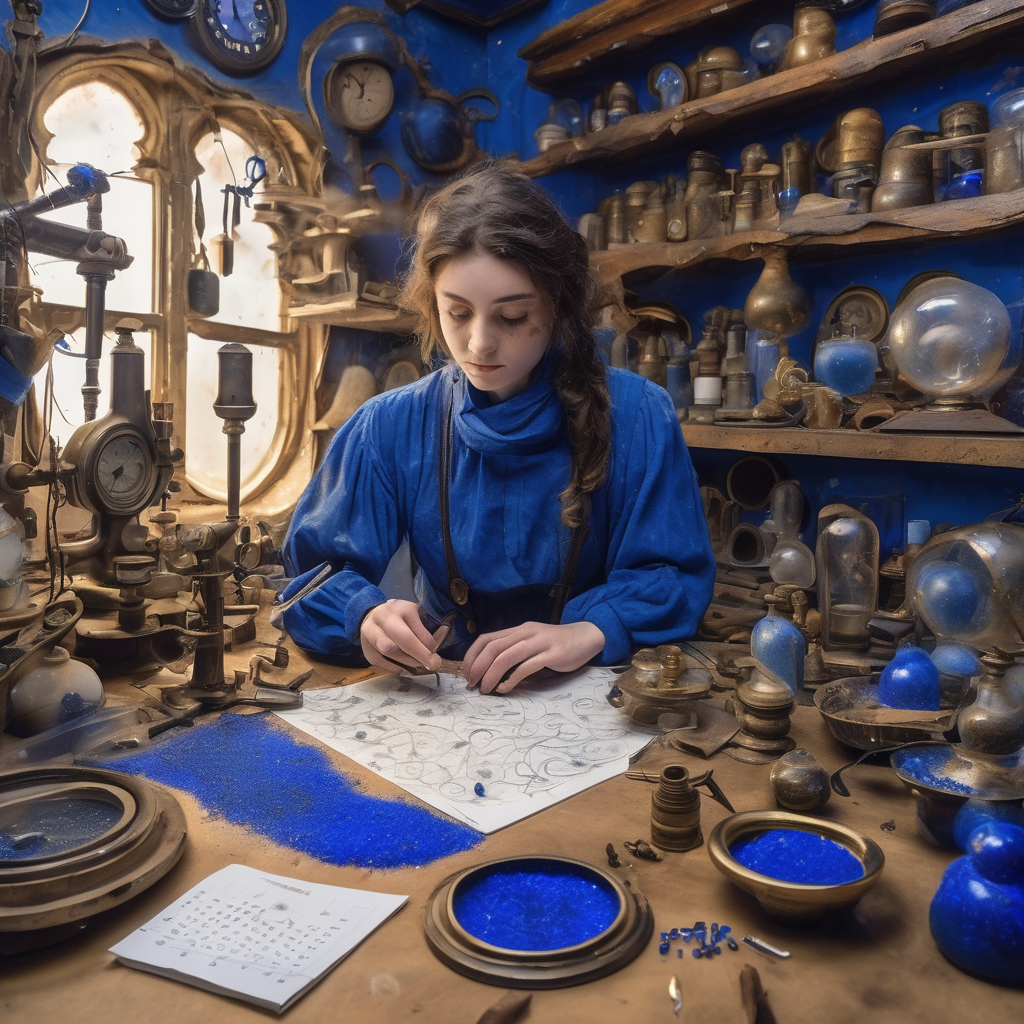
The morning Elara discovered Tuesday had been stolen, she was grinding lapis lazuli into powder for her father’s most ambitious clock yet—a timepiece that could measure the weight of promises. The blue dust swirled in the mortar like captured sky, but when she glanced at the workshop calendar, Monday’s square sat directly beside Wednesday’s, with nothing but a scorched hole where Tuesday should have been.
“Papa,” she called, but Hendrik van der Meer was deep in conversation with his latest client, a woman whose velvet dress seemed to absorb light rather than reflect it. The woman’s fingers traced the outline of a pocket watch that wasn’t there, and Elara noticed how her shadow fell in two different directions at once.
“My daughter will assist you,” Hendrik said, not looking up from his jeweler’s loupe. “Elara knows the old methods better than anyone.”
The woman turned, and Elara saw that her eyes were the color of minutes just before midnight. “I need you to build me a device that can hold a single day. Tuesday, specifically. The one that was mine.”
In the back room where her father kept the mechanisms too dangerous for ordinary clockwork, Elara learned the woman’s name was Madame Corvina, and that she belonged to an underground society of temporal collectors—people who traded in moments the way others traded in stocks or crypto. But someone had breached their vault and stolen her Tuesday, the day she’d fallen in love forty years ago.
“Without it, I’m slowly forgetting him,” Corvina whispered. “His face blurs a little more each sunrise.”
Elara had heard whispers of such thefts before, discussed in sustainability circles where people debated whether time itself was a resource that could be depleted. Her father had always dismissed such talk, but here was proof: a woman with a wound in her personal timeline.
They worked through the night, Elara incorporating springs of compressed starlight and gears carved from crystallized laughter—materials her grandmother had left behind with warnings never to use them together. The clock took shape like a lung learning to breathe, its crystal face revealing not numbers but moments: a first kiss at 2:17, shared coffee at 6:45, dancing to no music at 11:33.
But as dawn approached, Corvina’s condition worsened. She began forgetting words mid-sentence, her syntax unraveling like a democracy losing its foundation. Elara realized they weren’t just racing against time—they were racing against the absence of it.
“There’s another way,” Elara said, remembering something from her mother’s journals, before she’d disappeared into a Sunday that never ended. “We can’t retrieve your Tuesday, but we can create an echo of it. A parallel Tuesday that touches yours at exactly one point.”
She modified the clock’s mechanism, adding a pendulum made from a bird’s first flight. The device wouldn’t return the stolen day but would create a bridge—a single second where Corvina could reach across the gap and touch her memory, refresh it like a swimmer breaking the surface for air.
As Corvina wound the clock for the first time, the workshop filled with the sound of a day that had been: footsteps on wet cobblestones, the particular quality of Tuesday afternoon light, the smell of bread from a bakery that had closed twenty years ago. For one heartbeat, Elara saw him too—a man with kind eyes and paint under his fingernails, reaching through the clock face to take Corvina’s hand.
“Every week,” Elara explained, “when Monday ends, you’ll have this moment. A single second of Tuesday that they couldn’t steal because it exists outside their collection, outside anyone’s ownership.”
Corvina left as the real Tuesday—the one belonging to everyone else—began. She paid in currency Elara had never seen: small glass vials filled with discontinued colors and extinct sounds.
Hendrik emerged from his workshop, aged by hours in minutes, his latest creation ticking with the weight of unkept promises. “You used your grandmother’s materials.”
“Someone had to,” Elara replied, already sketching plans for her next impossible clock. Outside, she heard the city waking to its Tuesday—unaware it was living in a day that, for one woman, had needed to be rebuilt from scratch, second by second, memory by memory.
That night, Elara began investigating the underground market in stolen time, following digital breadcrumbs through forums where people discussed temporal sustainability and marketed moments like venture capitalists trading in futures—literal futures, it turned out. She had a feeling Madame Corvina’s case was just the beginning, that somewhere in the city’s margin between tick and tock, someone was collecting days like butterflies, pinning them to boards where they couldn’t decay or change or grow.
The clockmaker’s daughter had found her calling: building bridges across the gaps where time had been torn away, one impossible mechanism at a time.


Leave a Reply