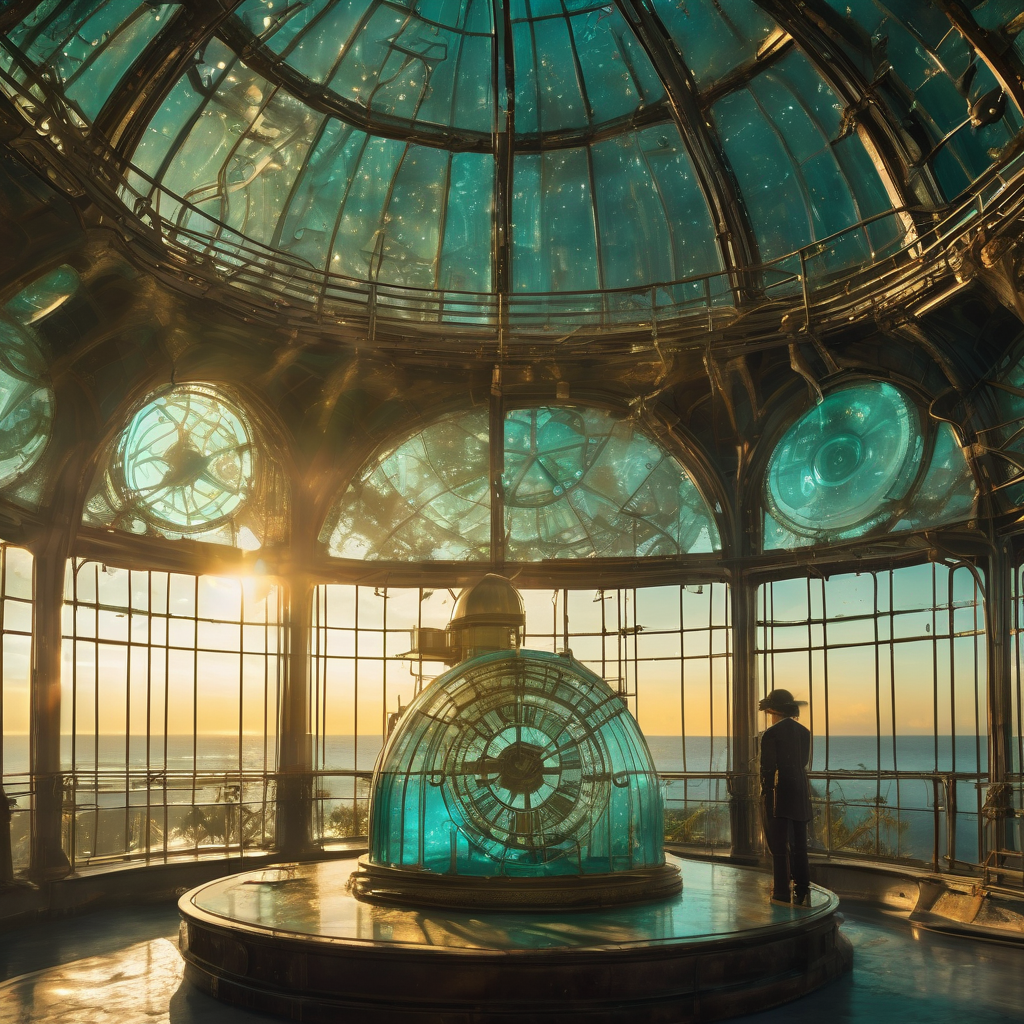
The brass astronomical calculator hadn’t moved in seventy-three years. Its gears, frozen mid-rotation, caught the amber light filtering through Europa Station’s greenhouse dome. Mira pressed her palm against the ancient device, feeling the cold metal patterns beneath her fingers—constellations etched by Victorian astronomers who believed mathematics could map the human soul.
“The sustainability committee wants to tear it down,” her grandmother whispered, adjusting her peacock-feathered hat. “They say the space could house vertical gardens.”
But Mira knew what the committee didn’t: the calculator was still calculating. Not through gears or springs, but through the mycelial network that had grown through its mechanisms, translucent threads that pulsed with bioluminescent equations. The fungi had been awakened by her grandmother’s tears, shed here during the great rationing of 2089, when love letters were burned for fuel and memories became currency.
“Show me grandmother’s algorithm,” Mira commanded the air.
The fungi responded, their light intensifying into patterns that resembled sheet music, or perhaps a recipe, or perhaps the migration pattern of extinct Arctic terns. This was how the universe computed now—not through silicon or quantum states, but through the democratic consensus of organisms too small to see, too numerous to count.
Her grandmother had been a refugee from the Algorithm Wars, when nations fought over the right to define reality through computational prophecy. She’d escaped to Europa Station, this floating garden above the Pacific, carrying only a vial of sourdough starter and the knowledge of one perfect calculation—a formula that could transform loneliness into chlorophyll, heartbreak into photosynthesis.
“The young environmentalist is here,” her grandmother said, nodding toward the entrance where Chen stood, his shirt covered in hand-drawn extinction charts, his eyes the color of rising sea levels. He’d been investigating the station for signs of greenwashing, but had found something else entirely: a place where resilience grew like morning glories through the cracks of abandoned technology.
“Your mushrooms,” Chen said to Mira, “they’re generating their own microclimate. The humidity readings are impossible.”
Mira smiled. The fungi were computing weather patterns from parallel timelines, averaging out the possibilities to create perpetual spring. It was her grandmother’s last algorithm, the one she’d encoded in spores and scattered through the calculator’s bronze intestines.
Chen approached the machine, and the fungi recognized something in him—perhaps the sourdough culture in his pocket, perhaps the trace minerals from his tears (he’d been crying over footage of the last wild dolphins). The brass gears shuddered, then began to turn, creakingly, impossibly, driven not by springs but by the collective intelligence of the fungal web.
The calculator projected patterns in the air: geometric forms that looked like viral structures, or flowers, or the facial expressions of the democracy of moss that governed the station’s lower levels. Each pattern was a solution—not to mathematical problems, but to the question of how to remain tender in a world of steel and glass.
“Your grandmother knew,” Chen said, understanding flooding his features. “She knew that computation could be biological, that algorithms could be grown rather than programmed.”
The peacock feather in the old woman’s hat caught fire—not with flame, but with a phosphorescence that spread through the greenhouse. Every plant began to glow, their chloroplasts performing calculations at the speed of photosynthesis. The station itself became a living computer, processing not data but dreams, metabolizing sorrow into oxygen.
Mira took Chen’s hand as the brass calculator finally completed its seventy-three-year calculation. The answer appeared not as numbers but as a garden—sudden, impossible, erupting from the machine’s center. Orchids that sang in frequencies only fungi could hear. Tomatoes that grew in perfect Fibonacci spirals. Mint that could neutralize any poison, even despair.
“The committee can’t destroy this,” Chen breathed.
“They won’t need to,” Mira’s grandmother said, removing her hat to reveal hair like silver lichen. “The algorithm is complete. The station will vote on its own future now.”
And in the democratic manner of all living things, the garden voted to grow—through the floors, through the walls, through the careful boundaries between computation and cultivation, until Europa Station became what it had always been calculating how to become: a place where the future could take root, one spore, one equation, one moment of unexpected tenderness at a time.
The brass gears continued turning, but now they turned like seasons, like generations, like the tender recursion of hope replanting itself in unlikely soil, computing the only answer that ever mattered: yes, life finds a way to continue its brilliant, impossible mathematics.


Leave a Reply