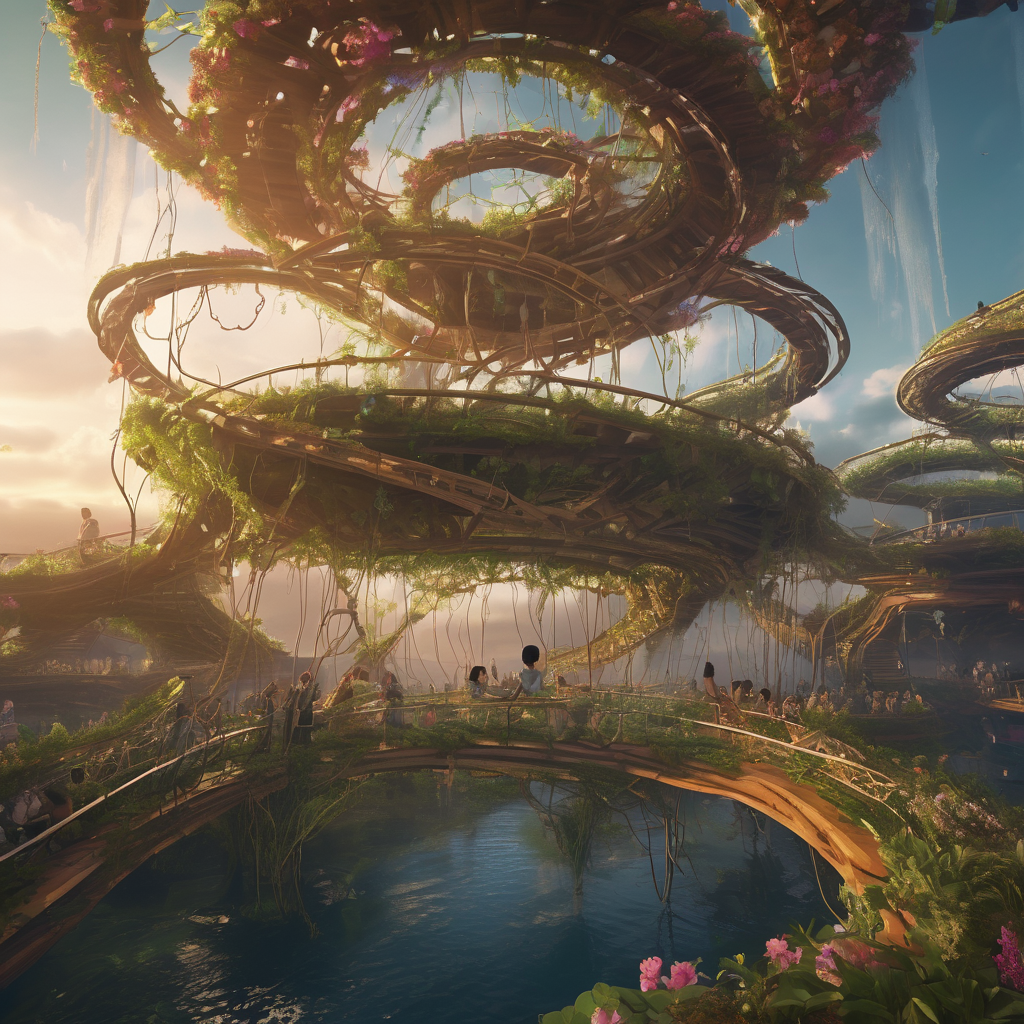
The brass astrolabe spun lazily in Mira’s palm, its ancient gears whispering secrets that only the wind-readers of Epsilon Colony could decipher. She stood at the edge of the floating gardens, where bioluminescent orchids pulsed in rhythm with the colony’s heartbeat—a mathematical pattern discovered centuries ago when humans first learned to grow cities from songs.
“The sustainability council meets at moonrise,” her apprentice, Kael, reminded her, adjusting his ceremonial robes made from recycled starlight. “They’re voting on whether to open the Vault of Forgotten Equations.”
Mira had been the colony’s Chief Algorithm Keeper for forty years, protecting the last remaining formula that kept their sky-bound city aloft. Not a digital code, but something far older—a living equation passed down through generations via dance, breath, and the precise arrangement of sacred stones.
The colony had thrived on radical transparency. Every decision, every harvest ritual, every marriage blessing was performed in the open amphitheater where citizens could witness and participate. But the Algorithm was different. It required solitude, silence, and sacrifice.
“The young ones think we should share it,” Kael continued, watching a school of air-fish swim past, their scales reflecting anxieties about climate change that had driven humanity skyward generations ago. “They say secrecy is killing us faster than the poison winds below.”
Mira touched the tattoo on her wrist—not ink, but living mathematics that shifted and evolved with each lunar cycle. Her grandmother had worn the same patterns, as had her grandmother’s grandmother, back when Epsilon Colony was just a cluster of refugees seeking mindfulness in the chaos of the Great Ascension.
That evening, as the council gathered in the Chamber of Conscious Votes, Mira knew what she had to do. The democracy they’d built demanded it, even if it meant ending a tradition older than memory.
She began to dance.
Not the festive reels of harvest time or the solemn steps of remembrance, but the Algorithm itself. Each movement was a variable, each turn an operation, her body becoming pure mathematics in motion. The colonists watched, mesmerized, as understanding dawned—this wasn’t just about keeping the colony afloat. The dance was teaching them resilience, showing them how to bend without breaking, how to rise without forgetting the earth below.
Young voices began to hum, finding the harmony. Old voices added percussion with their walking sticks. The inclusive rhythm spread through the amphitheater as citizens of every age and ability found their part in the equation.
By dawn, three hundred souls knew the Algorithm. They danced it together as the sun painted the sky in shades of hope, their collective movement generating the precise vibrational frequency needed to maintain their altitude. What had once required one keeper’s perfect isolation now thrived on community, each person’s imperfection balanced by another’s strength.
Kael found Mira sitting in the garden afterward, her astrolabe finally still.
“Was it hard?” he asked. “Letting go?”
She smiled, watching new apprentices practice their steps among the orchids, their movements still clumsy but full of joy. “The hardest part was realizing it was never mine to keep.”
Below them, the poisoned world waited for healing. Above them, the stars offered infinite equations yet to be discovered. But here, suspended between earth and sky, Epsilon Colony had found its balance at last—not through secrecy, but through the shared rhythm of survival, beating in three hundred hearts moving as one.
The brass astrolabe crumbled to dust in her palm, its work complete. The last algorithm of Epsilon Colony was no longer last, no longer singular, but first among many—a new mathematics of community that would carry them through whatever storms lay ahead.


Leave a Reply