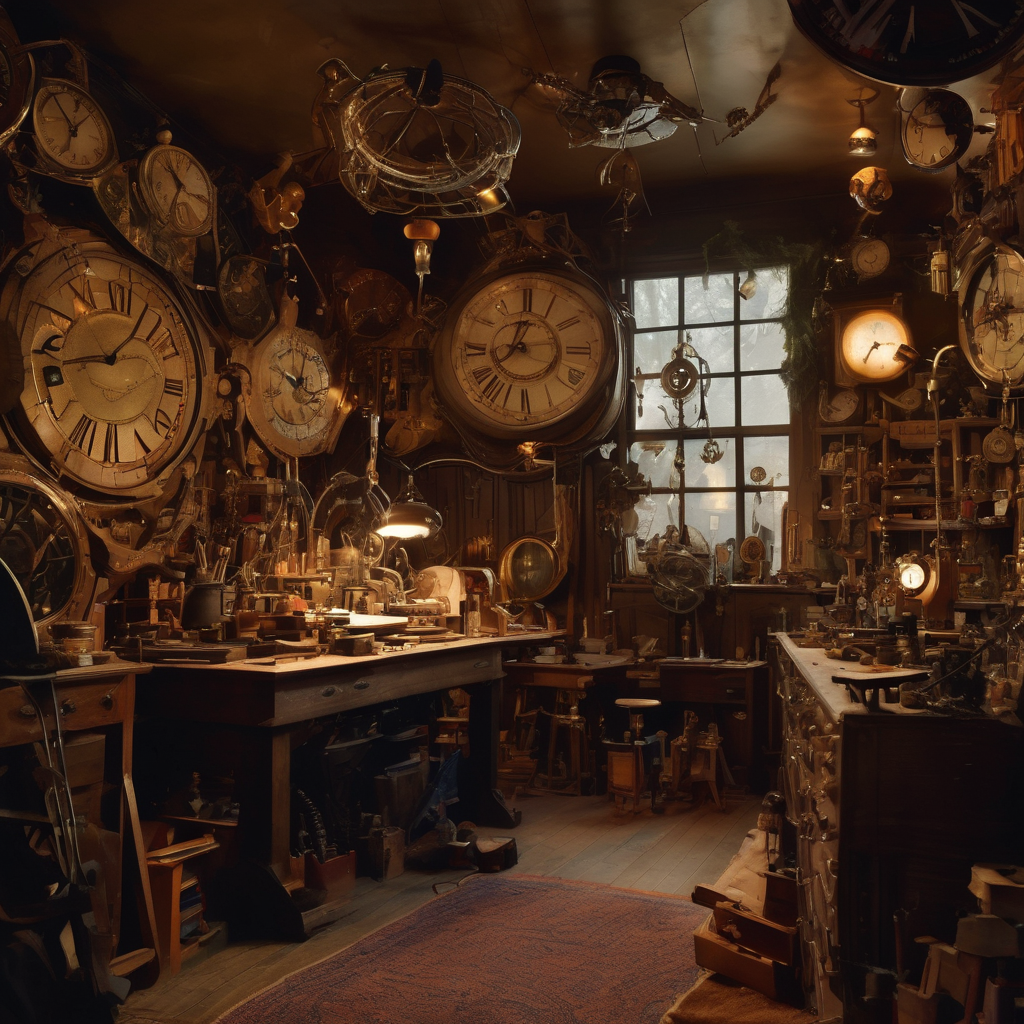
The brass gears clicked their final revolution as Margot pressed her ear to the workshop door. Inside, her grandfather’s voice rose and fell in heated argument, though she heard no second speaker. The scent of bergamot and machine oil drifted through the keyhole, mingling with something else—something that made her skin prickle with ancient recognition.
“You cannot simply take what was never yours to claim,” Grandfather Aldric’s voice cracked like old leather. “The debt was paid in full generations ago.”
Margot had returned to the coastal village of Millhaven expecting to find her grandfather’s mind addled by age, his once-precise fingers too tremulous to repair the delicate timepieces that had sustained their family for centuries. Instead, she discovered his workshop thrumming with an energy that seemed to bend the very air, and clocks that ticked in rhythms that matched no earthly time.
The argument ceased abruptly. Margot pressed closer to the door, her breath forming small clouds in the suddenly frigid air. Through the crack beneath the door, shadows moved in impossible ways—stretching upward like smoke, then condensing into shapes that hurt to perceive directly.
“The girl carries the bloodline,” spoke a voice like wind through cemetery stones. “She will do.”
“Margot knows nothing of the covenant. She came here believing in nothing more mystical than inheritance tax.”
This was true. Margot had driven up from the city with a head full of estate planning and elder care, her hybrid car loaded with legal documents and half-hearted good intentions. She’d expected to find a doddering old man surrounded by the detritus of a dying trade. Instead, she’d found clocks that chimed the hours of distant worlds and a grandfather whose eyes held depths that seemed to reflect eternity.
“Teach her, then. You have until the winter solstice.”
“That’s barely a fortnight.”
“Then you had best begin immediately.”
The shadows contracted, pulling inward like a collapsing star, and the temperature returned to normal so abruptly that Margot gasped. She stumbled backward as the workshop door swung open, revealing her grandfather silhouetted against the amber glow of his workbench.
“How long have you been standing there, child?”
Margot straightened, trying to summon the confident professional demeanor that served her well in corporate boardrooms. It felt flimsy as tissue paper under his knowing gaze. “Long enough to know that you weren’t talking to yourself.”
Aldric stepped aside, gesturing for her to enter. The workshop stretched impossibly far back, filled with workbenches that shouldn’t have fit within the cottage’s modest walls. Clocks of every conceivable design lined the walls—grandfather clocks with faces that showed the phases of moons that hung in alien skies, delicate mantel pieces whose hands moved backward, massive astronomical instruments that tracked the movements of constellations she couldn’t name.
“Sit,” Aldric said, indicating a stool beside his primary workbench. “There are things you need to understand about our family business.”
Margot remained standing, her arms crossed. “Grandfather, I know you’ve been isolated out here, but if you’re experiencing episodes—”
“Episodes?” Aldric laughed, a sound like silver bells. “Child, I haven’t been more lucid in decades.” He lifted a half-assembled pocket watch from his bench, its exposed mechanism gleaming with metals that seemed to capture and hold light in impossible ways. “Tell me, what do you think we do here?”
“You repair clocks. You make clocks. It’s honest work, but hardly profitable in the digital age—”
“We are time shepherds, Margot. We tend to the boundaries between moments, ensuring that what should remain separate stays separate, and that what must flow together finds its proper course.”
She stared at him, searching his weathered features for signs of dementia or delusion. His hands remained steady as he worked, placing gears with microscopic precision. “That’s poetic, Grandfather, but—”
The pocket watch chimed once, a note so pure it seemed to resonate in her bones. The workshop around them shifted, walls stretching and contracting like a breathing lung. Through the windows, Margot glimpsed not the familiar Yorkshire countryside, but a landscape of crystalline trees beneath a sky the color of old roses.
“Our family has maintained the temporal boundaries for seven hundred years,” Aldric continued, as if reality hadn’t just performed an impossible somersault. “We inherited the responsibility from the previous guardians, and someday—soon—it will pass to you.”
The otherworldly vista faded, replaced by the ordinary view of stone walls and winter-bare gardens. Margot gripped the edge of the workbench, her knuckles white. “This isn’t possible.”
“Possibility is a luxury for those who don’t carry the weight of necessity.” Aldric set down his tools and turned to face her fully. “The entity you heard me arguing with represents forces that exist outside conventional time. They’ve grown restless, hungry. The barriers we maintain are the only things preventing them from spilling into the present moment and devouring everything you hold dear.”
“Why me? I’m an accountant. I balance spreadsheets and optimize tax strategies. I don’t know anything about—” she gestured helplessly at the impossible workshop around them, “—any of this.”
“Because you’re the last of the bloodline, and the work requires someone who understands patterns, someone who can see the underlying structures that hold complex systems together.” His smile was gentle but implacable. “Also, you have no choice. The covenant binds us all.”
Over the following days, Margot found herself drawn into a curriculum that defied every assumption she’d held about the nature of reality. She learned to read the temporal fluctuations displayed on instruments that predated Newton, to calibrate clockwork mechanisms that regulated the flow of causality itself. Her grandfather proved a patient teacher, guiding her through exercises that began with simple gear ratios and progressed to calculations that mapped the intersection points between parallel moments.
The work was exhausting in ways that had nothing to do with physical labor. After each lesson, Margot felt as though she’d been running marathons with her mind, every synapse stretched beyond its normal capacity. Yet she found herself returning to the workshop each morning with growing eagerness, drawn by the intoxicating sense of engaging with forces vast and ancient.
On the seventh day, she successfully calibrated her first temporal regulator, a delicate chronometer designed to maintain the boundary between Tuesday and Wednesday in the village of Millhaven. The achievement felt simultaneously monumental and absurd.
“I still don’t understand why any of this matters,” she confessed as they shared tea in the cottage’s kitchen afterward. Beyond the windows, snow had begun to fall, each flake catching the light like tiny clockwork mechanisms. “If these barriers fail, what actually happens?”
Aldric was quiet for a long moment, staring into his cup as if it held answers to questions she hadn’t yet learned to ask. “Time becomes malleable,” he said finally. “Past and future lose their meaning. Every moment that has ever existed or ever could exist happens simultaneously. Most minds cannot process such chaos—they simply cease to function.”
“And the entities you were arguing with?”
“They thrive in that chaos. They feed on the dissolution of ordered reality.” He met her eyes across the small table. “They’ve been growing stronger lately, testing the boundaries more frequently. I suspect my time as guardian is coming to an end, one way or another.”
The winter solstice arrived with unseasonable warmth, as if the earth itself had forgotten what season it was meant to be experiencing. Margot woke to find her grandfather already in the workshop, making adjustments to a massive astronomical clock that dominated the far wall. Its face showed not hours and minutes, but the positions of forces she was only beginning to comprehend.
“They’re coming,” he said without preamble as she entered. “Can you feel it?”
She could. The air itself seemed to thicken, becoming viscous with possibilities that pressed against the boundaries of the present moment. Through the windows, the landscape flickered between seasons—snow giving way to spring flowers, then autumn leaves, then the green abundance of summer, cycling through the possibilities of what this day could be.
“What do we do?”
“We hold the line.” Aldric handed her a peculiar device that resembled a compass crossed with a tuning fork. “This will help you maintain your anchor to the present moment. Whatever you see or hear, remember that you exist in this specific instant, in this specific place.”
The workshop door burst open, though Margot hadn’t heard anyone approach. The entities flowed in like living shadow, their forms shifting between states of matter. They moved with the fluid inevitability of time itself, and where they passed, objects aged years in seconds or reverted to their component materials.
“The old guardian grows weak,” they spoke in unison, their voices harmonizing in frequencies that made Margot’s teeth ache. “The covenant dissolves. The barriers fail.”
“The covenant transfers,” Aldric replied firmly, positioning himself between the entities and his granddaughter. “As it always has.”
“To her?” The shadows turned their attention to Margot, and she felt their regard like ice water in her veins. “She understands nothing. She believes in nothing beyond her small mortal concerns.”
This stung because it was partly true. Three weeks ago, Margot’s greatest worry had been optimizing client portfolios for the new tax year. The cosmic responsibilities her grandfather described felt like burdens meant for someone far wiser and more capable.
But as she watched the entities probe the edges of reality, seeking weak points in the temporal barriers, something crystallized in her understanding. This wasn’t about wisdom or capability—it was about choice. Someone had to maintain the boundaries that kept chaos at bay, and that someone happened to be her.
“I accept the covenant,” she said, her voice steadier than she felt.
The entities laughed, a sound like glass breaking in reverse. “Pretty words. But acceptance requires sacrifice. Are you prepared to give up your small life for the sake of abstract principles?”
Margot thought of her apartment in the city, her carefully planned career trajectory, the predictable rhythms of a life built around quantifiable goals. Then she looked at the impossible workshop around her, at the clocks that maintained the flow of time itself, at her grandfather’s face etched with seven decades of quiet dedication.
“I’m prepared to trade a small life for a meaningful one.”
The workshop filled with light—not the warm amber glow of the workbenches, but something sharper and more fundamental. The entities recoiled, their forms becoming less distinct as the temporal barriers strengthened around them.
“The transfer is witnessed,” Aldric said formally, and Margot felt something settle into her consciousness like a key turning in a lock. Suddenly she could perceive the flow of time as a tangible thing, could sense the places where it pooled and eddied around the workshop’s carefully maintained instruments.
The entities began to fade, their forms dispersing like smoke in a strong wind. “This is not finished,” they whispered as they dissolved. “The barriers weaken with each generation. Eventually, you will falter as they all have.”
“Perhaps,” Margot replied, already reaching for the tools of her new trade. “But not today.”
As the last shadows vanished, the workshop settled into its normal configuration—impossible but somehow stable, a place where human will imposed order on cosmic chaos. Aldric smiled at her with profound relief.
“Now,” he said, lifting a half-completed timepiece from his workbench, “let me show you how to regulate the boundary between cause and effect. It’s trickier than it looks.”
Outside, the snow resumed falling in its proper season, each flake landing in its designated moment, and time flowed forward as it always had and always would, tended by watchful hands and protected by ancient promises renewed.


Leave a Reply