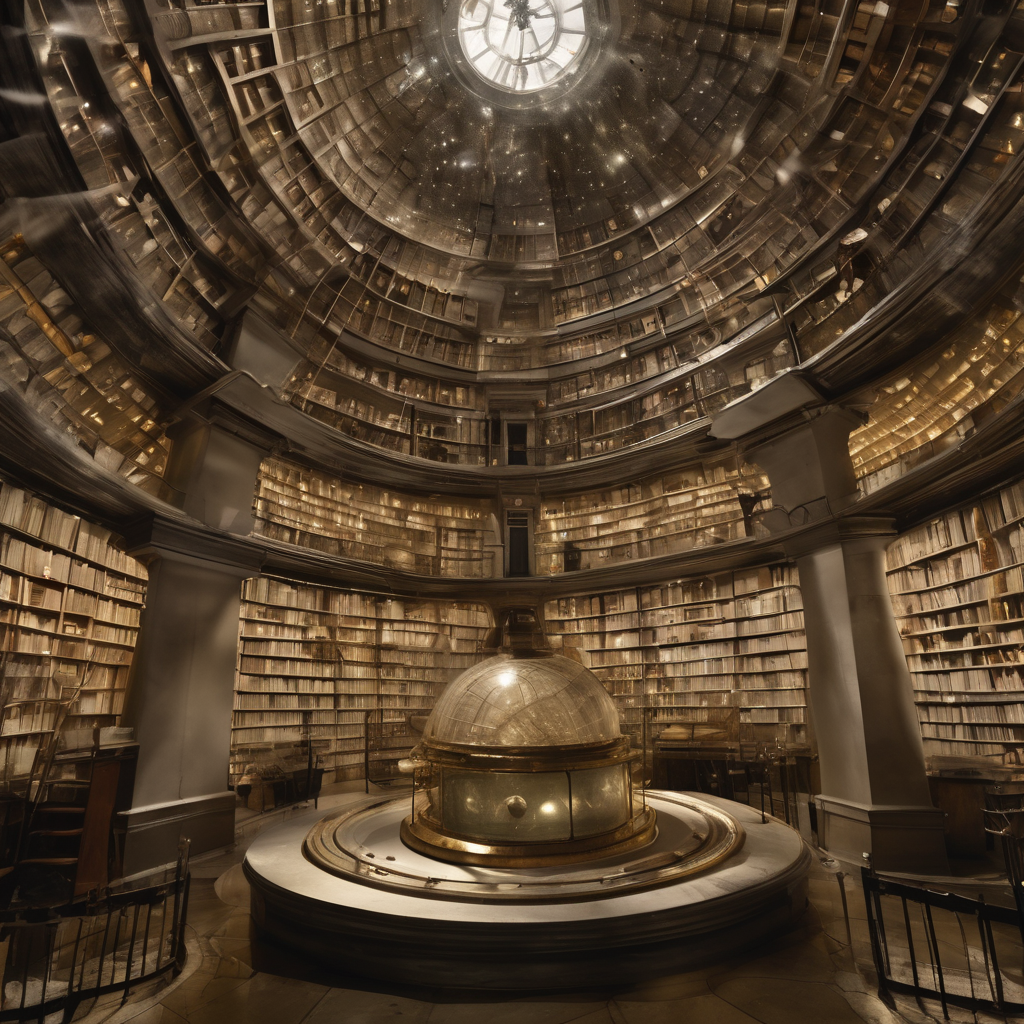
The job was a life sentence handed down through generations. Elara was the Curator, and her duty was to catalogue the dead. Not people, but winds. Each was captured at its moment of expiration, a final exhalation sealed in a bell jar, a spun-glass sphere, or a lead-lined box. Her movements through the vaulted halls had a listless precision, the practiced apathy of someone who was, in spirit, quiet quitting a post she could never leave.
The world outside was a cacophony of rage-winds and fury-squalls, a climate of ceaseless tantrum. Here, in the archive, was the silence of history. On the shelves sat the brittle soprano of a dying chinook, the deep baritone hum of a sirocco that had baked its last desert, the gossamer whisper of a sea breeze that had forgotten the shore. Each was labeled in her grandmother’s spidery script. Elara’s only task was to ensure their continued stillness.
Her only companion was a ghost. Master Florian, the first Curator, dead four hundred years. She had formed a strange, one-sided devotion to him, a parasocial bond woven from the ink of his journals. While the world outside doomscrolled through ever-worsening storm reports, Elara consumed Florian’s life in nightly installments. He wasn’t a dispassionate archivist; he was a poet, a chaser of gales. He wrote of the “rizz” of a particular monsoon, its flirtatious dance before it finally gave itself to his instruments. He spoke of coaxing, not capturing.
One passage, underlined in frantic red, described his greatest failure. He’d tried to capture a wind he called the “Unburdened,” a phantom current that carried no dust, no pollen, no scent of rain or salt. It was pure motion. His attempt was a disaster. It cost him three of his finest specimens—a mischievous zephyr, a loyal trade wind, and a young, mournful wail from the arctic. In his notes, he justified the loss with a kind of logic Elara found both mad and captivating. To lose three lesser breaths in pursuit of one true Tempest was, to him, a net gain. It was a fool’s bargain, a piece of beautiful, broken reasoning that snagged in her mind.
A memory that had burrowed into her core surfaced: she was five, and a savage autumn gale, tasting of salt and sorrow, had ripped her mother’s favorite silk scarf from the washing line. She’d watched it writhe and vanish into the grey sky, a scrap of vibrant life devoured. That was her first understanding of loss. All these winds in their jars felt like that scarf—beautiful, stolen things.
The thought of Florian’s Unburdened wind became an obsession, a secret side quest in the monotony of her days. She began neglecting the meticulous dusting, the careful monitoring of the barometers. Instead, she hunted for Florian’s trail. She found it not in the grand catalogues, but in the marginalia of star charts and the annotations on blueprints for the Ossuary itself. He’d been charting its appearances, which coincided with no known meteorological phenomena. It was, he theorized, a psychic artifact, the collective sigh of everyone who had ever dreamed of escape. His belief bordered on the fanatical, the beautifully delulu.
His final entry guided her to the high cupola, a place forbidden for its instability. The circular chamber was empty save for a single brass astrolabe, its rings aimed at the perpetually storm-wracked sky. Florian’s notes described it not as a trap, but an ear.
She waited. Days turned into a week. Her era of dust and silent protest was giving way to something new, an era of anticipation. Then one night, it came. The Ossuary, usually a tomb of silence, began to vibrate. Not with the shudder of an external storm, but with an internal thrumming. The countless jars and globes sang with a sympathetic hum.
Elara put her hands on the astrolabe. It was cold, but a vibration traveled up her arms, a silent music. She closed her eyes. It wasn’t a wind she felt, but a feeling. A vast, sweeping sense of release. It carried not the memory of a place, but the possibility of one. It was the feeling of a held breath finally let go, of a locked door swinging open onto an unknown horizon. It was the antithesis of this building, of her life. The Unburdened wasn’t a thing to be captured; it was a lesson to be learned.
Florian hadn’t failed. He had understood.
Elara descended from the cupola, the phantom current still echoing in her bones. She walked past the shelves of captured memories, no longer seeing them as prisoners, but as sentences in a language she was just beginning to learn. She reached the great, sealed doors of the Ossuary, the ones that led to the rage-winds and the fury-squalls. For the first time, she did not fear them. She placed her hand on the cold iron, ready not to flee, but to step out and listen.


Leave a Reply