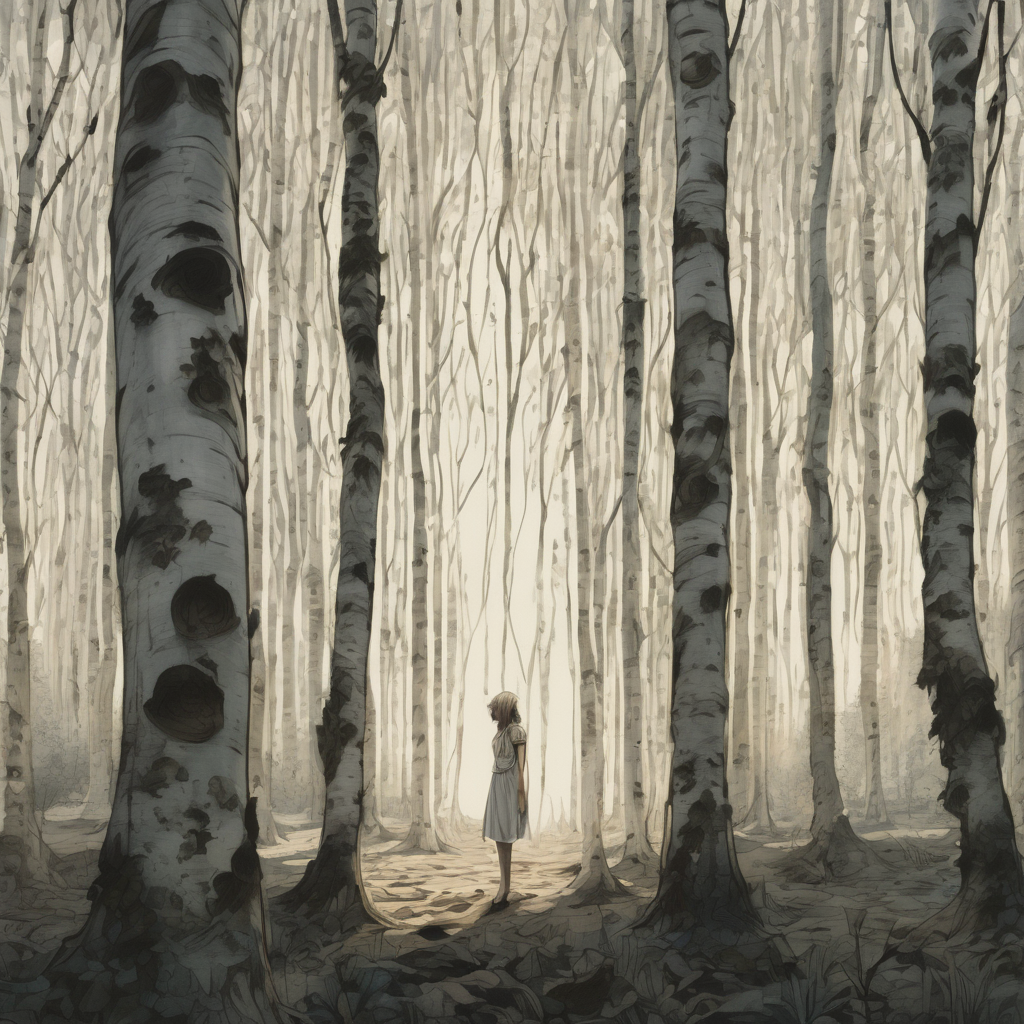
The village elders spoke of it in whispers, the way one speaks of a shameful sickness in the family. They called it the Quiet Wood, the Place of Un-knowing. Younger folk, who picked up their slang from city traders and their moods from the shifting sky, had a different name. They called it the Forest of Static.
Elara was in her quiet era, or so she told herself. It was a time for healing, for mending the frayed edges of her heart, which had been torn to shreds by a man named Finn. Before leaving, she made herself a small, strange meal on the scarred oak of her table: a wedge of hard cheese, three pickled damsons, and the last of the honeyed almonds. It was a chaotic little spread, a perfect girl dinner for one about to walk into the unknown.
She had heard the legends. The Forest of Static didn’t erase memories; it… unspooled them. It took the clean narrative of a thing, the beginning-middle-end, and broke it into a million shimmering, meaningless pieces. Go in with a grief you can’t bear, and the forest will take the story from it, leaving you only with the raw, contextless data. A phantom limb of a feeling.
Was she a little delulu to think a forest could fix her? Probably. But the constant, looping reel of her time with Finn—their first meeting by the river, the argument in the rain, his hand waving goodbye from the back of a departing carriage—had become a form of mental doomscrolling she couldn’t escape. She needed a fundamental vibe shift.
The moment she stepped under the first canopy of silver-leafed birch, the world changed. It wasn’t a sound, the static. It was a presence. The air grew thick and heavy, shimmering as if viewed through a heat haze. The crisp chirp of a finch became a single, sustained, toneless note. The rustle of leaves was replaced by a visual flicker, each leaf vibrating in place, a silent, frantic tremor.
Deeper she went, and the memories began to fray. Not the story of Finn, but everything else. The taste of her strange dinner vanished. The face of her mother, the name of her childhood street—they pixelated and dissolved. In their place, the Finn-memories grew sharper, but also stranger. Fragmented.
It was a feeling more than a narrative, a kind of corecore of the soul. The smell of his rain-damp wool coat, de-attached from any specific day. A single, echoing laugh, stripped of its cause. The precise shade of blue of his eyes, but just the color, a floating disc of impossible lapis. The memory of his touch was no longer on her skin, but a low hum in her bones. The forest was taking the story, just as promised, leaving behind the sensory grit.
She reached the heart of the woods, a small clearing where the static was so dense the light itself seemed granular. Here, the final piece of their story played out in her mind, not as a film, but as an assault. The coldness in his voice. The finality of the closing door. The hollow space he left behind. The forest was offering to take even this, to granulate the pain into meaningless dust. All she had to do was let go.
And in that moment, Elara knew. She hadn’t come here to forget. She had come here to learn how to remember. Forgetting was easy. The real work was learning to live with the ghosts.
“No,” she whispered, her own voice sounding alien and whole in the silent noise. She had to unpack this herself.
She took the fragmented image of his final, apologetic smile—a memory that had haunted her for months—and refused to let the forest dissolve it. Instead, she deliberately held it, looked at it from all angles. It wasn’t an emblem of her failure. It wasn’t an eternal curse. It was just… a sad thing that had happened. It’s giving tragedy, she thought, a wry, modern phrase blooming in her ancient-feeling mind, but it’s not giving life sentence.
She gathered the other fragments: the laugh, the scent of wool, the disc of blue. She didn’t try to weave them back into the linear story they’d come from. That story was broken. Instead, she let them be what they were: pieces of a life she had lived. Not a weapon to be used against herself, but artifacts in her own museum.
It was the ultimate act of main character energy. She had come to slay a dragon, and realized the dragon was a part of her own hoard.
Walking out of the forest was like surfacing from a deep dive. The air thinned, sounds regained their texture, and the world snapped back into focus. The grief was still there, a weight in her pocket. But it was just a weight now. It no longer had a voice. She could carry it. The static was gone, but she had kept the pieces she had chosen. They were hers to arrange now. The quiet era was over. The next one had just begun.


Leave a Reply