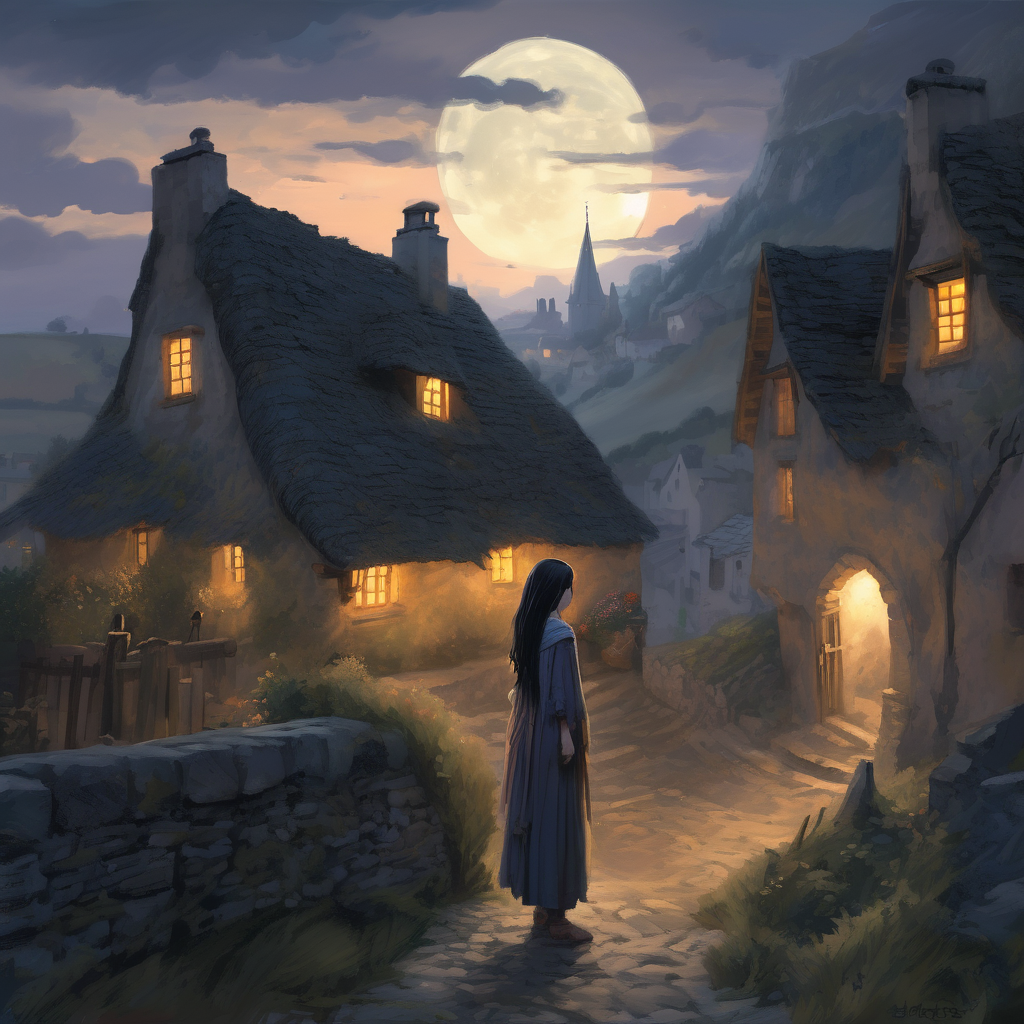
In the mist-shrouded hills of Eldoria, where the whispers of ancient oaks mingled with the sighs of the wind, lived a seamstress named Liora. Her fingers danced over fabrics that held secrets, weaving threads of forgotten tales into garments worn by villagers who scarcely remembered their own histories. Liora had inherited her craft from her grandmother, who spoke of a time when the world balanced on the edge of a veil—a thin, shimmering barrier between the seen and the unseen.
One autumn evening, as crimson leaves swirled like embers in the twilight, Liora discovered a peculiar relic in the attic of her thatched cottage. It was a veil, not of silk or lace, but of something ethereal, like woven moonlight. Its edges frayed with age, yet it pulsed with a faint glow, as if alive. Her grandmother’s journal, tucked beside it, warned: “The Forgotten Veil echoes truths long silenced. Wear it wisely, or be consumed by the chorus.”
Curiosity, that relentless tide, pulled Liora to drape the veil over her shoulders. Instantly, the world shifted. The air thickened with voices—echoes not of the dead, but of histories erased by time’s indifferent hand. She heard the laments of forests ravaged by unchecked fires, pleas for climate action woven into the rustle of vanishing leaves. “Heal the earth,” the echoes murmured, “or the balance tips forever.”
Stunned, Liora wandered into the village square, where the harvest festival buzzed with merriment. But through the veil, she saw shadows dancing on the fringes—figures embodying the trending woes of the realm. A spectral woman, clad in armor of blooming vines, spoke of mindfulness, urging the villagers to pause amid their ceaseless labors, to nurture their inner gardens lest they wither like drought-stricken fields. Another echo, a bard with eyes like swirling galaxies, sang of self-care rituals from elder days, baths in moonlit springs and dances under starlit skies to mend fractured spirits.
As the night deepened, the veil’s power swelled. Liora glimpsed visions of distant lands: warriors fighting for social justice, their banners fluttering against tides of inequality; lovers entangled in romances that defied borders, their hearts beating in sync with the earth’s own rhythm. But darker echoes slithered in—warnings of viral plagues that spread not through air, but through words of division, and the quiet quitting of souls who abandoned dreams for survival’s sake.
Fear gripped Liora as the veil tightened, pulling her toward the unseen side. She realized it was no mere artifact but a guardian, amplifying the world’s unspoken cries. In a frenzy, she rallied the villagers, sharing fragments of the echoes. “Listen,” she implored, “to the forgotten veil’s song. It trends not in fleeting fashions, but in the eternal call to awaken.”
By dawn, the village transformed. They planted groves for sustainability, held circles for mental health confessions, and wove new veils from shared stories. Liora, exhausted, removed the relic, but its echoes lingered in her veins—a reminder that some barriers, once lifted, could never be forgotten. And in the hills of Eldoria, the wind carried whispers of change, eternal and renewed.

Leave a Reply