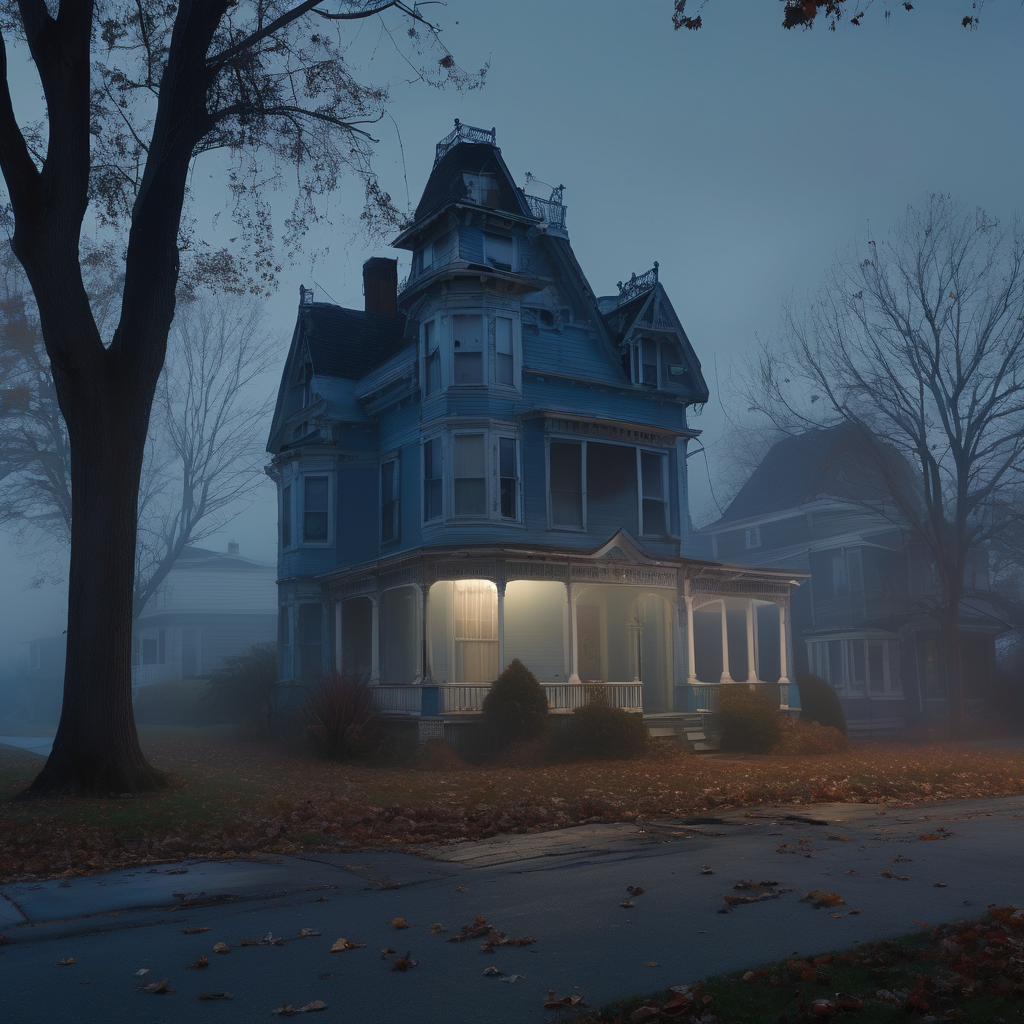
Meredith discovered the phenomenon while researching her dissertation on urban decay patterns. Houses left vacant for more than eighteen months began to exhibit what she could only describe as hunger.
It started with small disappearances. A neighbor’s cat would vanish near the Thornfield place on Maple Street. Children’s bicycles left on sidewalks overnight would be gone by morning, though no theft reports matched the missing items. The local Facebook groups buzzed with theories about a neighborhood kleptomaniac, but Meredith noticed the pattern: everything disappeared within a three-block radius of long-empty homes.
The Henderson house had been vacant since the divorce two years ago. Meredith watched from her car as the morning mist seemed to flow backwards, drawn toward the darkened windows like breath being inhaled. The realtor’s sign in the front yard leaned at an impossible angle, as if something had tried to swallow it but couldn’t quite manage.
She started documenting everything. The colonial on Oak Avenue consumed an entire flower bed overnight—soil, plants, decorative stones, even the plastic edging. By dawn, there was only a perfect rectangular depression in the earth, smooth as a tongue had licked it clean.
The appetite grew stronger as autumn deepened. Mrs. Chen’s prize-winning garden sculpture disappeared piece by piece, each section vanishing closer to the abandoned Victorian that loomed behind her property line. When Meredith interviewed her, Mrs. Chen’s hands shook as she served tea in delicate porcelain cups.
“The house watches,” Mrs. Chen whispered. “I see shadows moving behind windows that should be empty. Last week, I found my garden hose stretched toward the back fence, like something had been trying to drink from my sprinkler system.”
Meredith’s research led her to the city planning office, where she discovered that each hungry house shared a common thread: they’d all been homes where families had dissolved acrimoniously. Divorces, estrangements, children who’d left and never returned. The buildings seemed to be trying to fill the spaces their former inhabitants had left behind.
The night she decided to test her theory, Meredith brought offerings. She approached the Thornfield house with items that spoke of domestic life: a knitted scarf, a coffee mug, a child’s drawing. She placed them on the front porch and waited in her car.
The house accepted them slowly, like a shy animal learning to trust. The items didn’t disappear dramatically—they simply became less present, fading from view as if the house were gradually digesting them. By sunrise, only faint impressions remained on the weathered porch boards.
Word spread through the neighborhood networks. Residents began leaving small gifts: old family photos, handwritten recipes, worn paperback novels. The houses’ appetites became more selective, more refined. They no longer devoured pets or property, instead sustaining themselves on these deliberate offerings of memory and meaning.
The mayor’s office issued a statement calling it an “innovative community beautification program.” Real estate agents began marketing the arrangement as a unique neighborhood feature. But Meredith understood what was really happening: the houses had learned to feed on love instead of loss.
She finished her dissertation that spring, documenting how abandoned spaces could be rehabilitated not through renovation or demolition, but through the simple act of remembering that every empty house was once someone’s home. Her advisor suggested she consider urban planning as a career, but Meredith had already accepted a position with the city’s new Department of Architectural Therapy.
On moving day, as she packed her research files, Meredith walked past the Thornfield house one last time. In the front window, she could swear she saw the faint outline of a family photograph that someone had left on the porch months ago, now permanently etched into the glass like a memory the house refused to digest completely.
The new owners would arrive next week, but Meredith suspected they’d find the house already prepared for them, nourished by two years of the neighborhood’s collective care and ready once again to be filled with the irreplaceable presence of human life.


Leave a Reply