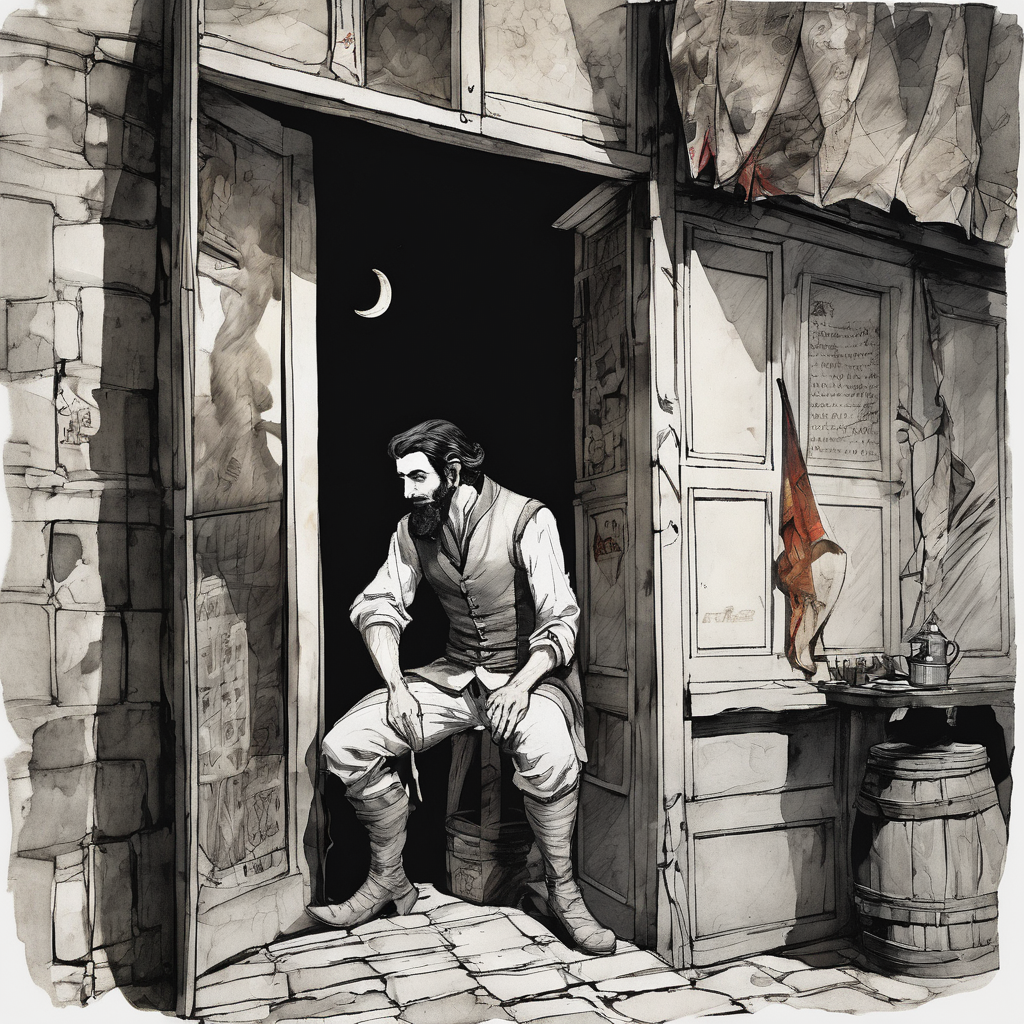
Elias was not a liar; he was a craftsman. His shop, tucked behind the Saffron Exchange in a street so narrow it was perpetually in shadow, did not sell silks or spices. It sold absences. People came to him not for where they wanted to go, but for where they needed to have been.
His first client of the day was the third daughter of the Salt Baron, a young woman whose existence was a masterclass in quiet quitting. She was present at every ball, her name on every list, but her spirit had long since tendered its resignation.
“I need an evening,” she said, her voice a reedy whisper. “From seven bells until midnight.”
“A tryst at the Serpent’s Coil tavern? A dalliance with the river poets?” Elias suggested, pulling down a ledger bound in what looked like fog.
“No,” she said, looking at her gloved hands. “I intend to lock my door, remove my corset, and stare at the ceiling. I need you to build me an alibi for that.”
An alibi for nothing. For the glorious, slovenly peace that high society deemed a sickness. Elias felt a surge of professional admiration. Most clients wanted grand passions; she just wanted to enter goblin mode, to enjoy the blessed squalor of true privacy.
“An evening of intense study at the Orrery is what you require,” Elias declared, his mind already working. “Under the tutelage of the notoriously reclusive Master Valerius.” He began to assemble the components. A smudge-pot that smelled of ancient brass and ozone. A fine dusting of chalk for the hem of her gown. A single, coarse, grey hair—allegedly Valerius’s—to be discovered by a maid. “His specific brand of intellectual gaslighting leaves all his students dazed and uncommunicative. Your silence afterward will be seen as proof, not suspicion.”
She paid in silver, her eyes gleaming with the prospect of five hours of utter inertia. Her secret was safe. The existence of Elias’s service was the city’s most tightly guarded secret, a piece of knowledge protected by the most vicious gatekeeping. IYKYK.
His next appointment was a man tangled in a messy situationship with a Duchess’s handmaiden. It was a romance with no name and no future, conducted in stolen moments. The man didn’t need an alibi for an affair; he needed an alibi that *was* the affair, a plausible history for a phantom courtship he could present to his family. Elias sold him a six-month backlog of correspondence, complete with faked wine stains and the faint, bespoke scent of a non-existent woman’s perfume.
Elias worked with the primary colors of deception: motive, opportunity, and evidence. He was a master of narrative rizz, able to craft a story so compelling it could charm its way past any scrutiny. He sold people the main character energy they lacked in their own rigid lives. For a few hours, his clients weren’t just cogs in the great machine of the city; they were protagonists in a story only they and Elias knew.
He was charting a secret geography of the city, a map of desire and dereliction drawn over the official grid of streets and plazas. Each client was a new territory, a new branching path. The city was changing, too. You could feel it. A subtle vibe shift in the air, a restlessness that hummed beneath the cobblestones as autumn bled into the streets. People were entering their villain era, their hermit era, their desperate-for-anything-else era. Business was booming.
That night, Elias sat alone in his workshop. The tools of his trade surrounded him: vials of scent distilled from memory, scraps of fabric from a thousand different lives, inks that faded at a predetermined rate. He looked at the vast, sprawling map on his wall, not a map of the city, but of the alibis he had constructed. A web of shimmering, intricate lies.
He had given the Salt Baron’s daughter an excuse for solitude and the desperate man a love story. He had charted escape routes for nepo babies and boltholes for revolutionaries. He provided the architecture for double lives, meticulously crafting each one, and yet he himself had only one. A quiet, orderly, observant life.
A thought, sharp and unwelcome, pierced the comfortable quiet. Was he the cartographer, or merely another resident of a city of cages, his own gilded and self-made? He had the skills to fake a man’s journey to the Sunken City of Aeridor, complete with the scent of brine-logged leather and a shard of impossible, deep-sea coral. He could fabricate a pilgrimage to the Silent Peaks, providing a satchel full of pressed mountain-herbs and a convincing limp.
Slowly, deliberately, Elias pulled a fresh sheet of vellum towards him. His finest, the one reserved for the most difficult cases. He uncorked an inkpot, not of the usual ferrous black, but of a rare, shimmering cerulean. He began to draw, not a map for a client, but one for himself. It was a complex and beautiful chart, detailing a long and arduous journey to a place that didn’t exist. He added a receipt from a ferryman who had never been born and a pressed flower that grew only in dreams.
He worked all night, with a focus that bordered on feverish. This was his masterpiece. An alibi not for an evening or a season, but for a lifetime. An alibi for the man who was once The Cartographer of Alibis, for the empty shop the city would discover in the morning. An alibi for the man who had finally decided to get lost, for real.


Leave a Reply