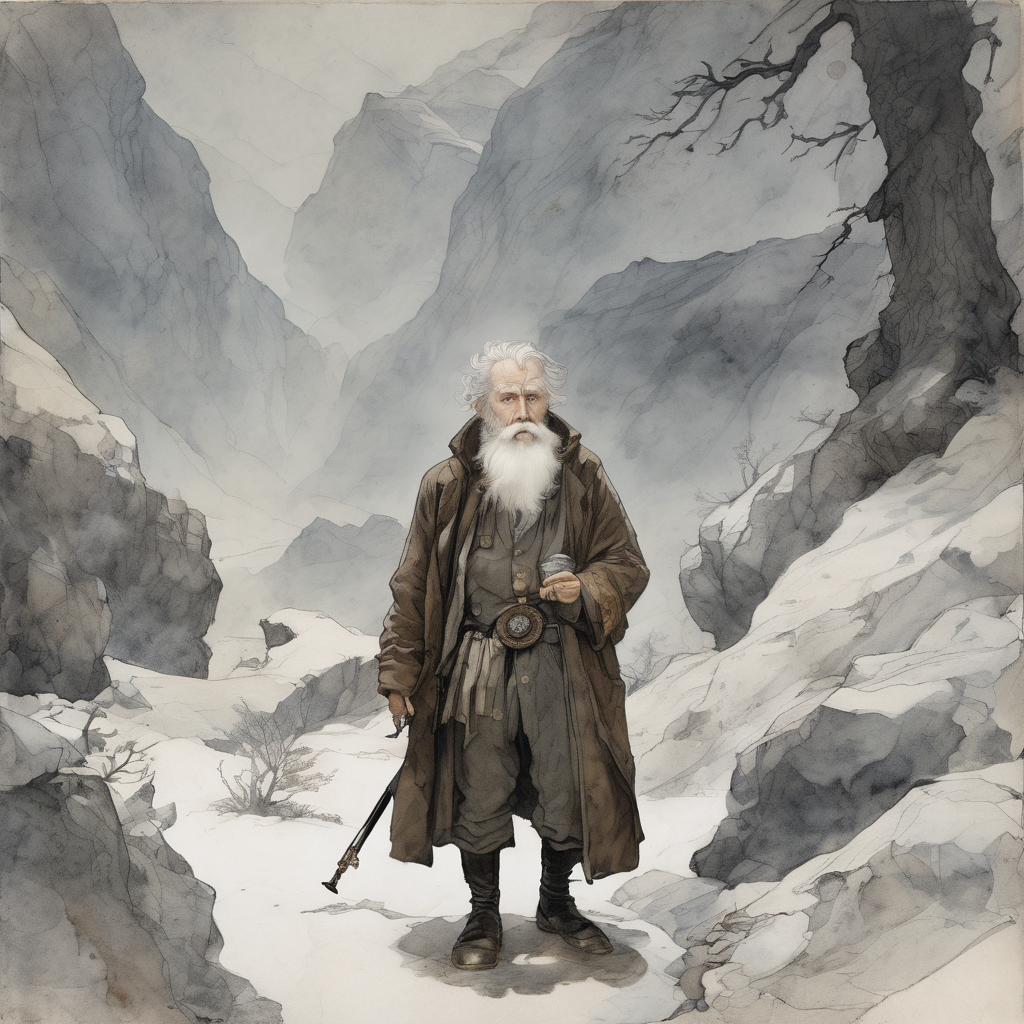
Elias, Royal Cartographer, was a man who believed the world was a solvable puzzle. For thirty years, he had pinned it to parchment, one crisp ink-line at a time. He’d charted the Serpent’s Tooth shoals and the shifting dunes of the Glass Desert. But the Sighing Valley, a misty cleft in the northern mountains, remained a blank, mocking smear on his otherwise perfect masterwork.
It wasn’t for lack of trying. He’d sent three expeditions. The first returned with maps that contradicted each other, their compasses spinning uselessly within the valley’s borders. The second’s sketches were smudged as if by a phantom hand, the ink bleeding into floral, unreadable shapes. The third apprentice simply turned back at the entrance, speaking of a profound disquiet, a feeling that the very landscape was trying to convince him he wasn’t there at all.
The valley, it seemed, was a master of gaslighting.
Lena, his final and most promising apprentice, watched his obsession bloom like a dark flower. Her mentor, once the kingdom’s most brilliant mind, was now just… present. A master of the art of quiet quitting on his own soul, he performed his royal duties with a hollowed-out precision but poured all his remaining light into this one impossible task.
“It changes,” he would mutter, hunched over a warped survey map in the candlelight. “I mark a stream, and the next day it’s a line of birch trees. It tells me one thing and then insists it never did.”
Lena didn’t press. She had her own side hustle, illustrating botanical encyclopedias with a life and vibrancy her master’s maps had begun to lack. Their undefined connection—a mentorship, a friendship, a silent longing—was a classic situationship, another of Lena’s modern words that fit their strange, static orbit perfectly. She saw his singular focus on the valley as his biggest beige flag: a passion so all-consuming it left no room for anything else.
One evening, he told her why. “I saw it, as a boy,” he whispered, his eyes distant. “My father took me hunting. We stood on the ridge, and I saw the mist part. It wasn’t a place. It was a feeling. A deep, green note of peace I’ve been trying to capture ever since.” It was a core memory, the anchor point of his entire career, and now it was threatening to drown him.
Lena thought his quest was, to use another of her favorite terms, completely delulu. But she saw the pain in it, too. He was in his great unraveling era, and she was the sole audience.
Finally, he could bear it no longer. Packing a small satchel, he announced he was going himself. “A cartographer must not fear his map,” he said, but his voice trembled.
Lena let him have a day’s head start before she followed. She found him not in the valley’s depths, but at its very edge, staring into the swirling white fog. His expensive parchment was scattered at his feet, covered in frantic, overlapping lines—a picture of madness, not geography. He hadn’t drawn a map; he had documented a breakdown.
He looked up at her, his face a ruin. “It won’t let me,” he rasped. “It won’t be known.”
Lena looked past him, not at the valley’s features, but at its presence. The air didn’t move, yet the leaves on the trees at the threshold shivered. There was no birdsong, only a low hum that you felt in your teeth. The vibe, she thought, wasn’t hostile. It was private.
“Maybe it’s not supposed to be known, Elias,” she said softly. “Not like that. You can’t pin a feeling to a grid.”
He stared at her, then at the mess of his failed attempts. He was a man who spoke in longitude and latitude, in elevation and declination. The idea of something existing outside those terms was an affront to his very being.
“Then I have failed,” he said, his shoulders slumping.
“No,” Lena said, stepping closer. She took a clean sheet of his parchment and a piece of charcoal. She didn’t look into the valley. She looked at his face, at the thirty years of captured coastlines and conquered mountains etched there. She looked at the raw wound of this one failure. Then she looked at the mist. She didn’t try to see through it. She just looked *at* it.
Instead of drawing a river or a mountain, she drew a single, elegant shape in the center of the page. It was not a topographical symbol. It was a gentle spiral, like a breath unfurling. An exhalation. The shape of a sigh.
She handed it to him.
Elias looked at the spiral, then at the valley’s shrouded entrance. He saw no trees, no streams, no landmarks. But for the first time, he felt that deep, green note of peace from his childhood. Not captured, but acknowledged. The map wasn’t of a place, but of an absence. It mapped the un-mappable by honoring its mystery.
He slowly, carefully, began to gather his scattered, frantic drawings. He left Lena’s spiral on the ground. When he had collected all of his own failed maps, he straightened up, turned his back on the valley, and walked away without looking back. Lena picked up her drawing, her perfect map of the cartographer’s blind spot, and followed him home.


Leave a Reply