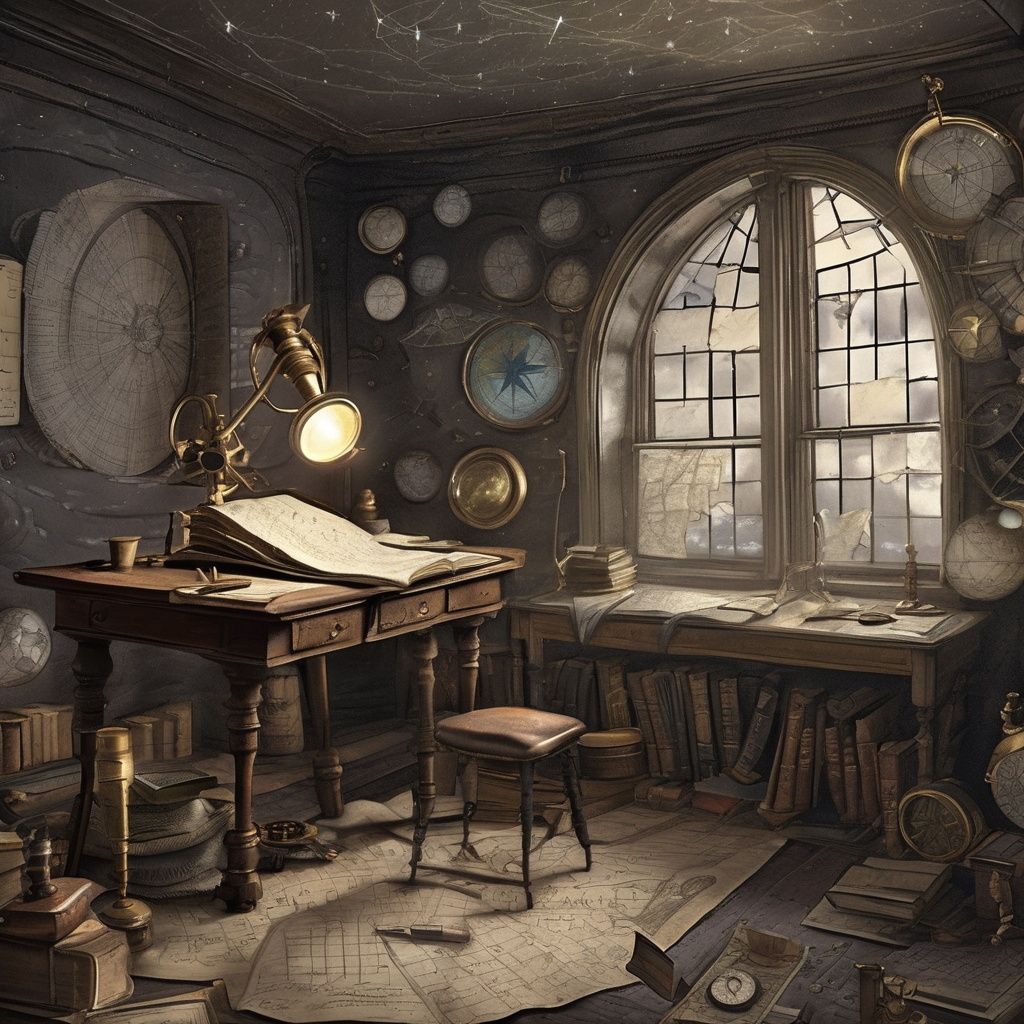
Margot discovered the peculiar inheritance on a Tuesday that felt like the end of the world. Her eccentric aunt Cordelia had left her a Victorian townhouse in Salem, complete with a tower room containing nothing but dusty atlases and a single brass compass that hummed when touched.
The compass needle didn’t point north. Instead, it quivered toward a leather-bound journal wedged between volumes of forgotten cartography. The journal’s pages were blank except for a single entry in Cordelia’s spidery handwriting: “Dreams are the only honest maps. To borrow them is to risk everything authentic about yourself.”
That night, Margot dreamed of wandering through markets that sold bottled starlight and conversations with dead poets. She woke with sand between her toes and the taste of cardamom on her tongue, though she’d fallen asleep in Massachusetts wearing wool socks.
The brass compass now pointed to a new location on her bedside table—a small vial filled with swirling, opalescent mist.
Over the following weeks, more vials appeared. Each contained dreams so vivid they left physical traces: burn scars from dragon encounters, pressed flowers from impossible gardens, foreign coins that didn’t exist in any earthly currency. Margot began mapping these nocturnal journeys, creating charts of places that couldn’t be found on Google Earth or in any geography textbook.
The dreams weren’t hers, she realized. They belonged to strangers whose sleep she was somehow accessing. A lonely widower in Kyoto who dreamed nightly of dancing with his deceased wife. A child in Mumbai who flew over her slum on wings made of newspaper. An old man in Iceland whose dreams took him back to conversations with his younger self.
Each borrowed dream left Margot a little more hollow, a little less certain of her own memories and desires. Were her growing cravings for green tea and honey purely her own, or remnants of the Japanese widower’s dreamscape? Did she genuinely love the sound of church bells, or was she channeling the Icelandic man’s nostalgia?
The journal began filling itself, pages covered with coordinates that led nowhere and everywhere simultaneously. Margot’s own dreams became increasingly sparse, as if she’d traded them away for these borrowed adventures. She consulted sleep specialists who found nothing wrong, visited therapists who suggested stress management techniques, and researched her family history for clues about Cordelia’s mysterious practices.
In the town’s genealogical records, she found references to women in her bloodline who were known as “dream merchants” and “sleep thieves.” The historical accounts were dismissed as folklore, but Margot recognized the symptoms described: insomnia paired with extraordinary empathy, the ability to navigate others’ subconscious landscapes, and the gradual erosion of one’s own identity.
The brass compass began spinning wildly, its hum growing more insistent. Following its erratic guidance, Margot discovered a hidden compartment in the tower room containing hundreds of dream-vials, each labeled with dates spanning decades. Cordelia had been collecting dreams for years, perhaps her entire adult life.
At the bottom of the compartment lay another journal, this one filled with Cordelia’s increasingly frantic handwriting. The entries detailed her growing disconnection from herself, her inability to remember her own childhood, her desperate search for a way to return the borrowed dreams to their rightful owners. The final entry was a map—not of any physical location, but of the pathways between sleeping minds.
Margot realized the inheritance wasn’t just the house or the compass. She’d been chosen to complete Cordelia’s unfinished work. Using the map as her guide and the compass as her anchor, she began the delicate process of dream-returning. Each night, she entered the collected experiences and carefully guided them back to their sources, following threads of memory and emotion across continents and decades.
Some dreams had to be delivered to people who had long since died, requiring journeys to graveyards where Margot left the vials nestled among headstones, watching them dissolve into morning mist. Others belonged to individuals she could track down, leading to awkward conversations about inherited family artifacts that she claimed belonged to their relatives.
The process took months. With each returned dream, Margot felt pieces of herself reassembling. Her own dreams gradually returned—modest suburban adventures and anxiety-fueled scenarios that felt luxuriously familiar. The compass’s humming softened, its needle eventually settling into contented stillness.
On the final night, Margot opened the last vial and found herself in Cordelia’s dream: a vast library where all the world’s unfinished stories waited to be completed. Her aunt sat reading in a leather armchair, looking decades younger than Margot remembered.
“The maps we make of other people’s inner worlds,” Cordelia said without looking up from her book, “are only as valuable as our willingness to eventually find our way home.”
Margot woke to find the brass compass pointing true north for the first time, its face reflecting the early morning sun streaming through the tower room windows. The vials had vanished, leaving only empty shelves and the satisfied silence of completed work. She made coffee in her inherited kitchen, tasting nothing but her own simple pleasure in the ritual, and began planning what to do with a house full of honest maps.


Leave a Reply