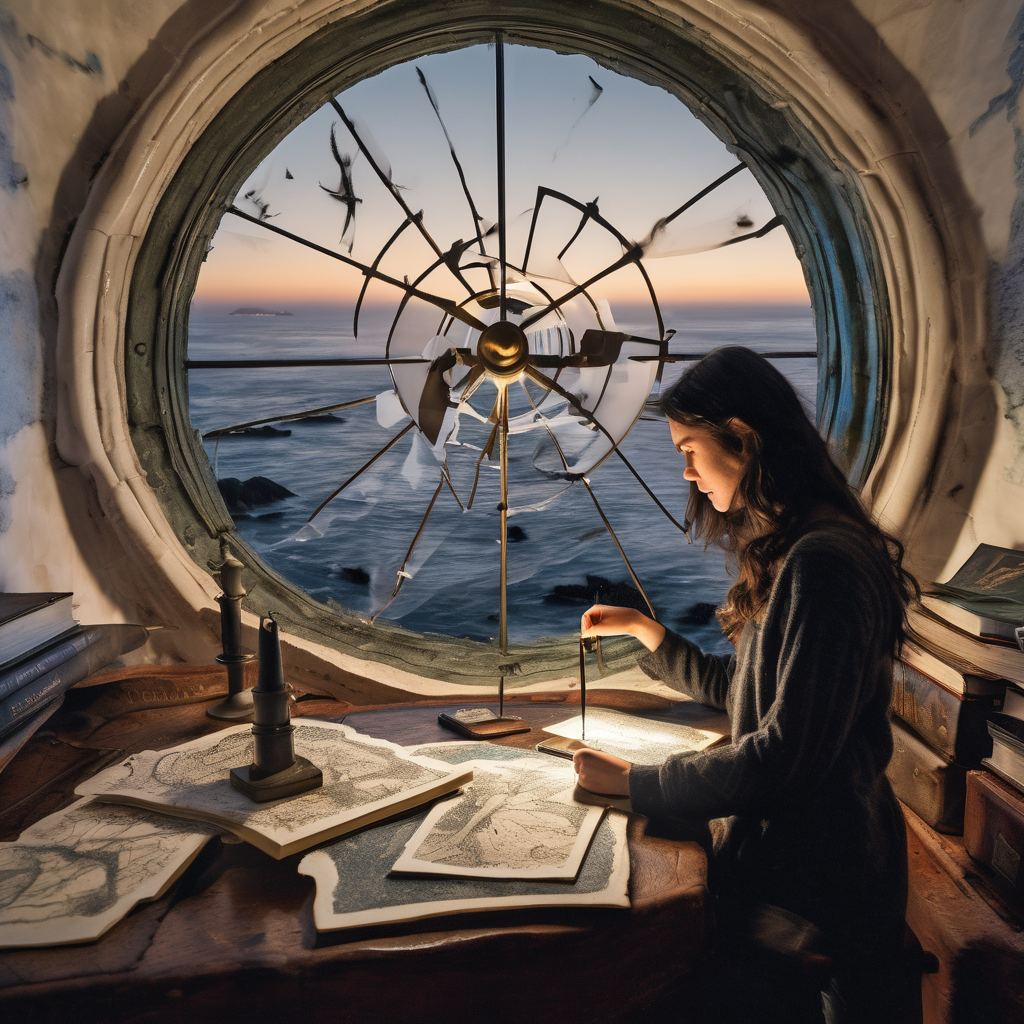
Marina inherited three things from her father: a leather-bound atlas that showed places that didn’t exist, a compass that pointed toward lost things, and the ability to taste colors on the wind. The morning he disappeared, the Mediterranean had tasted purple—the shade of goodbye.
Now she stood in the renovated lighthouse her father had converted into his studio, watching influencers pose against the sunset for their curated lives. They’d discovered Punta Estrella after that travel blogger proclaimed it “Portugal’s hidden gem,” though it was actually tucked into a forgotten corner of Galicia where Spain pretended to be something else.
The compass trembled in her pocket. West, toward the caves.
She’d been tracking the sustainability conference attendees all week—executives who spoke of carbon neutrality while their yachts leaked oil into her father’s sacred waters. But tonight was different. Tonight, the map had shown her something new: an island that appeared only when drawn with squid ink under a crescent moon.
“You’re Tomás the cartographer’s daughter,” said a voice. The woman wore a dress that seemed to be cut from the night sky itself, stars shifting across the fabric. “I’m here about the referendum.”
“There’s no referendum,” Marina said carefully.
“Not in this world.” The woman smiled. “But your father drew other possibilities. Worlds where the sea votes. Where the dolphins hold parliament. Where the crisis isn’t about fuel but about dreams running dry.”
Marina’s hand found the atlas. Inside, her father’s maps were changing, coastlines restructuring themselves like living things. The woman leaned closer, smelling of salt and storm.
“He drew a world where love isn’t regulated by algorithm, where music hasn’t been copyrighted by corporations, where children learn navigation by starlight instead of screens. But someone has to choose which world we keep.”
“The wellness retreat people won’t like that,” Marina said, thinking of the yogis who’d colonized the hillside, preaching mindfulness while pricing out the fishermen.
“They don’t get a vote. Only you do—the last cartographer who can taste the truth on the wind.”
Marina opened the atlas to a page she’d never seen before. It showed Punta Estrella, but different—wind turbines that sang whale songs, markets where people traded stories instead of currency, a world where her father stood on the dock, waiting.
“If I choose that world, what happens to this one?”
“It becomes the myth. The cautionary tale they tell children about a place where people poisoned their own air and charged money for water.”
The compass in Marina’s pocket spun wildly, pointing to everywhere and nowhere at once. Through the lighthouse window, she watched the influencers staging their perfect lives, the conference attendees planning their carbon offset schemes, the wellness seekers pursuing purchased peace.
She dipped her father’s pen in squid ink and began to draw.
The new map spread across the page like spilled wine, showing cities that breathed, forests that remembered, oceans that judged. She drew the referendum into existence—not a vote between politicians or parties, but between possibilities. Each stroke tasted of copper and cinnamon, the flavor of revolution.
“Will they know?” Marina asked as the lighthouse began to fade around them, reality restructuring itself to match her design.
“They’ll wake up tomorrow believing it was always this way. Except for the dreamers. They’ll remember, and they’ll know to thank the cartographer’s daughter who chose wonder over wealth.”
Marina added the final detail—a small lighthouse on a forgotten coast, where a man and his daughter mapped impossible worlds together, forever drawing better tomorrows into being.
The last thing she tasted was gold—the color of a father’s embrace, of a world reborn, of maps that led not to places but to possibilities.


Leave a Reply