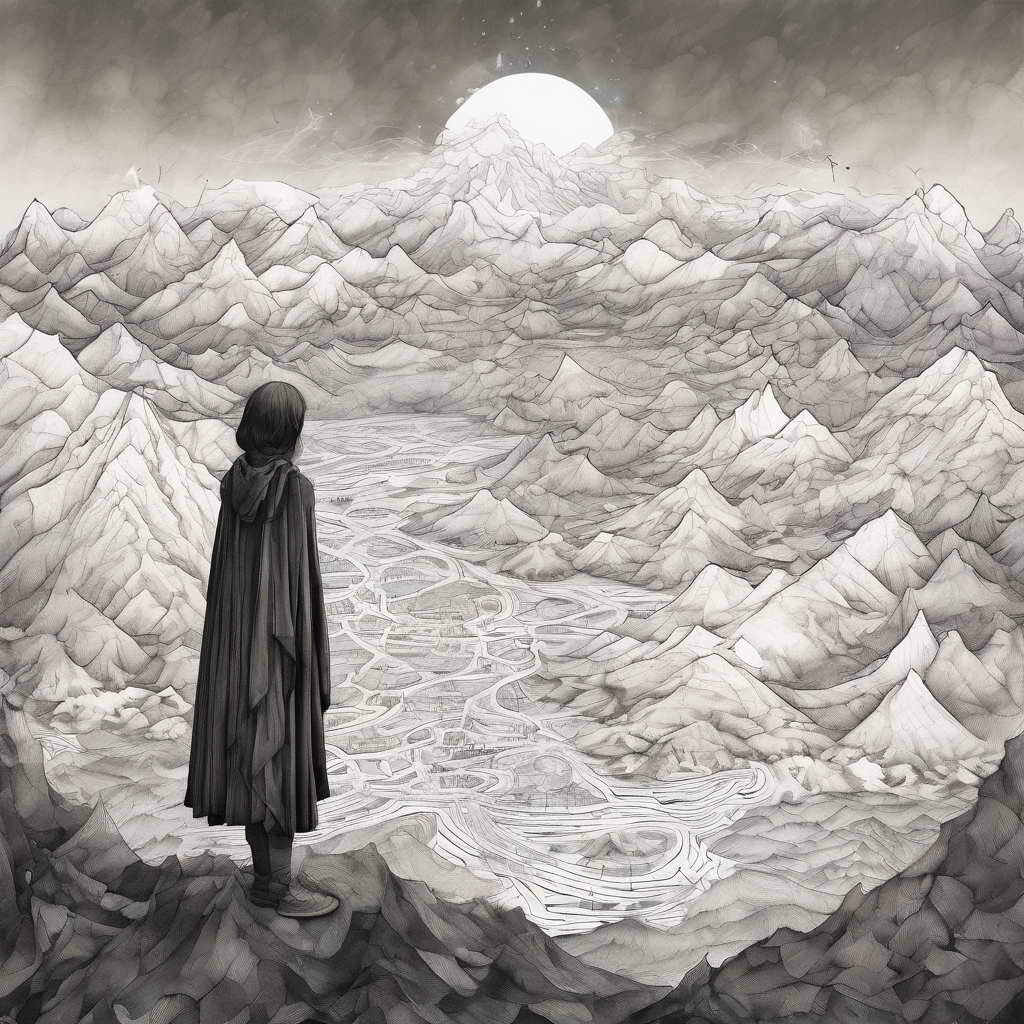
The old maps were wrong about everything except the bones.
Mira discovered this on her thirteenth birthday, when her father’s compass began bleeding copper-colored ink across his workbench. The liquid formed coastlines of countries that had never existed, mountain ranges that defied physics, and a single word that made her father go pale: RETURN.
“Pack only what sings,” he told her, his weathered hands already rolling up charts marked with impossible geometries. “We’re leaving tonight.”
Their cottage sat at the edge of the known world, where cartographers came to die or go mad—whichever found them first. Mira had grown up between these two possibilities, learning to read the space between latitude lines, to hear the whispers that lived in the margins of ancient atlases.
Her father had been the royal cartographer once, before the Queen discovered his true work: mapping the territories of the dead. Now they were both exiled, though Mira had never understood why the Queen feared those maps so much. The dead had their own geography, her father always said, their own trade routes and capitals. What harm could come from charting them?
She packed her mother’s violin (it hummed against her fingers), three vials of midnight rain (collected during the eclipse), and the ceramic rabbit she’d made before she learned that clay could hold memories. Everything else, her father burned in the fireplace, including his portrait from the palace—especially that.
They traveled by moonroad, that silver path that only appeared when you walked with your eyes closed, trusting your feet to find the way. Mira could hear her father’s breathing, ragged with fear or excitement—she couldn’t tell which. Behind them, something followed. Not footsteps exactly, but the sound geography makes when it rearranges itself.
“Don’t look back,” her father whispered. “The landscape is still deciding what it wants to be.”
Three nights later, they reached the Unmapped Territories, where the sky wore different colors depending on your intentions. Here, her father finally explained: the Queen’s daughter had died of the sleeping plague five summers ago, but the Queen had found Mira’s father’s maps. She’d tried to walk the paths of the dead to retrieve her child, but the dead have their own laws. You can visit, but you cannot steal. The Queen had returned changed—part living, part something else—and now she hunted anyone who knew the truth.
“But why run now?” Mira asked, watching aurora lights spell out warnings in languages that hadn’t been invented yet.
Her father showed her the compass. The copper ink had dried into a perfect portrait of Mira’s face. “Because you’re beginning to inherit it. The gift. The curse. The ability to see both worlds at once.”
That’s when Mira understood why her shadow sometimes fell upward, why birds flew backward when she sang, why her mother’s grave was always empty when she visited. Her mother hadn’t died—she’d become a cartographer of the other side, mapping the world from underneath.
The Queen’s soldiers found them at dawn, but they were no longer entirely human. Their faces shifted like sand dunes, their weapons were made of crystallized screams. The Queen herself rode a horse of living wind, her crown a circle of frozen tears.
“Give me the girl,” the Queen demanded. “She can map the path to my daughter.”
Mira’s father stepped forward, but Mira touched his shoulder. She understood now. The ceramic rabbit in her pack was warm, pulsing with stored memory. She’d made it the day her mother taught her that clay could hold more than shape—it could hold moments, entire worlds, even death itself.
She threw the rabbit at the Queen’s feet, where it shattered into a thousand pieces. Each shard became a door, each door opened onto a different map, a different possibility. The Queen saw her daughter in one—alive but choosing to stay with the dead. In another, her daughter had become rain. In a third, she was a constellation, writing messages in stars.
“Choose,” Mira said, her voice carrying the authority of someone who had just realized their inheritance. “But know that every map shows a different truth, and you can only follow one.”
The Queen dismounted her wind-horse, her partly-dead face streaming with tears that froze before they could fall. She reached for one shard, hesitated, reached for another. The sun began to rise properly now, and Mira could see that each piece of ceramic reflected not just a map, but a choice the Queen had made or unmade, paths she’d taken or avoided.
“I taught your mother this craft,” the Queen whispered, and Mira’s father gasped. “Before I was Queen, I was a cartographer too. I mapped the edges of reality until I found the place where all maps converge. Your mother was my apprentice. When my daughter died, I thought I could chart my way back to her. But the dead have their own cartography, don’t they?”
Mira nodded, understanding flooding through her like ink across paper. The Queen wasn’t hunting them—she was trying to return something. From her saddlebag, the Queen pulled out a rolled map, sealed with wax the color of dried blood.
“Your mother’s last map,” the Queen said. “She made it the day you were born. The day she chose to cross over, to map from the other side. She knew you would need both views—above and below, living and dead—to complete the great work.”
Mira took the map with shaking hands. The moment she touched it, she could feel her mother’s presence, like a familiar song played in a different key. The map showed nothing at first, then slowly, lines began to appear—not of places, but of possibilities. Every choice that could be made, every path that could be taken, spreading out like veins from a single point marked “NOW.”
“The great work?” Mira asked.
“To map the moment when all worlds touch,” her father said quietly. “The cartographer’s dream and nightmare. The place where every map is true and false simultaneously.”
The Queen’s soldiers were dissolving with the sunrise, returning to whatever space between life and death they’d been summoned from. The Queen herself was fading too, becoming translucent as morning claimed the night’s strange permissions.
“I chose wrong,” the Queen said, her voice now wind through leaves. “I tried to force the maps to show me what I wanted, not what was. Don’t make my mistake, Cartographer’s Daughter. Maps are meant to show the way, not create it.”
As the last of the Queen disappeared, Mira unrolled her mother’s map fully. It was blank except for a single instruction written in her mother’s careful hand: “Start where you are. Map what is. The rest will follow.”
Mira looked at her father, who was aging backward in the strange light of the Unmapped Territories, becoming the young cartographer who had once believed maps could save the world. She pulled out her own mapping tools—inherited from both parents, blessed by exile, touched by death—and began to draw.
She started with the broken ceramic rabbit, each shard a doorway. Then the moonroad they’d traveled, silver and uncertain. The Queen’s tears, frozen mid-fall. Her father’s compass, bleeding truth. Her mother’s violin, humming with unplayed songs.
As she drew, the landscape around them began to settle, to choose what it wanted to be. Mountains grew from her pencil strokes, rivers flowed from her ink. She was not creating the world, she realized, but revealing it—the world that had always existed between the living and the dead, between the mapped and unmapped, between what is and what could be.
Her father watched with pride and sorrow as his daughter worked, knowing that this was her inheritance, her burden, her gift. To be a cartographer was to stand between worlds, marking the paths others would travel, never quite belonging to any single territory.
When Mira finally looked up from her work, the sun was setting again, or perhaps rising—in the Unmapped Territories, it was hard to tell. Her map was complete, showing not a place but a moment—this moment—when a girl understood that the most important maps were the ones that showed you where you were, not where you were going.
“What now?” her father asked.
Mira rolled up the map carefully, sealed it with wax made from bee dreams and starlight. “Now we map our way home. But first, we need to visit Mother. I finally understand which map to follow to find her.”
They walked into the new landscape Mira had drawn, leaving footprints that would become roads, breathing paths into existence. Behind them, the ceramic rabbit reformed from its shards, whole but different, and hopped after them into territories that no map had ever shown, because they had only just begun to exist.
In the distance, a violin played a song that was both hello and goodbye, and Mira knew her mother was waiting, compass in hand, ready to teach her how to map the spaces between heartbeats, where all the most important territories lay hidden, waiting to be discovered.


Leave a Reply