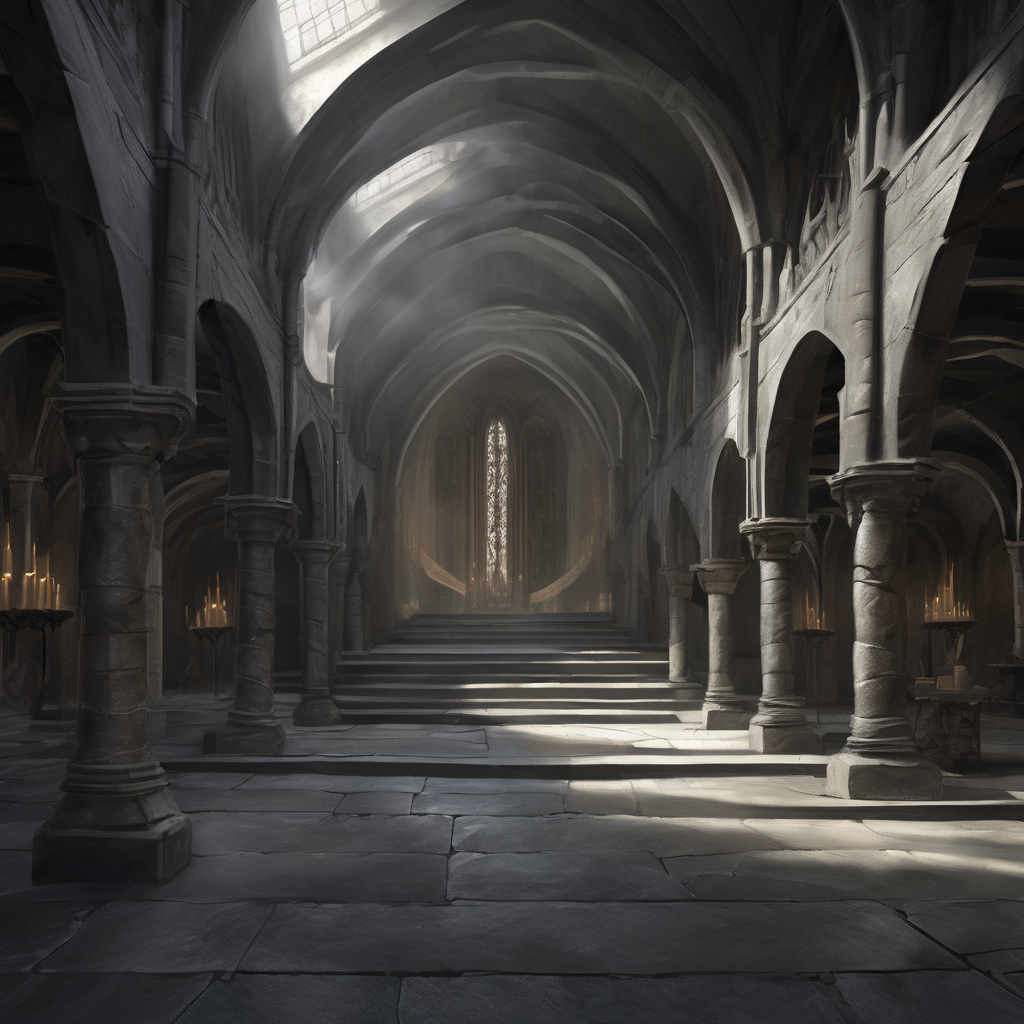
The world was a study in graphite and ash. Elara, a Scribe of the Third Order, knew this as divine truth. The Achromatic Synod taught that color was the original sin, a gaudy distraction from the True Form of the Creator’s work. Their robes, in a display of what the irreverent called quiet luxury, were not merely grey but a thousand textures of it—the smooth slate of the High Scribe’s vestments, the rough charcoal of an acolyte’s habit, the pearlescent silver of the sacred styluses.
Her life was a clean line of black ink on vellum parchment. But lately, the line had wavered. It began with the histories. She was tasked with transcribing pre-Synod texts, sanitizing them of chromatic language. Words like ‘saffron’ and ‘cobalt’ were to be replaced with ‘pale’ or ‘dark.’ But the words held a ghost-power. She’d inked the word ‘vermilion’ and felt a phantom warmth on her tongue. Her superior, Proctor Malachi, said such feelings were the death-throes of vanity.
Her relationship with Malachi was a careful, undefined thing, a sort of professional situationship built on shared silence and the unspoken fear of error. He was kinder than most, his eyes a less severe shade of grey, but he was a man made of rules.
One afternoon, a wasp, fat and drowsy, crawled from the spine of a forbidden herbal. Annoyed, Elara swatted it. It fell onto her vellum, and in her haste to brush it away, she crushed it. A smear, thick and shocking, stained the page. It wasn’t grey. It was a viscous, vibrant yellow, shot through with veins of black. Her breath caught. It was hideous. It was beautiful. She stared, her heart a frantic drum against her ribs. This was it. The heresy. Right there, on a page of Synod-sanctioned history.
She spent the next week in a state of controlled panic the Synod would have called delulu. She saw potential heresy everywhere. The faint browning on a wilting prayer-leaf. The subtle patina on a copper hinge. These weren’t degradations of grey; they were… other things. Intrusions. The Synod taught that the world had been bled of its chaotic hues by the First Patriarch. Was the color seeping back in?
She began to think of it as Synod math. One infraction, like a misplaced comma, was a demerit. A smear of forbidden yellow should have been an eternity of penance. But the sheer scale of the lie it revealed felt so vast that it circled back around to being a kind of truth. If the Synod was wrong about the wasp, they were wrong about everything. Heresy math. It was the only logic that held.
She found another heretic by accident. A young mason named Rhys, who was repairing a flagstone in the cloister. He dropped his chisel, and when it struck the stone, a spark flew. For a split second, Elara saw it not as a fleck of white light, but as a searing pinprick of orange. Her gasp was audible. Rhys’s head snapped up. His eyes, wide and terrified, met hers. He saw it too. They didn’t speak a word, but in that shared, forbidden glance, a conspiracy was born.
He started leaving her things. A pigeon’s feather that shimmered with an oily purple-green. A shard of glass from the ancient, pre-Synod catacombs that, when held to the light, cast a soft blue shadow. Each object was a silent sermon. Her grey world was a lie, a cataract over the eye of reality. She began to unpack a lifetime of doctrine, finding it hollow. The vibe of the Scriptorium, once calming in its monotony, now felt like a tomb.
This was her new era. Her chromatic era. The fear was still there, a cold stone in her gut, but it was now overlaid with a thrilling, terrifying sense of purpose. She felt a strange centrality, as if the story of the world, so long written in black and white, was waiting for her to add the illuminations. It was a dangerous feeling, like main character energy in a story where the main character always ended up burned at the stake.
The crisis came during the Feast of Austerity. The High Scribe was delivering a sermon on the vulgarity of emotion. “Passion is the root of all color!” he thundered, his voice echoing in the Great Hall. “Joy is a garish yellow, anger a violent red, envy a sickly green! We must remain placid, content in the divine greyscale!”
As he spoke, Elara looked at Rhys, who stood among the artisans. He gave her the barest of nods. It was time. Malachi was standing beside her, his face a mask of pious concentration. “Proctor,” she whispered, her voice trembling. “Do you see the stain on the High Scribe’s robe?”
Malachi frowned, his eyes scanning the perfect, slate-grey vestments. “There is no stain, Scribe. Your mind is wandering.”
“No,” Elara said, her voice growing stronger. She held up the pigeon feather Rhys had given her. “Look. It’s not grey.”
Malachi’s face tightened. He saw only a drab feather. “This is foolishness. You are unwell.” He reached for her arm.
But Elara was already moving. She stepped forward, past the proctors, into the open space before the dais. In her other hand, she held the shard of ancient glass. She held it up to the single beam of light filtering down from the hall’s high window.
A soft, perfect polygon of blue light bloomed on the grey stone floor.
A collective gasp went through the hall. Most saw nothing, a trick of the light, a smudge. But dozens, maybe more, saw it. They saw the blue. They saw the impossible, heavenly, heretical color. Rhys stared, his face alight with terror and awe. The High Scribe stopped his sermon, his mouth a thin line of fury. He saw it too.
“Seize her!” he shrieked, his voice cracking, losing its sonorous authority. “The Chromatic Heresy is upon us!”
But as the guards moved in, something had already broken. A girl near the back began to weep, and those around her swore they saw a shimmer of silver-blue on her cheeks. An old man bellowed in rage at the guards, and a flush of deep crimson bloomed on his neck. The High Scribe’s fury was a blotchy purple on his temples. Emotion was color, and for the first time in centuries, the people in the Great Hall were truly feeling. Elara stood in her small pool of blue light, a Scribe no more, and watched the grey world begin to bleed.


Leave a Reply