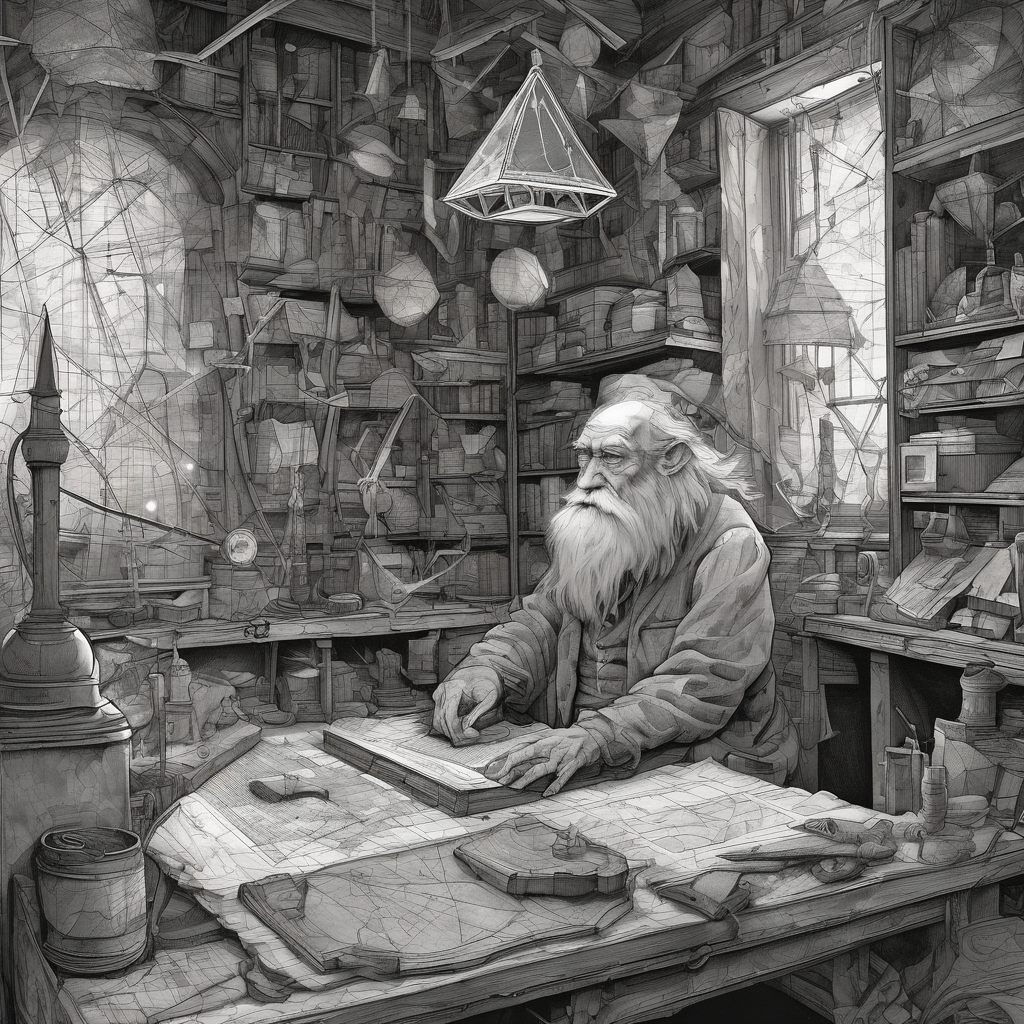
The shop was tucked into a sliver of an alley, a place where forgotten winds went to die. Its window displayed a single, dust-furred octahedron, catching the thin city light with a morose glitter. Lena pushed the door, a chime like a breaking bone announcing her arrival.
Inside, the air smelled of old paper, ozone, and something like the mineral tang of shed tears. A man sat at a vast wooden desk, a drafting table really, etched with a million intersecting lines. He was old, his face a complex cartography of its own, but his eyes were sharp and clear as calipers. Around him were the tools of his trade: brass protractors for measuring angles of betrayal, compasses with diamond tips for inscribing circles of obsession, and rulers of polished bone for calculating the long, straight lines of consequence.
“I was told you could… adjust things,” Lena said, her voice a tremor. She had been quiet quitting her own life for months, moving through the days with the bare minimum of emotional expenditure, all her energy consumed by the single, searing point of her past.
The man, the Geometer, didn’t look up. He was shading a complex diagram on a sheet of vellum. “I do not adjust. I re-delineate. I provide a more… sustainable geometry for the soul.”
Lena approached, placing her palms flat on the desk. “I have a regret. It’s… it’s not a moment. It’s a structure. An architecture of a single bad decision that has become the house I live in.”
He finally raised his eyes. “They all are.” He motioned to a stool. “Show me.”
She didn’t know how, but he did. He took a strange device, like an astrolabe for gazing inward, and held it to her temple. The cold metal was a shock. “Now,” he said, his voice a low hum, “find its cornerstone. The first lie you told yourself.”
She closed her eyes and the doomscrolling began, not through a screen, but through the flickering, treacherous feed of her own memory. There it was: the train station, the rain, the words she didn’t say to him. The lie wasn’t to him, but to herself—that leaving was strength, that silence was kindness.
“Ah,” the Geometer breathed, as if he could see it too. He began to sketch furiously on a new sheet of vellum. “A flawed foundation. You’ve been gaslighting your own history. You see the shape? A fractal of cowardice, branching infinitely. Every new day, a new, tinier spike of the same pattern. It’s tearing you apart.”
He was right. It felt like that, a million microscopic paper cuts on her spirit. This was her current era: the era of frayed edges and phantom conversations.
“The memory cannot be erased,” the Geometer stated, setting down his charcoal stick. “To do so would create a vacuum, and your psyche would collapse into the void. No, the shape must be resolved. We will not demolish it. We will transform it from a prison into a monument.”
He explained the process. It wasn’t about forgiveness or acceptance in the way the pamphlets described. It was a rigorous, mathematical mindfulness. She would have to relive the memory, but this time as a passive observer, noting only its vertices, its planes, its impossible angles. She would provide the dimensions; he would perform the calculations.
For an hour that stretched into an eternity, she did as he asked. She felt the cold rain, saw the train pull away, tasted the metallic lie on her tongue. But with his guidance, she also saw the clean line of the platform edge, the perfect parabola of a raindrop falling from the eaves, the intersecting vectors of their gazes in the final moment. She gave him the raw data of her pain.
He worked with intense, silent focus. His compass swung, his ruler clicked. He drew lines of force, bisected angles of intent, and calculated the volume of unspoken feeling. He was like a divine engineer finding a fatal flaw in ablueprint and drawing in a new, load-bearing wall.
“There,” he said at last, tapping the vellum. The jagged, chaotic fractal was gone. In its place was a drawing of a perfect, smooth dodecahedron. “The memory remains. The choice remains. But its structure is now finite. It is contained. It will no longer replicate. It will simply be.”
Lena opened her eyes. The ache inside her had not vanished, but it had changed. The sharp, piercing quality was gone. In its place was a weight—solid, heavy, but manageable. It was a lodestone, not a shiv. She could carry this.
She stood up, her legs steadier than before. “What do I owe you?”
The Geometer was already cleaning his tools. “You will pay by living in the new space provided. Do not let it fall into disrepair.”
Lena walked out of the shop, the chime sounding less like a break and more like a precise, singular note. The city light felt different, warmer. The wind in the alley seemed to be moving somewhere, now. The regret was still with her, a solid shape settled low in her gut, a strange and quiet companion. It was no longer a house. It was a stone in her pocket, a reminder of the weight of things, a proof that she had lived. And for the first time in a very long time, she felt there was room for a new blueprint.

Leave a Reply