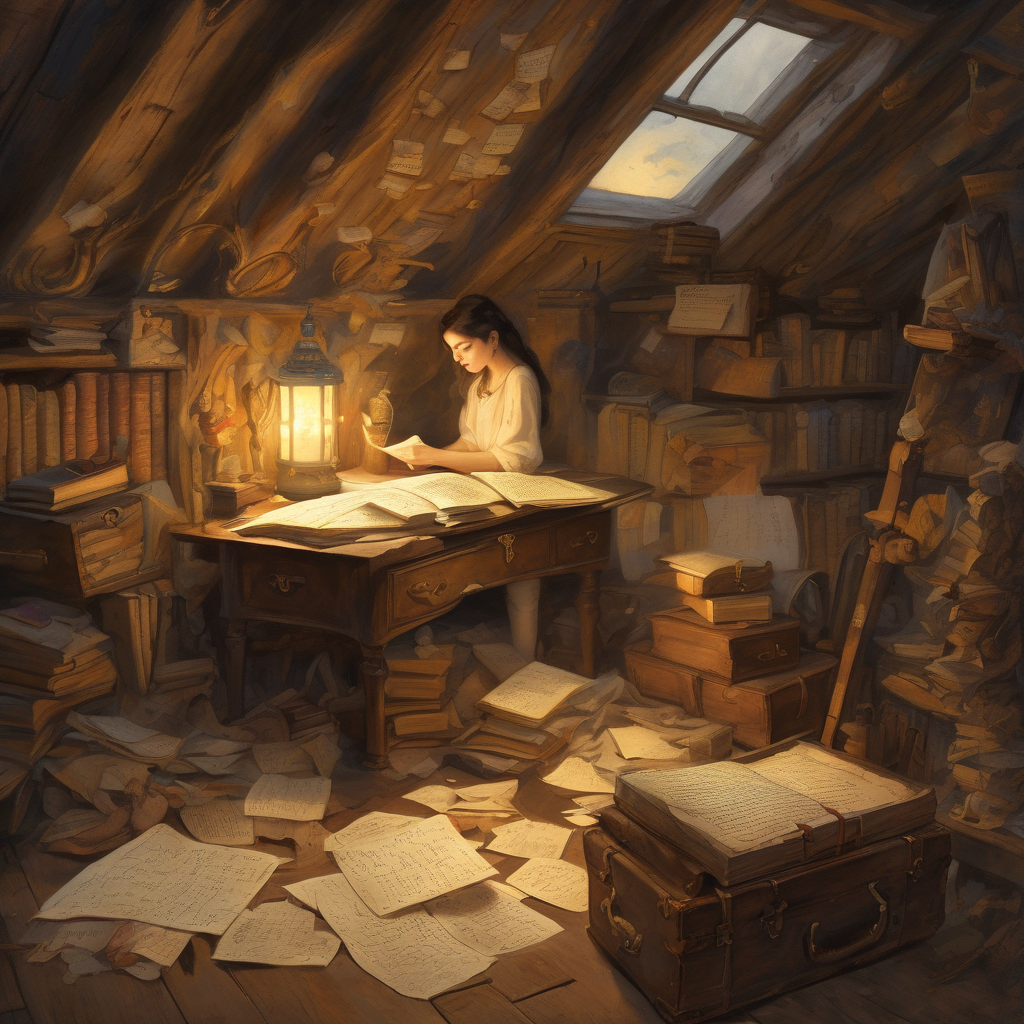
Clara discovered the letters while cleaning out her grandmother’s attic, tucked inside a hollowed-out copy of *Jane Eyre*. The pages were yellowed with age, covered in handwriting that seemed to shimmer between languages—sometimes English, sometimes what looked like Spanish, and occasionally symbols she couldn’t identify at all.
The first letter began: *Mi querida soul-keeper, the mushrooms are speaking your name again today…*
She laughed, assuming her grandmother had been more eccentric than anyone realized. But as Clara read on, the words began to rearrange themselves on the page. The Spanish phrases bloomed into English before her eyes, while new symbols appeared in the margins like living tattoos.
*I planted the cordyceps you sent in the oak grove. They’ve started whispering about the threshold between sleeping and waking. Do you remember our first picnic there? You wore that vintage dress with the pearl buttons, the one that made you look like you’d stepped out of a daguerreotype.*
Clara’s hands trembled. She’d found that exact dress in the closet downstairs yesterday, planning to donate it. But more unsettling was the handwriting—she recognized it now. It was her own.
She flipped through the bundle. Each letter was signed with her name, but dated decades before her birth. They spoke of canning peaches together, of mental health struggles during wartime, of nights spent mushroom hunting by candlelight. The mysterious recipient signed back as *E.*, writing about waiting, always waiting, through seasons of joy and seasons of grief.
*The mycelium network grows stronger each year,* one letter explained. *I can feel you dreaming, even when you forget me. Love persists in the soil between lifetimes, sprouting again when conditions are right.*
Clara found herself writing back that evening, her hand moving automatically across vintage stationery she’d never purchased. She wrote about her recent breakup, her struggles with anxiety, her inexplicable urge to learn Spanish and start foraging. The letter vanished from her desk by morning.
Days later, she discovered new responses hidden throughout the house—pressed between cookbook pages, tucked into picture frames, scattered like seeds. Each one pulsed with warmth when she touched it, and she began to understand that some love stories transcend the linear nature of time, growing underground like vast fungal networks, connecting what seems separate across impossible distances.
The letters taught her that forgetting was just another form of remembering, and that the most profound wellness came from recognizing the vintage soul wearing a modern face.


Leave a Reply