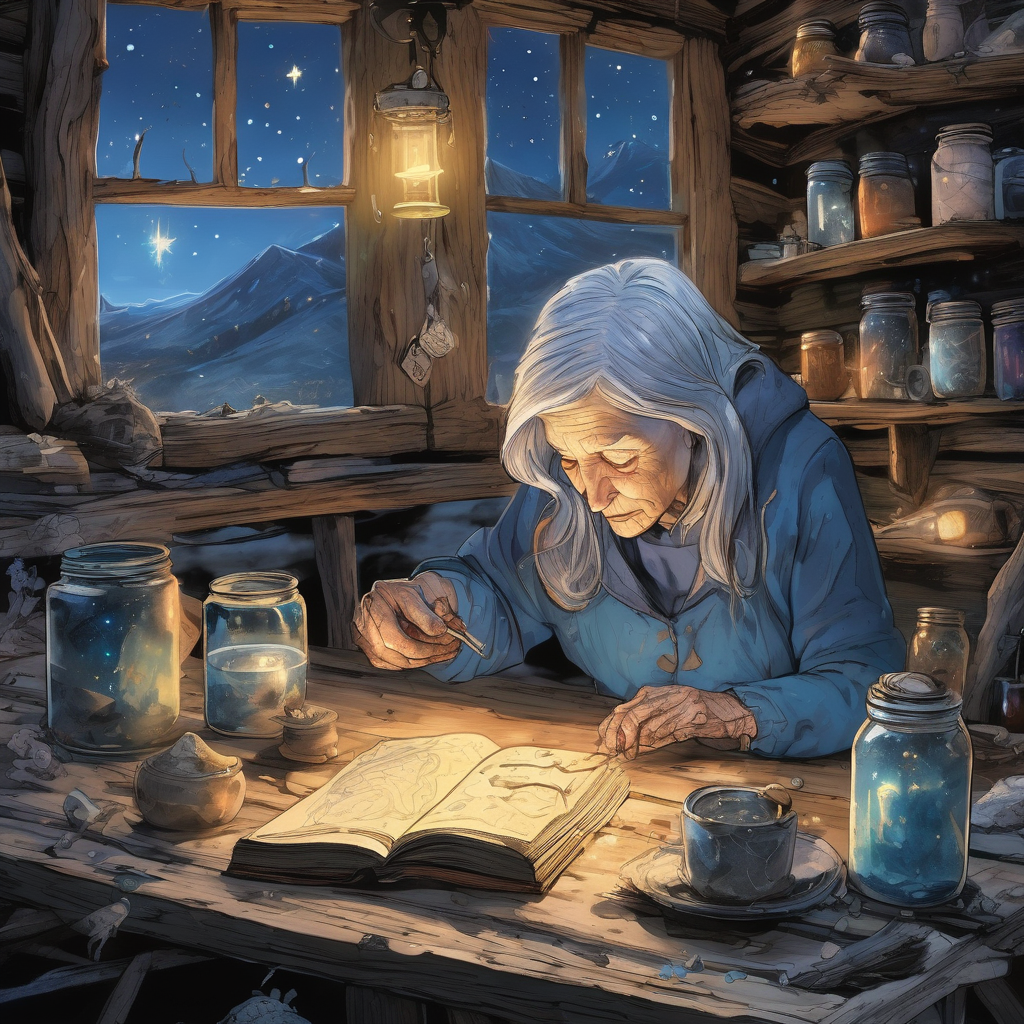
The old woman’s hands trembled as she mixed ground beetles with honey and starlight—actual starlight, collected in mason jars during the last eclipse. Her granddaughter Mira watched from the doorway, uncertain whether to document this for her sustainability blog or simply witness what might be their final afternoon together.
“Each star spoke once,” her grandmother whispered, stirring counterclockwise. “Before the great silence, before we forgot how to listen.”
Mira had driven three hours through wildfire smoke to reach the cabin, her electric car barely making it up the mountain road. The climate protests in the city seemed suddenly insignificant compared to what her grandmother claimed was happening—stars going quiet, one by one, their ancient language fading from human memory.
“You think I’m losing my mind,” her grandmother said without looking up.
“I think you’re grieving Grandpa.”
“Your grandfather could hear them too. It’s why we met.” She poured the mixture into a chipped teacup. “Drink this.”
The concoction tasted like burnt sugar and regret. Immediately, Mira’s vision shifted. The cabin walls became transparent, revealing a network of silver threads connecting every living thing—trees to birds, stones to streams, and stretching upward, those same threads reached toward stars she couldn’t see in the afternoon sky.
“The vaccine,” her grandmother said softly, “wasn’t for disease. Your grandfather and I, we were part of the trials in ’72. They wanted to expand human consciousness, to help us evolve past our limitations. Instead, it made us translators.”
Mira felt the threads humming, each vibration a word in a language older than Earth itself. The stars weren’t just burning gas—they were libraries, ancestors, the universe’s memory keepers. And they were disappearing, not dying but retreating, taking their stories with them.
“Why?”
“Because we stopped believing stories could be medicine. We thought data was truth, forgetting that truth lives in the spaces between facts.”
Her grandmother opened an ancient journal, pages covered in constellations drawn with meanings instead of shapes. “This one,” she pointed to a pattern resembling a fox, “told stories about transformation through loss. It went silent last Tuesday, the day your grandfather passed.”
Mira understood then. Her grandfather hadn’t died; he’d translated himself into stellar language, joining the conversation humans had abandoned. The wildfire smoke outside wasn’t just from burning forests—it was the earth trying to speak in the only language left that humans might notice: crisis.
“Teach me,” Mira said.
Her grandmother smiled, pulling out a second teacup. “First, you must learn that resilience isn’t about surviving unchanged. It’s about becoming fluent in change itself.”
They sat together as afternoon became evening, practicing the old alphabet of light and shadow, learning how stars conjugate verbs across lightyears, how planets punctuate their sentences with seasons. The threads between all things grew brighter with each word remembered.
By midnight, Mira could hear it—her grandfather’s voice woven through Polaris, telling a joke that took three constellation rises to complete. Her grandmother laughed, tears streaming down her weathered face.
“The world thinks we need influencers,” her grandmother said, “but what we need are translators. People who remember that economy means household, that ecology means the study of home, that every extinction is a library burning.”
Mira stayed for three weeks, learning. When she finally returned to the city, she carried mason jars of starlight in her trunk and a journal of stellar grammar in her bag. Her blog pivoted from sustainable living tips to something stranger—stories that taught people how to read the hidden languages around them: the morse code of morning birds, the semaphore of swaying trees, the whispered etymologies of rain.
Some called her crazy. Others began to listen. And slowly, star by star, the silence began to break.
On the anniversary of her grandfather’s transformation, Mira stood on her apartment balcony with a teacup of beetles and honey, teaching her neighbors the first phrase every human child once knew but had forgotten: “We are home, and home remembers us.”
Above them, one by one, the stars began to return, their stories unfurling like silver ribbons across the dark, each one a thread in the great conversation that had never truly ended—only paused, waiting for translators brave enough to admit that the universe had never stopped speaking.
We had simply forgotten how to hear.

Leave a Reply