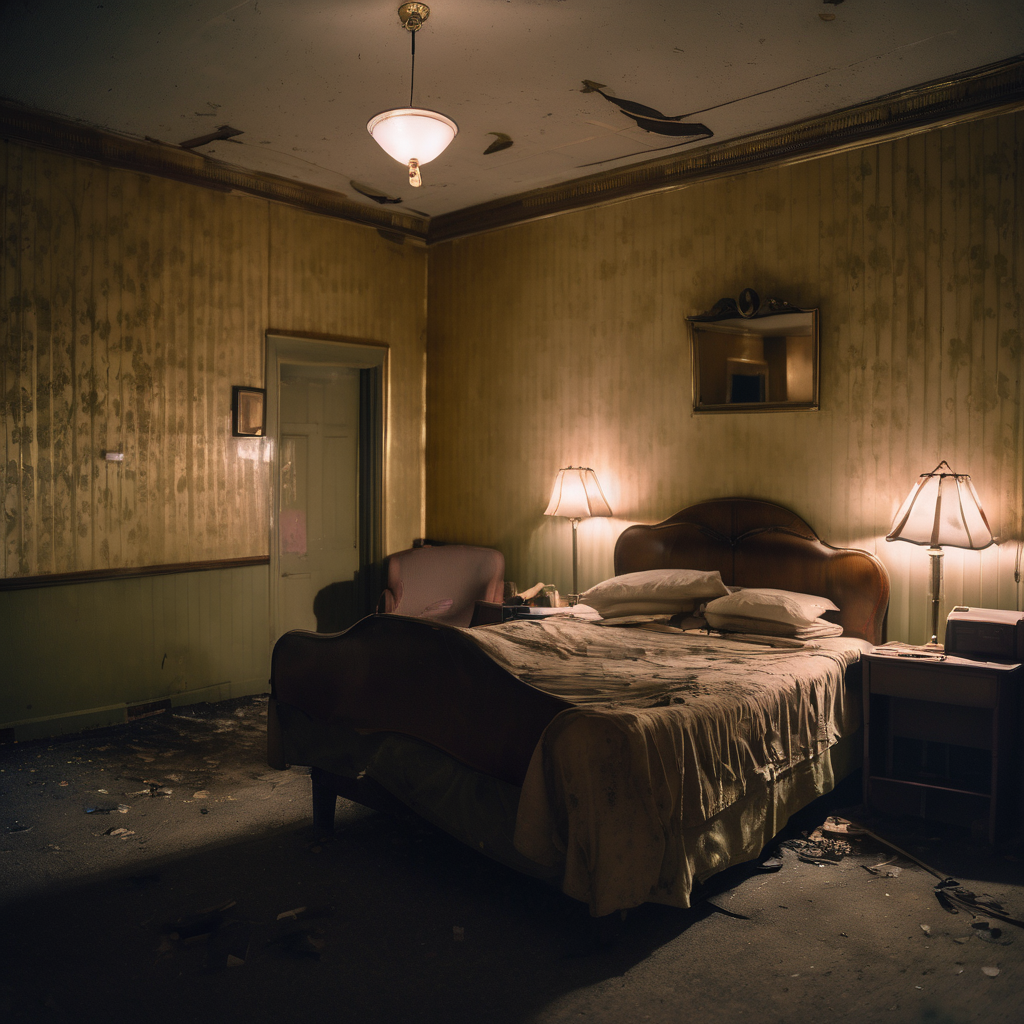
The wallpaper knew everything. It had absorbed seventy years of whispered secrets, midnight tears, and the peculiar energy that accumulates when too many lives pass through the same four walls. In Room 237 of the Grand Bellemore Hotel, the roses printed on that yellowing paper had witnessed three murders, seventeen breakups, one exorcism, and exactly one hundred proposals of marriage.
Tonight would be different.
Margot Chen pressed her palm against the door, feeling the brass numbers beneath her fingers. She’d inherited this particular gift from her grandmother—the ability to hear what rooms wanted to say. Most people collected vintage vinyl or designer handbags. Margot collected confessions from architecture.
“I need to know about Eleanor Voss,” she whispered to the door. “The influencer who disappeared here in 1962.”
The room sighed as she entered, a sound like silk scarves falling. The bed, still made with military corners despite the hotel being abandoned for a decade, seemed to shift in the moonlight. Margot had discovered the Bellemore through a series of cryptic posts that had gone viral before vanishing entirely—breadcrumbs left by someone who signed themselves only as “E.V.”
She pulled out her phone, not to record, but to use its flashlight. The beam caught the mirror first, and in it, she saw not her own reflection but a woman in a beaded dress, holding a cigarette holder.
“You came,” Eleanor said, stepping out of the mirror as casually as one might exit a taxi. “I’ve been sending those messages for months, hoping someone with your particular sustainability would notice.”
“Sustainability?” Margot asked, though she thought she understood. Her gift meant she could hold conversations that existed outside of time, maintaining connections that others couldn’t sustain.
Eleanor laughed, a sound like champagne bubbles. “This room wants to confess, darling, but it needs someone who can carry the truth without breaking. The wallpaper has been trying to peel itself off for decades, desperate to reveal what’s underneath.”
As if responding to its cue, a corner of the wallpaper began to curl. Beneath it, Margot saw not plaster but what appeared to be pages—hundreds of them, covered in handwriting.
“Every person who ever stayed here left a piece of their story,” Eleanor explained, floating now, her feet inches above the carpet. “The room absorbed them all, but I was the first to figure out how to read them back. I became obsessed, spent months here, learning everyone’s secrets. The affairs, the debts, the crimes they thought they’d buried.”
“But why did you disappear?”
Eleanor’s expression darkened. “I didn’t disappear, dear. I became part of the collection. The room offered me a trade—eternal life within these walls in exchange for being its curator. I accepted, thinking I was being clever. But rooms don’t understand loneliness.”
The wallpaper was peeling faster now, revealing layer upon layer of stories. Margot saw fragments: “—loved him despite the war—”, “—buried the money beneath the—”, “—she never knew I was her real—”
“The room wants to let them all go,” Eleanor continued. “Every secret, every confession. But if it does, I’ll go too. I’ll finally be free, but I’ll also be… gone.”
Margot understood. This was why she’d been summoned. Not just to witness, but to decide. She could preserve this museum of secrets, keep Eleanor imprisoned but existing, or she could set them both free.
She thought of all the trending obsessions with true crime podcasts, the endless appetite for other people’s mysteries. But there was something obscene about secrets that weren’t freely given, stories stolen by walls that had no right to them.
“What about your own story?” Margot asked. “The real one. Not the one the room tells.”
Eleanor smiled sadly. “I was twenty-three. I’d just been offered a modeling contract in Paris. I came here to meet my lover one last time, to say goodbye. He never showed. I waited three days, and by then, the room had already started whispering to me. It told me he’d been here the night before with someone else. The room knew because it knows everything. I chose knowledge over life. It was a fool’s trade.”
Margot walked to the window, looking out at the city that had grown up around the abandoned hotel. So many new buildings, new rooms, new secrets being made every moment. She thought about resilience, about the courage it took to let go of the past.
“Tell me how to free you both,” she said.
Eleanor pointed to a spot where the wallpaper had peeled completely away. “Touch the wall. Take one secret—just one—and carry it out of here. The room will unravel, and I’ll unravel with it, but the stories will finally dissipate. They’ll become what they were always meant to be—forgotten whispers, not preserved specimens.”
Margot pressed her hand to the exposed wall. Immediately, she felt it—a single secret flowing into her mind. It was small, almost insignificant: a traveling salesman in 1948 who had written a love letter to his wife but never sent it, ashamed of his poor spelling.
As she held that gentle secret, the room began to shake. The wallpaper fell in sheets, the stories scattering like birds released from cages. Eleanor was fading, but she was smiling.
“Thank you,” she whispered, becoming transparent. “For choosing freedom over preservation.”
The room gave one final shudder, and then everything was still. Margot stood in an empty, ordinary hotel room, the wallpaper intact but somehow lighter. The roses looked like roses, nothing more.
She left the hotel as dawn broke, carrying that one small secret like a seed. Sometimes, she thought, the kindest thing you could do for history was to let it rest.
The Grand Bellemore was demolished two weeks later. They built a community garden in its place, and the roses that grew there were the most beautiful anyone had ever seen.


Leave a Reply