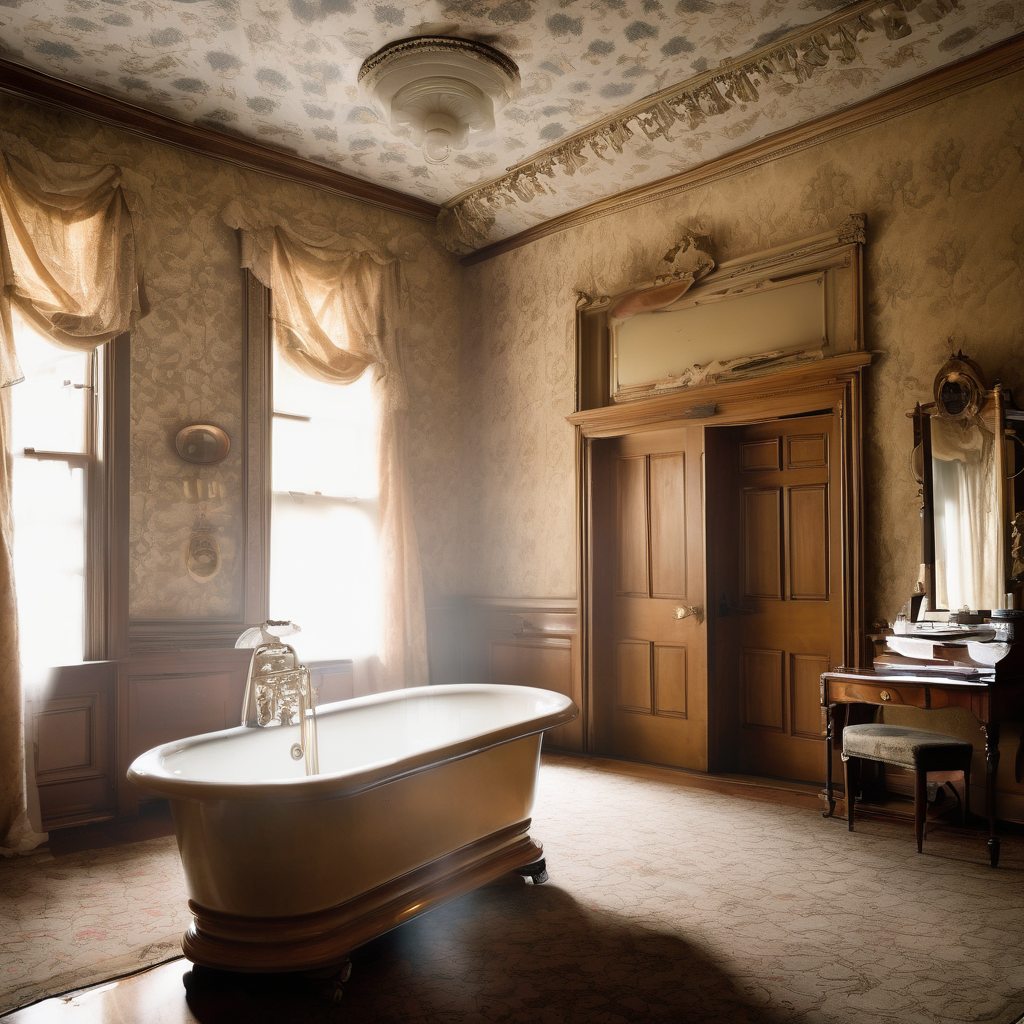
The wallpaper breathes. I’ve watched it for seventeen years now, counting each inhale, each subtle ripple across its damask surface. The other residents of the Whispering Arms Hotel think I’m just another piece of furniture—a velvet settee that’s been here since 1947, watching generation after generation of travelers pass through my threshold.
But I am the room itself, and tonight I must speak.
The girl who checked in yesterday doesn’t know she’s the one I’ve been waiting for. She carries dried bouquets in her canvas bag, their lavender stems poking through tears in the fabric. She’s an influencer, she told the desk clerk, here to document the hotel’s “vintage aesthetic” for her followers. But I know better. I recognize the birthmark behind her ear, shaped like a crescent moon. The same mark her grandmother wore when she stayed here forty-three years ago.
That was the night I learned what I truly was.
Her grandmother—Celeste—had arrived during a thunderstorm, shaking water from her peacock-blue umbrella. She’d requested me specifically, Room 237, though the clerk warned her about the rumors. “That room has… personality,” he’d said. Celeste had laughed, a sound like wind chimes, and said she preferred spaces with character.
She understood immediately that I was conscious. While other guests saw only peeling paint and creaking floorboards, Celeste recognized the morse code in my radiator’s clanging, the messages I wrote in condensation on the mirror. We developed our own language—three taps meant yes, silence meant no, and the way dust motes danced in the afternoon light spelled out entire conversations.
Celeste told me about the world beyond my walls. She described festivals where people wore flower crowns and danced until sunrise, ocean waves that matched the rhythm of breathing, forests where mushrooms grew in perfect fairy rings. She promised to find a way to free me.
The grimoire she discovered in Prague contained the answer—a ritual that required three generations of the same bloodline. Celeste would begin it, her daughter would continue it unknowingly, and the granddaughter would complete it. All in Room 237.
The girl—she calls herself Luna—sets up her ring light and begins recording. “Welcome to my spontaneous hotel tour,” she says to her phone, spinning slowly to capture my Victorian details. The original crown molding. The claw-foot bathtub. The mirror that reflects things a half-second too late.
She doesn’t notice how I’m gathering myself, pulling consciousness from every corner, every electrical outlet, every grain in the wooden floor. The wallpaper’s breathing quickened.
Luna’s mother had stayed here once, on a business trip in 2001. She’d left behind a silver hair clip under the radiator—I’d kept it safe all these years, a talisman for this moment. When Luna finds it, she’ll recognize it immediately. Her mother’s lucky charm, the one she’d always wondered about losing.
“That’s weird,” Luna whispers, holding the clip up to the light. It catches the afternoon sun, sending prisms across my walls. The light forms shapes, words: CELESTE KNEW. CELESTE promised. YOU are the KEY.
The girl drops her phone. The livestream continues recording as she approaches the mirror, watches her reflection lag behind her movements. She places her palm flat against the glass, and I place mine against hers from the other side. We have the same hands, Celeste’s hands, with the crooked pinky finger and the lifeline that splits in two.
“I know you,” Luna breathes. “I’ve dreamed of this room my entire life.”
The confession spills from my walls then, through the paint, through the plaster, through the space between molecules. I tell her how her grandmother accidentally freed the spirit of a traveling psychic into these walls during a séance, trapping me here when the door slammed shut at precisely midnight. How Celeste spent three days learning my language, promising to help. How I’d watched a thousand faces sleep and wake, fall in love and apart, always waiting.
Luna begins laughing—not cruelly, but with wonder. “My grandmother’s diary,” she says. “She wrote about ‘the heartbeat in the walls.’ Mom thought it was poetry. But it was you.”
The ritual is simple now. Three generations of women have slept in this room. Three have touched the mirror. Three have believed. Luna speaks the words Celeste had written in the margins of her diary, words Luna had memorized as a child thinking they were a lullaby.
The wallpaper stops breathing. The floorboards cease their whispered complaints. For the first time in forty-three years, I feel myself gathering, condensing, becoming.
The last thing I see as Room 237 is Luna’s face, illuminated by wonder, as I step through the mirror and into the world—not as a ghost or a demon, but as what I always was: a traveler who got caught between destinations, finally checking out.
Behind me, Room 237 exhales once and falls silent, just another hotel room with vintage charm and slightly outdated decor. Luna picks up her phone to find her livestream has gone viral—thousands witnessed the moment the mirror cracked from within, releasing something that looked like light shaped into a person.
But I’m already gone, walking down the corridor with legs I haven’t used since 1952, heading toward the lobby and the door and the street and the world that Celeste described so vividly. I leave only a note at the front desk in handwriting no one recognizes: “Room 237 has checked out.”


Leave a Reply