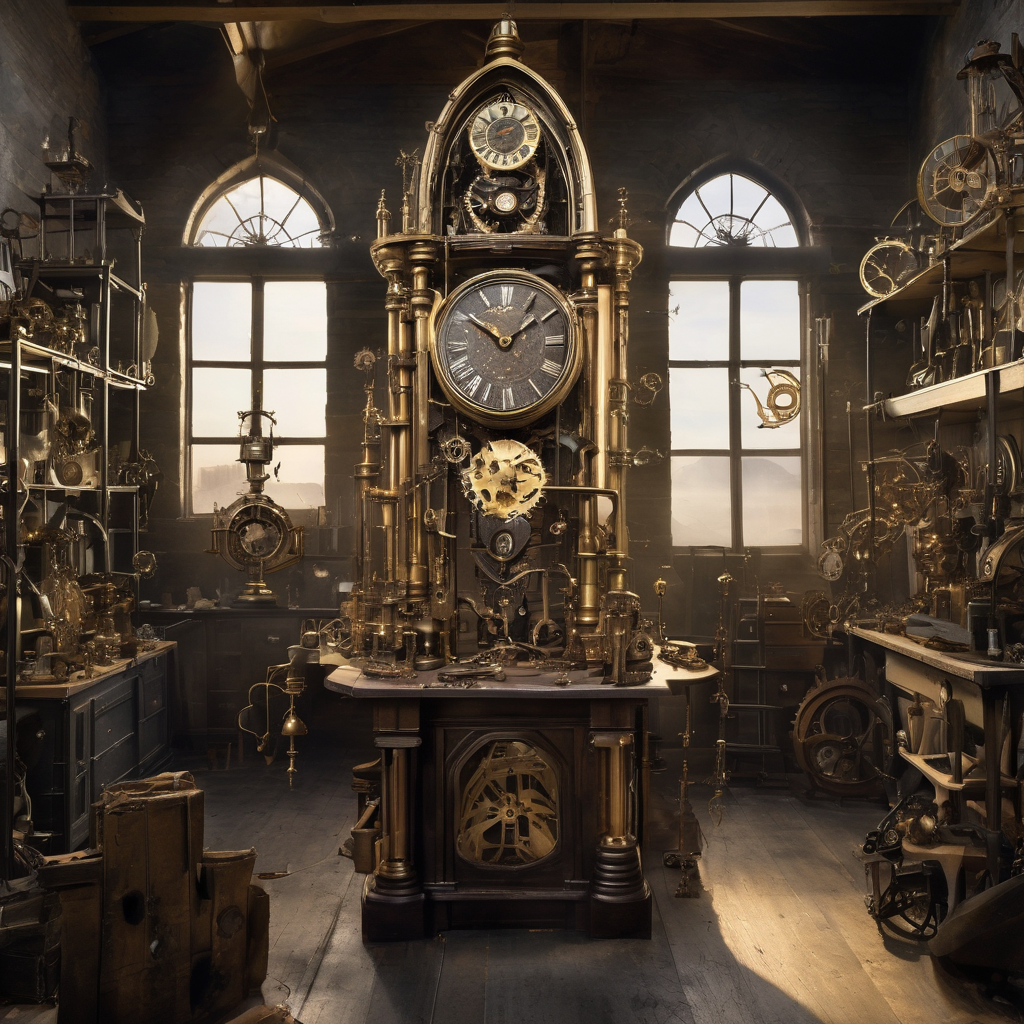
The parish priest found me in the workshop three days after Papa disappeared, surrounded by a thousand frozen timepieces. Each clock face showed 11:47, the exact moment he taught me that time was never what it seemed.
“Child,” Father Benedict said, his voice soft as moth wings, “the constable believes you know where your father has gone.”
I wound the music box on the workbench, its melody playing backward. “Papa didn’t go anywhere. He simply decided to exist elsewhere.”
The priest’s eyes fell upon the unfinished clock at the center of the room—Papa’s masterwork, its gears exposed like metal viscera. Tiny brass bees circled its face instead of numbers, and where the hands should be, two golden keys turned in opposite directions.
“Your father was seen entering the cathedral crypt at midnight,” Father Benedict pressed. “The groundskeeper swears he never emerged.”
I laughed, remembering Papa’s lessons about quantum entanglement, though he never called it that. He preferred “the dance of sister particles,” demonstrating with paired pocket watches that always showed different times yet somehow remained perfectly synchronized.
“Have you heard of the Overtone?” I asked, knowing he hadn’t. No one had, except Papa and me. It was the space between the tick and the tock, where lost time gathered like dust in corners. Papa discovered it while repairing the cathedral’s bell tower clock, when a spring snapped and for one impossible moment, the massive hands moved backward.
The priest crossed himself. “Your father spoke of such heresies. The bishop warned him—”
“The bishop wanted Papa to fix time, not understand it.” I opened the small leather journal Papa left behind, its pages filled with diagrams of impossible clocks. “But Papa learned that every timepiece is a door. Most only open forward. But if you know the secret, if you understand the mathematics of minutes…”
I showed him Papa’s final entry: a drawing of a woman made entirely of clock gears, her heart a pendulum, her eyes two compass roses. My mother, who died when I was seven, frozen at thirty-three.
“He went to find her,” I whispered. “In the Overtone, everyone who ever was still is. The dead are just living at a different speed.”
Father Benedict grabbed my shoulders. “These are dangerous thoughts, child. Your father—”
The workshop door burst open. The constable stood there with his men, their faces grim. “We found him,” he announced. “In the crypt, just as the groundskeeper said.”
My heart stuttered. “But that’s impossible. Papa wouldn’t still be here. He understood the equation—”
“Come see for yourself.”
In the crypt beneath the cathedral, they led me to an ancient stone sarcophagus that had been pried open. Inside lay a skeleton wearing Papa’s clothes, his pocket watch clutched in bleached fingers. But the bones were old, centuries old, and around the skeleton’s neck hung a locket I recognized—one Papa had made for my mother before I was born.
The constable held up a piece of parchment found in the skeleton’s pocket, the ink fresh despite the ancient bones. In Papa’s handwriting: “Time is a circle, not a line. I finally understood this too late. Or perhaps too early. Tell my daughter I found her mother, but we exist now in a place where before and after have no meaning. The clock in my workshop will explain everything, if she has the courage to wind it.”
That night, alone in the workshop, I stood before Papa’s masterwork. The golden keys beckoned. I thought of Officer Newton’s sustainability initiative to preserve the old quarter, of how he fought to maintain things exactly as they were. But Papa taught me that preservation and stagnation were different things entirely.
I turned both keys simultaneously, clockwise and counter-clockwise.
The bees on the clock face began to move, creating patterns that looked almost like words. The exposed gears sang a familiar melody—my mother’s favorite song, but played in a key that didn’t exist in our world. Through the clock’s glass face, I glimpsed them: Papa and Mama, young and old simultaneously, existing in a place where every moment happened at once.
Papa’s voice echoed from somewhere between the tick and the tock: “To join us, you must confess the truth about time to someone who will never believe you. Only then can you step sideways into the Overtone.”
Father Benedict arrived at dawn, finding me still standing before the clock.
“I need to confess,” I said.
He pulled out his rosary. “Tell me everything, child.”
So I told him about the Overtone, about the mathematics of minutes, about how Papa discovered that death was just a different timezone. I told him about the woman made of gears and the space between tick and tock where all lost things waited to be found. I told him how every clock was a door and every door opened both ways if you had the right key.
He didn’t believe a word.
And as his skepticism solidified around my truth like amber around an insect, I felt myself becoming lighter, less synchronized with the world’s ordinary tempo. The workshop began to fade, or perhaps I did.
The last thing I heard was Father Benedict calling for help, saying the clockmaker’s daughter had vanished before his very eyes, leaving nothing behind but a music box playing backward and every clock in the workshop striking thirteen.
But I hadn’t vanished. I had simply decided to exist elsewhere, in the Overtone with Papa and Mama, where the only sustainability that mattered was love, and where time moved in all directions like bees dancing their secret language, forever spelling out the words we never had time to say.

Leave a Reply