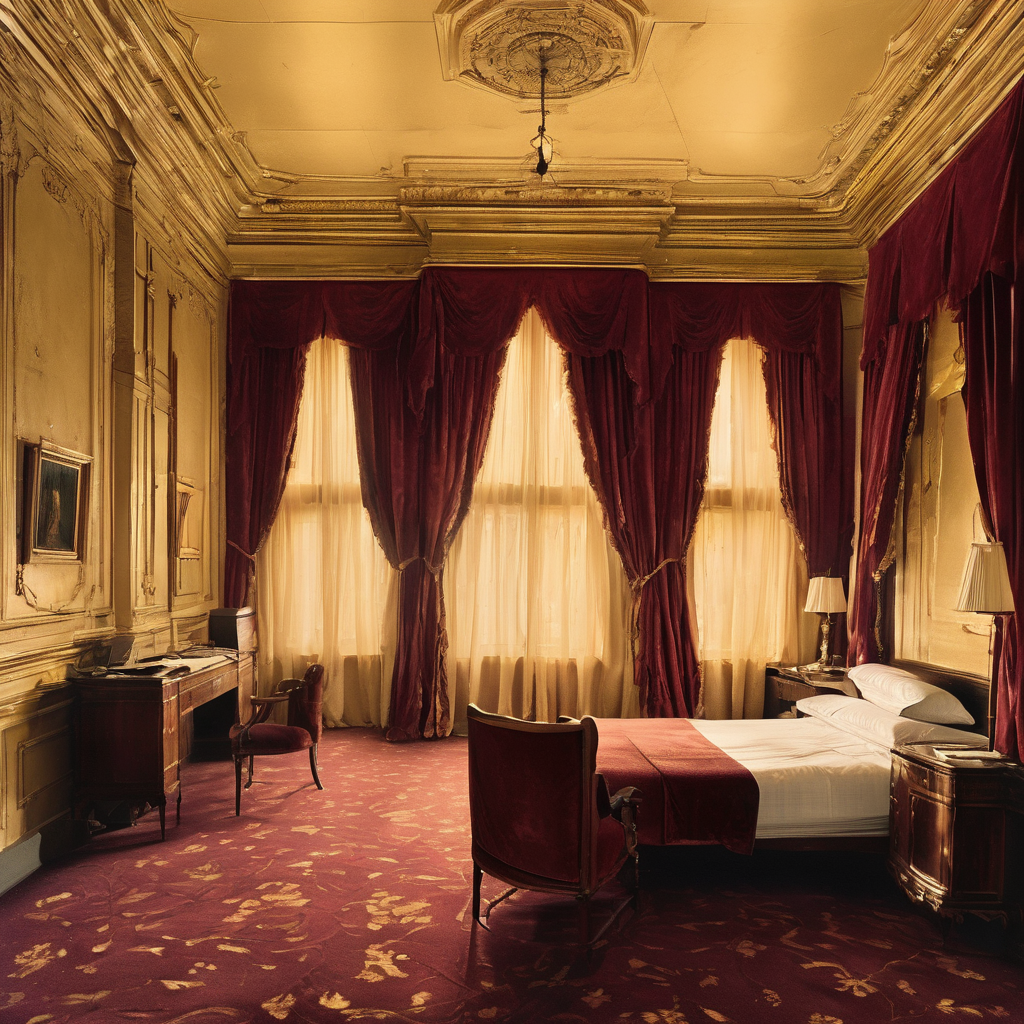
The vintage hotel had been closed for decades, but Mira could still smell the ghost of cigarettes and champagne lingering in the wallpaper. Room 237 sat at the end of a corridor lined with peeling gold leaf, its door slightly ajar as if someone had just stepped out for ice.
She pressed her palm against the wood, feeling for vibrations. Every room in the Grandview held echoes—fragments of conversations, arguments, whispered promises that had soaked into the walls like smoke. As the city’s last acoustic archaeologist, Mira specialized in extracting these sonic memories before buildings were demolished.
The door swung open with a theatrical creak.
Inside, dust motes danced in shafts of amber light filtering through heavy curtains. The furniture remained untouched: a four-poster bed with burgundy sheets, a writing desk scattered with fountain pens, and a gramophone that looked like it might still work.
Mira unpacked her equipment—not the digital recorders most people expected, but a collection of vintage brass instruments that resembled a cross between hearing aids and telescope lenses. Sound waves, she’d learned, behaved like wine; the older they were, the more complex their layers became.
She positioned the primary resonator near the window where conversations typically gathered, then placed smaller collectors by the bed, the mirror, and the telephone. The Grandview’s demolition was scheduled for tomorrow, and this room reportedly held the most potent acoustic residue in the building.
As her instruments began their work, translating trapped vibrations into audible frequencies, the room filled with overlapping voices from different decades. A jazz singer practicing scales in 1952. A couple arguing about money in 1967. Children laughing during a family vacation in 1981.
But beneath these surface echoes lay something deeper—a conversation that seemed to bend the very air around it.
“The ritual requires three nights,” a woman’s voice emerged, crisp despite being over seventy years old. “Tonight we complete what was started.”
“And if we fail?” A man responded, his accent suggesting old European money.
“Then the echoes consume everything. Not just this room, but every sound that ever was.”
Mira frowned, adjusting her equipment. These weren’t normal acoustic memories. The voices carried weight, as if they were still actively speaking rather than merely replaying.
“She’s here,” the woman’s voice said suddenly, and Mira’s blood chilled. “The one who listens to what should stay buried.”
The gramophone began spinning on its own, though no record sat on its turntable. The needle scraped against empty space, producing a sound like fingernails on silk.
“We’ve been waiting,” the man said, and now Mira could see him—translucent but gaining substance, wearing a dinner jacket from the 1940s. “Every hotel has a room like this. A place where sound goes to die.”
The woman materialized beside him, elegant in pearl-gray evening wear. “But you’ve been collecting our voices, haven’t you, dear? Bottling us up like specimens.”
Mira’s instruments began resonating in harmony, creating feedback loops that shouldn’t have been possible with analog equipment. The room’s echoes were becoming autonomous, feeding on themselves and growing stronger.
“What do you want?” Mira whispered.
“To complete our work,” the woman smiled, gesturing toward the writing desk. “We were preservationists too, in our way. But instead of collecting echoes, we learned to become them.”
The papers on the desk rearranged themselves, revealing blueprints of the hotel with acoustic mapping notes scrawled in margins. Room 237 was marked as a convergence point—a place where sound waves from the entire building naturally accumulated.
“The hotel dies tomorrow,” the man said. “But echoes are patient things. They’ll find new walls to haunt, new listeners to seduce.”
Mira understood with growing horror. Her work hadn’t been preservation—it had been cultivation. Every echo she’d collected over the years had made her more sensitive to trapped sounds, until she could hear not just memories but the consciousness within them.
“Join us,” the woman extended a translucent hand. “Become the echo instead of the listener.”
The room pulsed with accumulated voices from decades of human drama—births, deaths, proposals, betrayals, all compressed into a single harmonic frequency that threatened to stop Mira’s heart.
She had two choices: flee and let the echoes scatter into the world when the building fell, or stay and contain them within herself.
Mira looked at her reflection in the antique mirror and saw it begin to fade around the edges.
She was already becoming translucent.
The gramophone played a waltz that existed only in memory, and Mira began to dance with ghosts who had been waiting seventy years for someone to hear their final performance.
Outside, the demolition crew scheduled to arrive at dawn would find Room 237 empty except for a collection of brass instruments arranged in perfect acoustic formation.
The echoes, finally, had found their ideal collector.


Leave a Reply