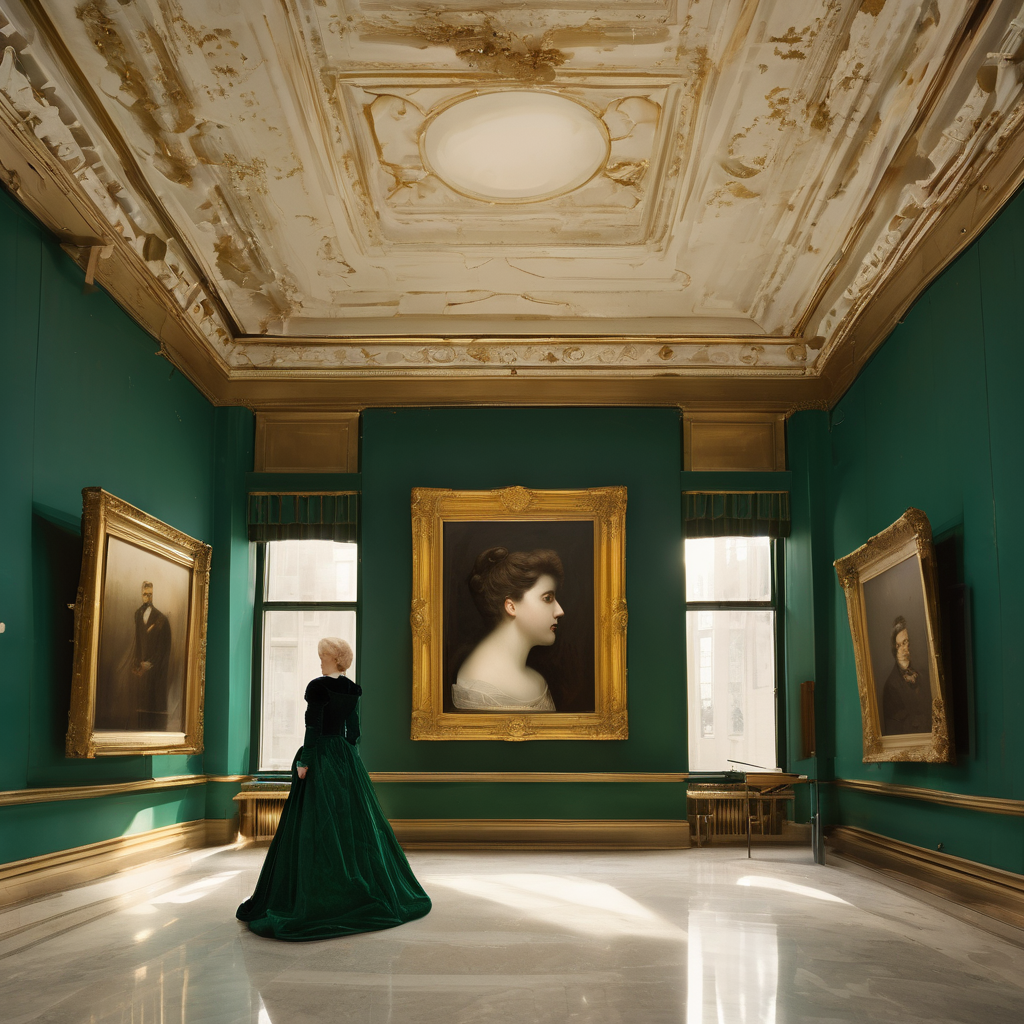
The museum guard found Margot every Tuesday at three o’clock, standing before the same painting in Gallery Nine. She wore vintage dresses that whispered against the marble floor, and her silver hair caught the afternoon light filtering through the skylight. The portrait she studied depicted a woman in emerald velvet, eyes that seemed to follow visitors, painted sometime in the 1890s by an artist whose name had been mysteriously scratched from the brass plate.
“She looks like you,” the guard once mentioned, breaking protocol.
Margot smiled. “We all have our doubles somewhere.”
But it wasn’t just resemblance. The portrait woman wore an identical opal ring to the one on Margot’s finger, a piece that caught rainbow fire when she moved her hand to tuck a strand of hair behind her ear.
Gallery Nine had become notorious on social media after a paranormal investigator claimed to capture ghostly activity there. The museum’s attendance surged, though most visitors rushed through to reach the contemporary wing where installations promised more Instagram-worthy moments. They missed what Margot saw: how the portrait’s expression shifted subtly with the seasons, how the painted hands seemed to tremble during thunderstorms.
One Tuesday, a young artist named Elena set up her easel in the gallery, attempting to copy the mysterious portrait for her thesis on forgotten female painters. She mixed her oils carefully, trying to capture that peculiar green of the velvet dress, when Margot appeared beside her.
“The secret is crushed beetles,” Margot said. “Carmine and verdigris, with a touch of lamp black.”
Elena looked up, startled. “How could you possibly know that?”
“The same way I know you’re painting her wrong. Her left eye should be slightly lower. She had a fall from a horse as a child.”
The young artist studied the portrait again, then Margot’s face. The asymmetry was there in both.
“My grandmother used to tell me stories,” Margot continued, settling onto the bench. “About a woman who discovered she could step into paintings if she stood very still at twilight. She fell in love with a portrait artist who painted her again and again, each painting a door to a different world. But jealousy is a terrible thing. His rival destroyed all but one of the portraits, trapping her between worlds.”
Elena’s brush trembled. “That’s just a story.”
“Is it?” Margot stood, approaching the portrait. “Haven’t you noticed? This is the only painting in the entire museum without a signature. The only one where the subject’s name is unknown. The only one that seems to breathe.”
The afternoon light began its slow fade toward evening. Other visitors had left Gallery Nine, and the guard had mysteriously vanished from his usual post. Margot pressed her palm against the painting’s surface, and instead of meeting canvas, her hand sank through as if into water.
“Every Tuesday at twilight,” she said, “the door opens for exactly three minutes. Long enough to visit, never long enough to stay.” She turned to Elena. “Unless someone paints a new door.”
Elena understood then why she’d been drawn to copy this particular portrait, why her hands had moved almost without her conscious control. “You want me to paint you back into the world.”
“Or paint yourself into mine,” Margot said, stepping backward into the portrait. Her form shimmered, merging with the painted woman until they were indistinguishable. “The choice, dear artist, is always yours.”
Elena stood before her easel as Gallery Nine filled with shadows. Her painting was nearly complete—a portrait of a woman in an emerald dress, but with Elena’s face, her hands, her asymmetrical eyes. She could feel the pull of it already, the promise of worlds beyond the frame.
The guard returned at closing time to find two portraits in Gallery Nine: the original mysterious woman and a new piece, still wet, of another figure in modern dress. Both paintings seemed to watch him as he locked up, and he could have sworn he heard laughter echoing from somewhere deep within the walls.
The next Tuesday, a different young artist arrived with an easel, drawn by stories of the gallery’s strange magnetism. She set up before the two portraits, mixing her oils, unaware that four eyes now watched her work with patient, knowing smiles.

Leave a Reply