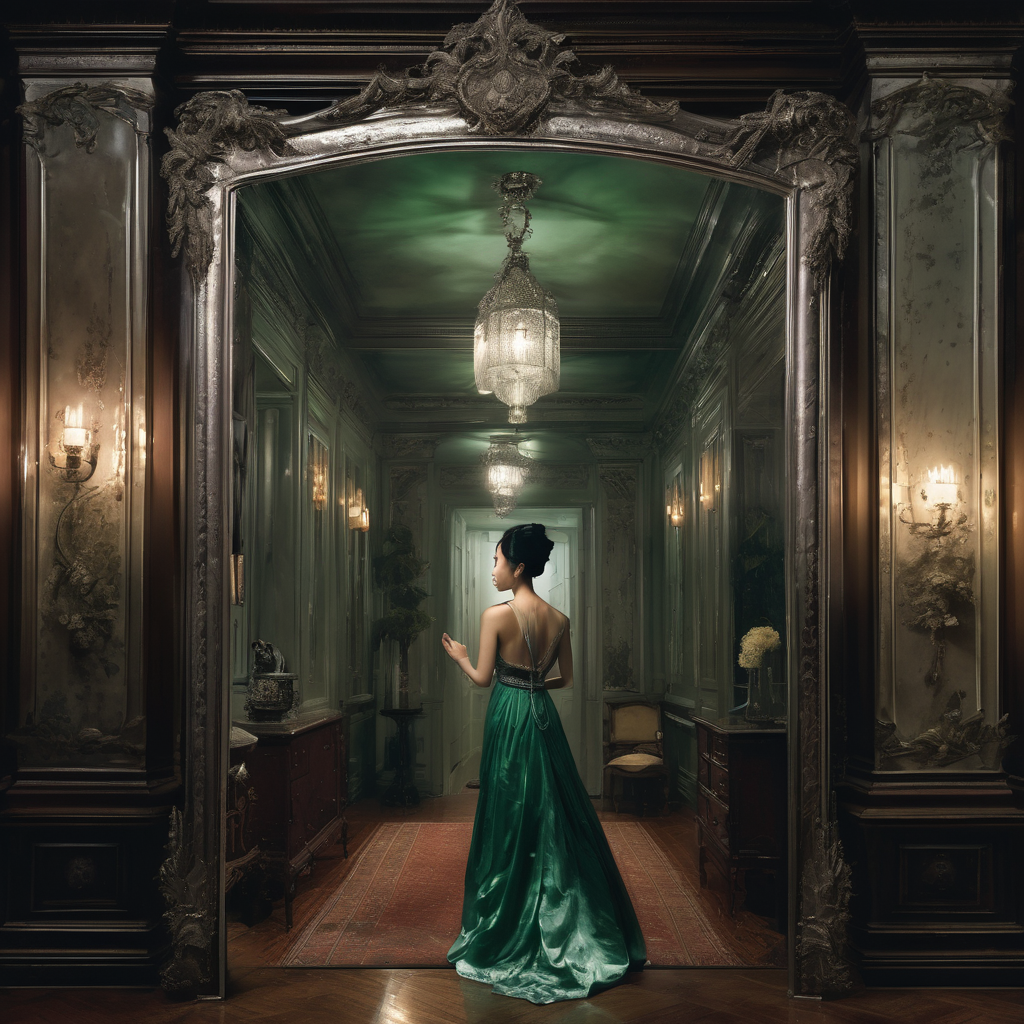
The mirror had been collecting memories for three hundred years, storing them in its silver-backed glass like pressed flowers between pages. It hung in the hallway of the Meridian House, where the sustainability committee now met every Tuesday to discuss the town’s rewilding project, though none of them knew what the mirror truly was.
Esther Chen discovered its nature by accident. She’d been adjusting her earrings before the gala—a fundraiser for resilience training programs—when her grandmother’s jade pendant brushed against the glass. The mirror shuddered, and suddenly Esther wasn’t seeing her own reflection but a woman in a Victorian mourning dress, weeping as she fastened the same jade pendant around her neck.
“Curious,” Esther whispered, touching the glass again.
This time she saw a man teaching his daughter to waltz in 1924, then a couple stealing kisses during a World War II blackout, then a child hiding behind the hall table during a game of hide-and-seek in 1987. Each memory layered over the next like watercolors bleeding together.
The mirror, she realized, was dying.
Marcus, the house’s caretaker and a practitioner of mindfulness meditation, found her there at midnight, both hands pressed against the glass. “It’s transferring them to me,” she said, tears streaming down her face. “Every memory it ever caught. Every reflection it ever held.”
“Why you?”
“The pendant. My great-great-grandmother sold it to pay for passage to America. She stood before this mirror the day she left.” Esther’s voice cracked. “The mirror recognized it.”
As the memories flooded through her—centuries of small moments, private griefs, sudden joys—Marcus watched the mirror’s surface begin to cloud like cataracts forming over ancient eyes. He thought of the committee’s discussions about mental health resources, about community wellness, about the deep ecology of human connection. None of their initiatives could match what this mirror had done: bearing witness, holding space, remembering when no one else would.
“What’s the last one?” Marcus asked as the mirror’s surface went completely dark. “What’s the last thing it remembered?”
Esther’s eyes reflected something Marcus couldn’t see. “Us,” she said. “Right now. You and me, standing here at the ending of its long watch. It wanted someone to know that it had been more than just glass and silver. It wanted someone to remember that it remembered.”
The next morning, the sustainability committee voted to replace the antique mirror with something modern and energy-efficient. But Esther kept the old glass. She hung it in her apartment where it reflected nothing but darkness, except sometimes, when the light hit just right, she could swear she saw the faintest impression of all those accumulated lives still dancing in its depths—a reminder that even broken things can hold wholeness, that even silence can tell stories.
Marcus started a support group that met in the Meridian House hallway, where people shared their family histories beneath the new mirror. But it was just a mirror, reflecting only the present moment, remembering nothing.
Esther never told them about the weight she carried now, the centuries of memory living behind her eyes. She’d become the mirror’s heir, its living archive. At night, she dreamed in sepia tones and gaslight, in Charleston dances and victory gardens, in the whole inherited diaspora of human experience.
The jade pendant grew warm against her skin whenever she passed the spot where the old mirror had hung, as if agreeing: some things are too precious to forget, even when they’re too heavy to hold.

Leave a Reply