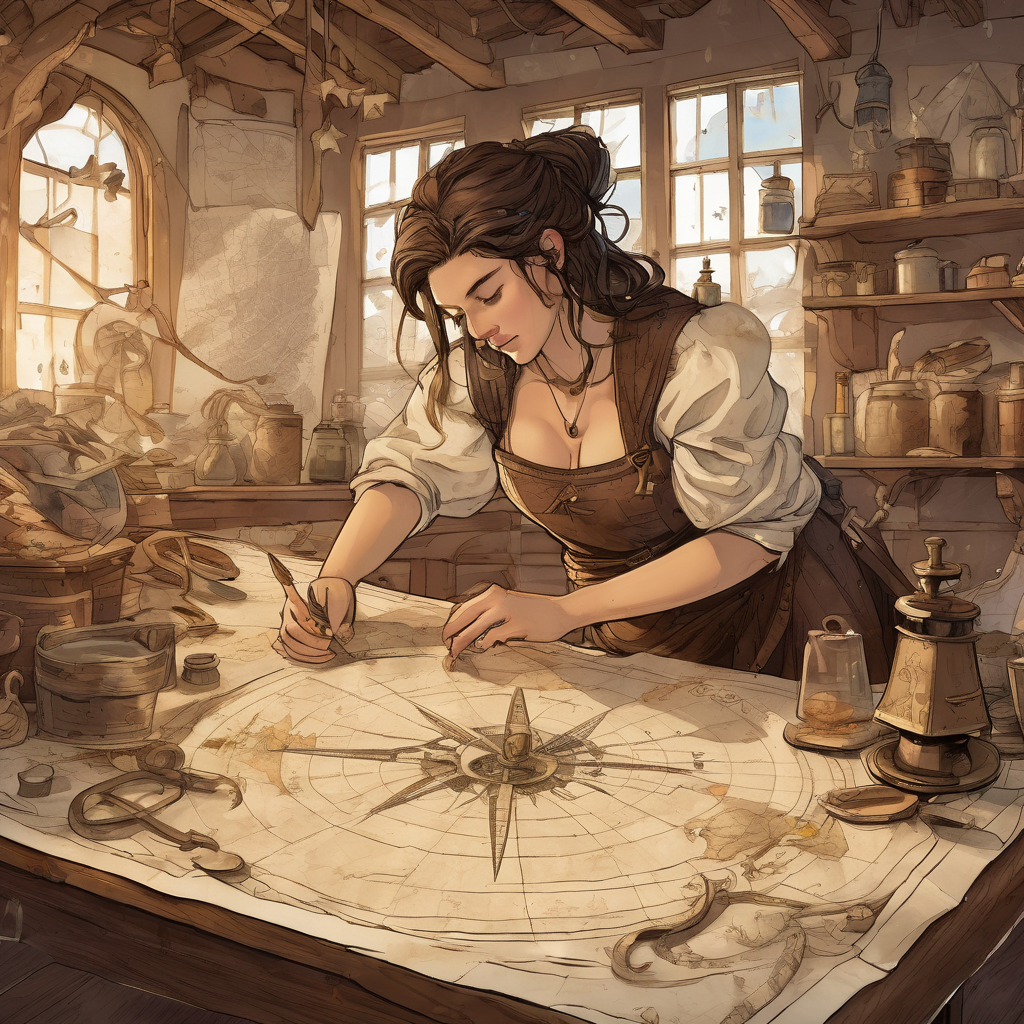
The cartographer’s workshop smelled of vellum and star anise, though Elara couldn’t explain the second scent. Her father had been missing for three moons, leaving behind only his unfinished maps and a note written in dissolvable ink: “The borders are shifting. Trust the tea leaves.”
She’d thought him mad until the morning she discovered her own gift. While sketching coastlines, her hand moved of its own accord, drawing islands that didn’t exist—yet. Within days, merchant ships reported new landmasses exactly where she’d drawn them. The sustainability of such discoveries troubled her. Were these lands meant to be found, or was she forcing the world to conform to her pen?
The bell above the door chimed. A woman entered wearing a dress that seemed to be cut from living shadows, its fabric shifting between purple and black like spilled wine at midnight.
“I need a map,” the woman said, her accent untraceable. “Not of what is, but of what refuses to be.”
Elara’s hand trembled. “I don’t understand.”
“Your father did.” The woman placed a glass vial on the counter. Inside, something like liquid starlight swirled. “He mapped the spaces between spaces, the places where lost things gather. Now those boundaries are collapsing. The old agreements are breaking.”
“What agreements?”
“Between your world and mine. We’ve maintained balance through careful blindness—your people refusing to see us, our people refusing to be seen. But someone has been drawing maps of the invisible territories, making them manifest. Making them vulnerable.”
Elara thought of her recent drawings, the islands that materialized from nothing. “My father would never—”
“Not willingly. But influence takes many forms. Someone whispered coordinates in his dreams, fed him visions disguised as creativity.” The woman’s eyes reflected depths Elara couldn’t fathom. “They seek to create a crisis between realms, to profit from the chaos when hidden things are dragged into light.”
“Who?”
“Those who trade in disruption. Who understand that uncertainty is the most valuable currency.” She gestured to the walls lined with maps. “Every border your father drew was a treaty. Every landmark, a promise. Now someone seeks to redraw the world for their own ends.”
Elara lifted the vial. The liquid inside responded to her touch, forming miniature constellations. “What is this?”
“Your inheritance. Your father spent years distilling it—one drop of truth from every map he ever made. Add it to your ink, and you’ll see what he saw. The real borders. The ones that matter.”
“And if I refuse?”
“Then both worlds suffer. The sustainable balance we’ve maintained for centuries will shatter. Your cities will find themselves sharing space with our forests. Our storms will carry your names.”
That night, Elara added a single drop to her ink pot. The moment her pen touched paper, the workshop transformed. The walls became transparent, revealing a city that occupied the same space but different angles—bridges that arched through solid buildings, gardens that grew downward into the sky, people whose shadows fell upward.
She understood then. Every map was a negotiation, every border a careful compromise between what was real and what was possible. Her father hadn’t disappeared—he’d simply shifted to the other side of the line, trying to hold the worlds apart with his bare hands.
Elara began to draw. Not islands this time, but bridges—structures that could exist in both worlds simultaneously, allowing passage without collision. She drew markets where shadow-cloth could be traded for solid goods, where the influence of one realm could flow safely into another without triggering collapse.
The woman watched from the corner, her dress now reflecting Elara’s lamplight like water. “You’re not like your father,” she observed.
“No,” Elara agreed, adding another bridge to her growing map. “He tried to keep the worlds separate. I’m going to braid them together. Make them stronger.”
“That’s never been tried.”
“Then it’s time someone drew that map.”
As dawn approached, Elara felt the workshop shift, the angles softening, the two versions of the space learning to coexist. Through the window, she glimpsed her father standing on one of her newly drawn bridges, smiling. He raised his hand—a greeting and goodbye combined—before walking toward the horizon where both suns were rising, one solid gold, one shadow-silver.
The bell chimed again. A queue had formed outside—people from both worlds, bringing their own drops of truth, their own impossible territories that needed mapping. Elara dipped her pen again, ready to chart the unmappable, to make peace from paradox.
The borders were shifting, just as her father had warned. But perhaps they had always been meant to.

Leave a Reply