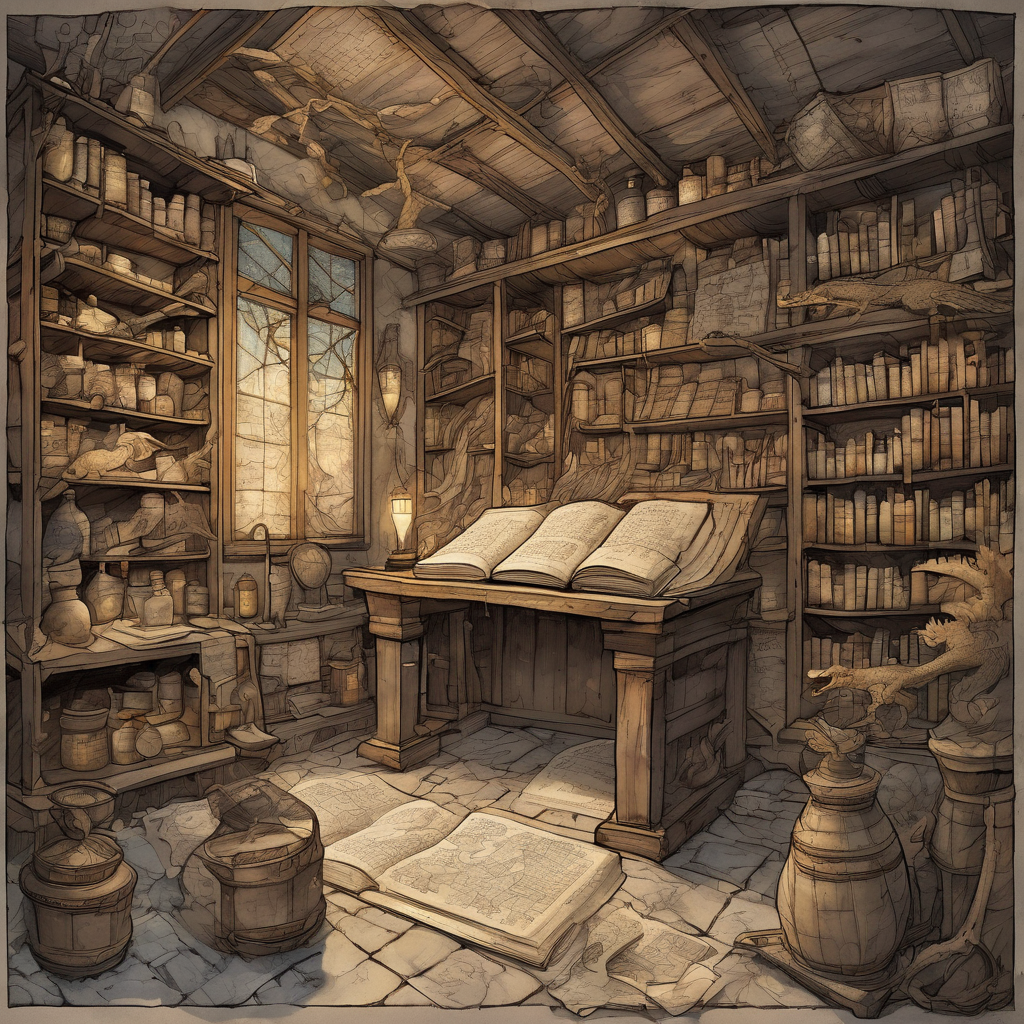
The cartographer’s shop smelled of ink and leather, but mostly of disappointment. Elara traced her fingers along the edge of her father’s final map, its corners already yellowing though he’d only been gone three weeks. The parchment showed the known world in exquisite detail—every mountain range, every river bend—except for the vast white space in the northwest corner where he’d written a single word: “Uncharted.”
“We’re closing,” she called to the gentleman browsing near the window display.
“I’m looking for something specific,” he said, not turning around. His voice carried an accent she couldn’t place, something between aristocratic and ancient. “A map that shows the way to things that aren’t supposed to exist.”
Elara’s hand stilled on the cash ledger. “All our maps show real places, sir.”
“Do they?” He finally faced her, and she saw his eyes were the color of old brass. “Your father didn’t think so. He believed some places only reveal themselves when you’re brave enough to draw them first.”
That night, Elara couldn’t sleep. She lit a candle and retrieved her father’s journals from beneath the floorboards, reading his increasingly frantic entries about “dimensional cartography” and “probability mapping.” The final entry, dated the day before his disappearance, contained only coordinates and a sketch of a door that seemed to shift perspective the longer she stared at it.
By morning, she’d made her decision. Using her father’s notes, she began drawing a new map—not of what was, but of what could be. Her pencil moved almost of its own accord, creating coastlines that shimmered with possibility, forests that breathed with ink-dark life. Where traditional cartographers would mark “Here Be Dragons,” she drew actual dragons, their scales picked out in gold leaf stolen from her mother’s old jewelry box.
The gentleman returned at precisely noon, as she somehow knew he would.
“It’s not finished,” Elara said, gesturing to the map spread across the entire shop floor.
“Maps never are,” he replied, kneeling beside her work. “Your father understood that. Reality is just the first draft.”
As he spoke, the map began to move. The illustrated waves rolled, the tiny trees swayed, and in the uncharted space where her father had left only white, a city began to emerge—crystal spires and bridges made of solidified moonlight.
“He’s there,” the gentleman said softly. “He drew himself into a place that needed mapping. But every cartographer needs an assistant.”
Elara understood then. Her father hadn’t disappeared; he’d simply traveled to a place that didn’t exist until he imagined it. She picked up her finest pen, the one made from a phoenix feather (or so the merchant had claimed), and began to draw a small figure at the edge of the crystal city—a young woman with ink-stained fingers and her father’s determined jaw.
The shop grew quiet. When the landlord came by the next morning to collect rent, he found only empty rooms and a strange map covering the floor, still wet with ink that seemed to move like living things. In the corner of the map, barely visible, two figures walked toward a city that shouldn’t exist, leaving footprints that sparkled like stars.
The landlord rolled up the map, meaning to throw it away, but something stopped him. Instead, he hung it in the window, where it remains to this day, though the shop has long since become a café. Sometimes, customers swear they can see the figures moving, drawing new territories into being with every step. The barista, who’s worked there for fifteen years, just smiles and offers them another espresso.
“Maps are funny things,” she always says. “They don’t just show you where to go—sometimes they show you where you already are, even if you haven’t arrived yet.”
And in the northwest corner of the map, if you look closely on rainy Tuesday afternoons, you can just make out new additions appearing: a bridge made of whispered secrets, a lake that reflects not your face but your dreams, and two small figures, still walking, still drawing the world into existence one impossible line at a time.


Leave a Reply