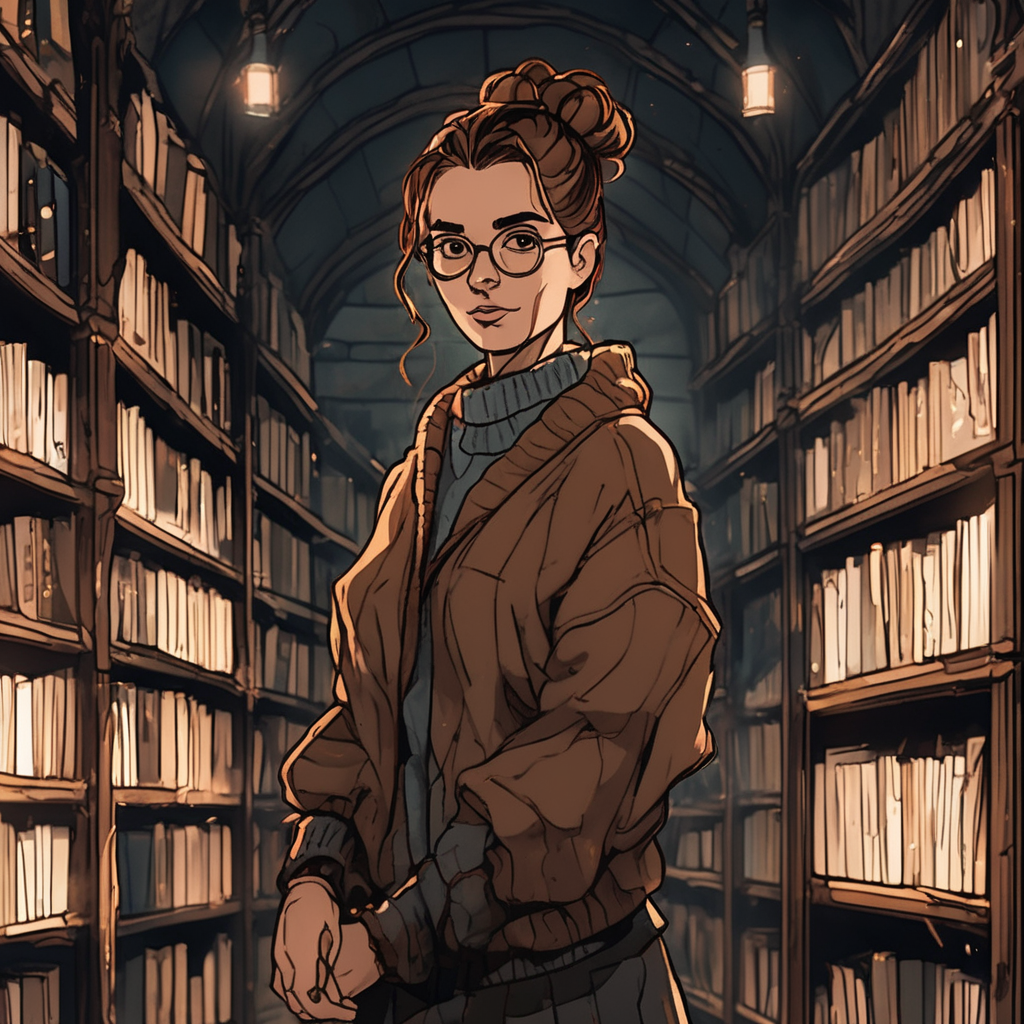
The university’s library was a place of managed decay. Dust motes, ancient and pedigreed, danced in the slivers of light piercing the stained glass. For Elara, who was deep in the throes of an academic burnout so profound it felt like a religious cavern, the library’s gloom was a comfort. She was Faking It. Not Making It. Her dissertation on forgotten 18th-century poets had stalled, and her participation in seminars had dwindled to a form of quiet quitting, her silence a tiny, embroidered rebellion.
Her advisor, a man whose kindness was rivaled only by his obliviousness, suggested she browse the sub-sub-basement archives. “For inspiration!” he’d boomed. So here she was, in a place that smelled of paper turning back into earth, running her fingers along spines of books that hadn’t been checked out since the invention of the telephone.
That’s when she found it. A slim volume of verse by a poet so minor he was a footnote in someone else’s biography. The book fell open to a page, and in the margin, a furious script in faded iron gall ink. *He has the constitution of a damp tea towel and yet the world lays itself at his feet.*
Elara smiled. A flicker of kinship. She turned another page. A different hand, this one delicate and looping. *To be in his presence is to feel the sun, and to be out of it is to know only shadow. Am I sick?*
She slammed the book shut, her heart thumping. It wasn’t the words. It was the feeling that had bled from them. The first note had transmitted a jolt of pure, spiteful envy. The second, a wave of lovesick nausea so potent she felt her own stomach swoop.
This became her new obsession, her new era. She abandoned her forgotten poets for the forgotten readers. Her apartment, once tidy, descended into a comfortable state of goblin mode, dishes in the sink and books covering every surface. She was hunting. The official histories in the library were a form of disinformation, she realized, telling sanitized tales of great men. The truth was here, scribbled in the margins.
She learned to identify authors by their emotional residue. There was “The Baron,” whose notes on military strategy pulsed with an arrogant energy, the 18th-century equivalent of what the kids in her department called main character energy. She found a tragic back-and-forth between two lovers, an entire situationship playing out over a copy of *Don Quixote*, each note a breadcrumb of hope or despair. She felt their hope, their longing, and in one particularly scathing entry about a man’s cloying laugh, a visceral jolt of the ick that spanned two centuries.
Her academic rival, Julian Thorne, would sometimes see her in the stacks. Julian, whose father was a department chair and whose path was paved with gold. A true nepo baby. He possessed a kind of effortless charisma, a natural rizz that made professors swoon and peers supplicate. Elara hated him with the focused passion of a thousand margin-scribblers. He’d nod at her, a pitying look on his handsome face, before gliding off to his next triumph. Once, she saw him through the library window, laughing with his girlfriend, a girl wrapped in a coat of such shocking, unapologetic pink it was pure Barbiecore in a world of tweed and mud-brown. The sight was so alien it felt like a broadcast from another planet.
She found a whole series of books annotated by a woman named Isolde. Isolde was brilliant. Her notes on Newtonian physics were sharper, more insightful than the printed text. But her tone curdled over time. She wrote of a colleague, a “Mr. S.,” who took her ideas, presented them as his own, and was lauded for his genius. *To believe he will ever give me credit is a dizzying delusion,* Isolde wrote, her script a barely controlled tremor. *He speaks of our ‘collaboration’ but it feels more like a supply chain, my thoughts mined and shipped for his profit.*
Elara tracked down Mr. S.’s published treatise. It was celebrated. It was foundational. And it was all Isolde.
The final book in Isolde’s trail was a thin almanac. Elara found it wedged behind a loose stone in the archive wall. There was only one annotation, on the page for the winter solstice. The ink was nearly black, the pressure of the nib having almost torn the page. It wasn’t a sentence. It was a sigil, a knot of lines and symbols, and below it, a single word: *Enough*.
As Elara’s fingers traced the character, the room went cold. The dusty air grew thick, not with envy or love or contempt, but with a feeling that had no name. It was the weight of a life stolen, the density of a voice silenced, the sheer, crushing gravity of injustice. It wasn’t Isolde’s feeling. It was Isolde. The echo had become a presence. The feeling poured into Elara, a horrifying, invigorating transfusion of will. It straightened her spine. It cleared her head. The burnout evaporated, replaced by a cold, clean fire.
She closed the almanac, the accumulated weight of another’s resolve now resting in her own hands. She walked out of the sub-sub-basement, leaving the dust and decay behind. Julian was holding court by the main circulation desk. He saw her approach and smiled his easy, patronizing smile.
Elara didn’t smile back. She held his gaze, and for the first time, he was the one who looked away. She walked past him, a new annotation already forming in her mind, and pushed open the great oak doors, stepping out into the biting wind of the present.


Leave a Reply