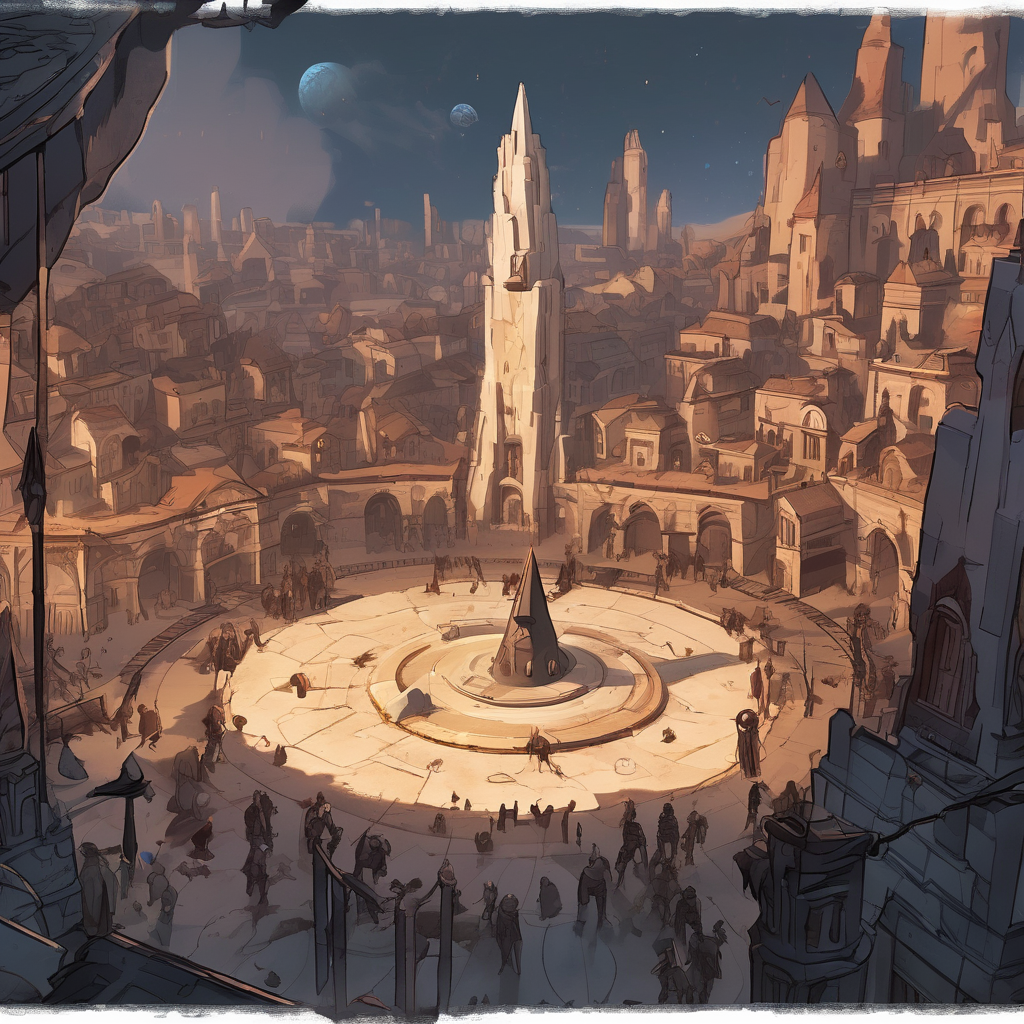
The sun had not moved in three generations. It hung perpetually above the western hills, a smoldering ember caught in an amber sky, casting the town of Aethelburg in an eternal late afternoon. At the center of the town, in the heart of the circular plaza, stood the reason: the great gnomon, a spire of obsidian that clawed at the motionless sky. Its shadow, a stark, unmoving spear, fell across the cobblestones, pointing forever at the numeral for four.
Elian was the only one who still cleaned the brass numerals of the great sundial. The other townsfolk had long since accepted the Great Stillness. They had made a life in the twilight, a cozy, predictable existence where bread always took the same amount of time to bake and the moss on the northern walls never deepened its shade of green. They called it the Era of Peace. Elian called it a cage.
His days were spent in the town archives, a place thick with the scent of decaying paper and dust. He was engaged in a kind of historical doomscrolling, sifting through crumbling accounts of the time before. He’d learned of the Sorrowing, a cataclysmic period when emotions ran so high they manifested as physical storms. The final, terrible event was said to have been an atmospheric river of pure grief that threatened to wash the world away. It was then that an ancient Astromancer had climbed the gnomon and stilled the sun, freezing time to save them.
The rest of the town had quiet-quitted on history. They preferred their gentle, muted reality. To them, Elian was an oddity. “Such delulu thinking,” Elder Maeve would say, her fingers weaving the same placid pattern in a tapestry she’d been working on for fifty years. “He wants the chaos back.”
Only Lyra understood, though she did not agree. She was a creature of the stillness, cultivating phosphorescent fungi in the permanent shade behind the tailor’s shop. She moved with a slow grace, her pockets full of spores and soil. She possessed a quiet rizz, a gravity that pulled you into her strange, fungal world.
“You see decay,” she told him once, holding up a mushroom that pulsed with a soft, blue light. “I see a new kind of life. A different kind of growth.” She was in her element, her own goblin mode embraced and perfected, finding beauty in the oddities the stillness had wrought.
But Elian saw the truth. The apples in the orchards were waxy and tasteless. Laughter was thin. No one fell truly, deeply in love anymore because there was no urgency, no sense of fleeting moments to be seized. He felt a burgeoning main character energy, a maddening conviction that he was the only one who could unmake this placid prison.
One evening—for it was always evening—he found it. A hidden passage in the Astromancer’s own journal, describing a keystone of crystallized starlight embedded at the tip of the gnomon. Shattering it would release the sun. But it came with a warning: “To break the Silence is to invite the Storm.”
He didn’t care. A storm was better than this profound nothingness.
He began his climb under the jaundiced glow of the unmoving sun. The obsidian was cold and slick. Halfway up, Lyra’s voice drifted from below.
“Elian, don’t! This is our home. It’s safe.”
“It’s a tomb, Lyra!” he shouted back, his voice echoing in the unnerving quiet. “We’re not living, we’re just… waiting.”
He reached the top. The town was a perfect miniature below him, a diorama of arrested time. At the very tip of the gnomon, nestled in the stone, was a gem that did not reflect the amber light but seemed to drink it. It was the heart of the stillness. He pulled a geologist’s hammer from his belt.
“Think of the stories you read!” Lyra cried, her voice strained. “The atmospheric river! You’ll drown us all in sorrow!”
He hesitated, a new kind of fear—not of the past, but of his own conviction—seizing him. He looked down at her, her small figure framed by the pulsing blue glow of the fungi she’d brought with her. Her world was real, too.
But his world, the one of sunrises and sunsets, of seasons and change, was the one that had been stolen. With a cry that was part grief and part hope, he swung the hammer.
The sound was not loud. It was a single, crystalline *tink*, like a star breaking. For a moment, nothing happened. The amber sky held. The spear of a shadow remained fixed. A collective sigh of relief, or perhaps disappointment, rose from the small crowd that had gathered. Elder Maeve shook her head at his foolishness.
Then, a groan. A deep, grinding protest from the very bones of the world. The shadow on the plaza trembled. It slid, inch by agonizing inch, from the numeral four. The edge of the sun, for the first time in living memory, dipped below the crest of the hill.
A gasp went through the crowd. Colors they had only read about began to bleed into the sky: deep oranges, then violet, then a bruised and brilliant crimson. The silence was broken, replaced by the hushed whispers of the townsfolk and the slow, undeniable sound of the world turning once more.
Lyra looked up, her face bathed in the dying light. The blue glow of her fungi seemed to pale in the face of the oncoming night. She looked at Elian, high above, a dark silhouette against a sky in motion. He hadn’t brought back the storm. He had brought back the dark. He had brought back the promise, terrifying and beautiful, of a dawn.


Leave a Reply