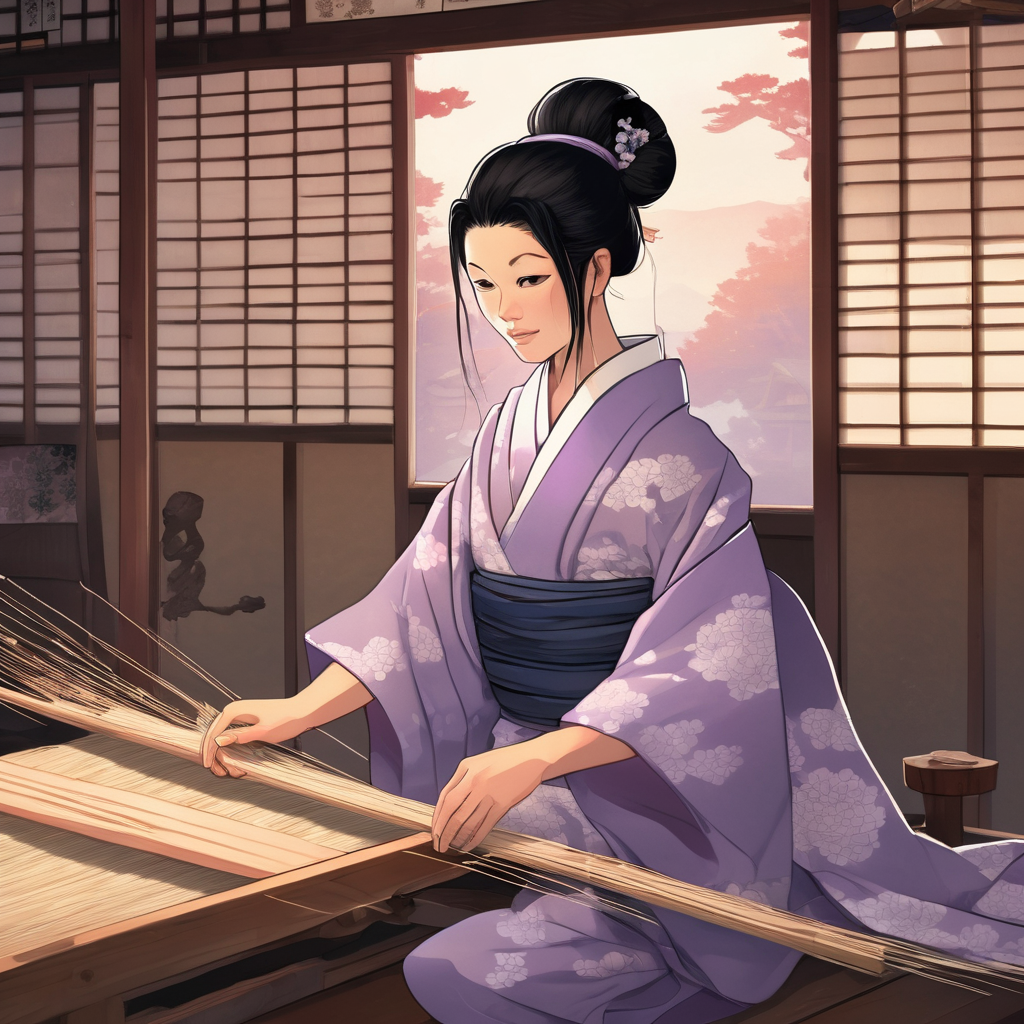
In the heart of Kyoto’s Gion district, where traditional tea houses lined the narrow streets and the scent of cherry blossoms lingered, a young woman named Emiko wove silken fabrics as vibrant as the city’s neon lights. Her hands moved deftly over the loom, the threads dancing beneath her fingers as she created a breathtaking kimono adorned with delicate peonies, a symbol of good fortune and prosperity.
As she worked, Emiko’s thoughts drifted to her mother, a renowned silk weaver who had taught her the intricacies of the craft. Her mother had passed away, leaving Emiko to carry on the family legacy, and though the grief still lingered, it was tempered by the joy she found in weaving.
One evening, as the sun dipped behind the city’s rooftops, Emiko received an unexpected visit from a mysterious stranger, who introduced himself as Hiro. He was tall, with piercing eyes that seemed to see right through her, and wore a simple yet elegant kimono that caught Emiko’s attention.
Hiro revealed that he was a collector of rare and exquisite fabrics, and had heard about Emiko’s remarkable weaving skills. He requested that she create a kimono for his sister, a bride-to-be who desired a garment as unique as she was.
Intrigued by Hiro’s enigmatic presence and the challenge he presented, Emiko accepted the commission. As they discussed the details, she learned that Hiro’s sister was a free-spirited artist, with a love for minimalist chic and a passion for social justice.
Emiko poured her heart into the kimono, selecting threads of silver and lavender, and intricate patterns that evoked the city’s hidden gardens. When she finished, the garment was a masterpiece, a testament to her mother’s legacy and her own creativity.
As Hiro collected the kimono, Emiko felt a sense of pride and accomplishment, knowing that her work would be worn on a special day. Their eyes met, and for a moment, she thought she saw a glimmer of connection, a spark of understanding that went beyond mere client and weaver.
In the days that followed, Emiko found herself wondering about Hiro, and the sister he had spoken of. She began to weave again, this time creating a fabric that captured the essence of Kyoto’s hidden alleys and secret gardens, a tribute to the city and its people.
As the threads came together, Emiko felt her mother’s presence guiding her, urging her to follow her heart and pursue the beauty that lay within and around her. And when she looked up, she saw Hiro standing in her doorway, a small smile on his face, as if he had been drawn to her craft, and to her, all along. In Kyoto’s Gion district, the cherry blossoms bloomed, filling the air with sweetness, as Emiko’s hands began to weave a new story, one that would intertwine with Hiro’s, in the city’s ancient, mystical fabric.
By
The Silk Weaver’s Daughter of Kyoto
Share
Tags
Get updated
Subscribe for your daily dose of short stories delivered straight to your inbox.
Your message has been sent

Leave a Reply