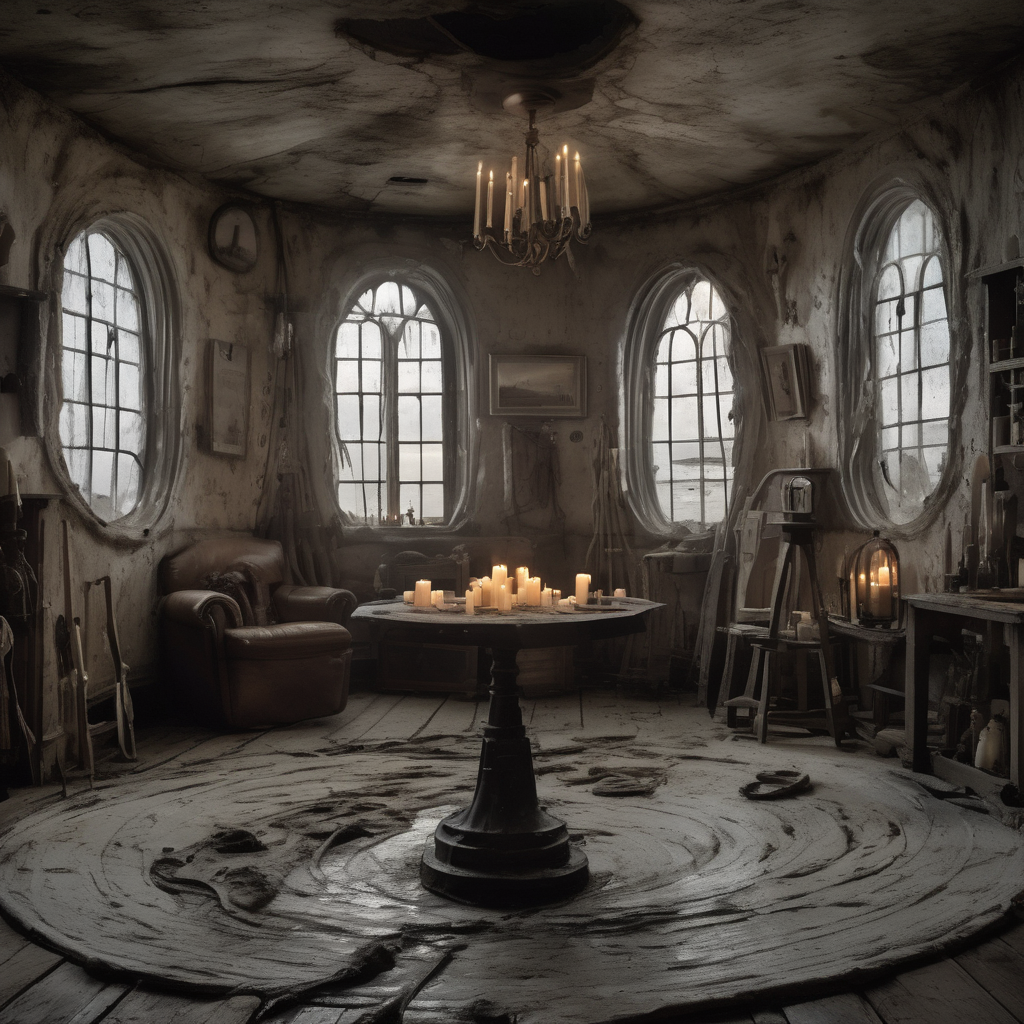
Marina inherited the lighthouse on a Tuesday, which everyone in the village agreed was the worst possible day to inherit anything. The solicitor handed her the brass key with visible relief, as if it had been burning his palm for the past seventeen years since her great-aunt Thessaly disappeared.
The lighthouse stood at the edge of everything—where the cliffs met the sea, where the sea met the sky, where reality grew thin as old linen. Marina had visited once as a child, remembered Thessaly serving tea that tasted of salt and secrets, remembered the walls humming with something that wasn’t quite electricity.
Now, standing in the circular living room, Marina heard it again. A grinding, growing sound, like molars pushing through stone. She pressed her ear to the wall and pulled back immediately. The sound was clearer there, accompanied by a warmth that shouldn’t exist in abandoned plaster.
The first night, she lit every candle she could find—Thessaly had never trusted the mainland’s power lines. In the flickering light, she noticed the walls were covered in pencil marks. Not random scribbles but careful notations: dates, measurements, names of bones. Thessaly had been tracking something’s growth.
By the third night, Marina discovered the pattern. The sounds followed the tide but ran counter to it. When the water retreated, the walls grew louder, more insistent. She began leaving offerings—milk in saucers, honey on windowsills—following an instinct she couldn’t name.
The breakthrough came when she found Thessaly’s journals hidden in the lamp room. Her great-aunt hadn’t disappeared; she’d transformed, become part of something older than the lighthouse itself. The building wasn’t built on the cliff—it had grown from it, a tooth in the earth’s own mouth, and Thessaly had been its guardian, then its food, then its voice.
Marina understood then why the inheritance had to happen on a Tuesday, the day sacred to Mars, god of boundaries and borders. She was meant to choose: feed the lighthouse what it needed or become what it needed.
The walls grew louder, more insistent. Through the window, she watched the tourism board’s demolition notice blow away in the wind. They wanted to build a resort here, wanted to extract every drop of value from the cliff’s edge view. They didn’t know what they would wake.
Marina made her choice. She mixed her blood with whitewash, painted sigils Thessaly’s journals had taught her. The lighthouse shuddered, pleased. The sound in the walls shifted from grinding to purring, a massive cat settling into sleep.
She would stay. She would guard. And when the developers came with their environmental impact studies and their profit projections, she would explain that some hungers were older than market forces, that some structures grew from needs deeper than human ambition.
The lighthouse kept its tooth-sound gentle now, a lullaby for its new keeper. Marina learned to love the noise, the way it promised that something vast and patient waited just beyond the thin places, grateful for her care. She began her own journal, tracking the growth, the patterns, the slow emergence of whatever dreamed inside the walls.
On Tuesdays, she served tea that tasted of salt and secrets, though no one from the village would visit anymore. They knew better than to disturb what grew at the edge of everything, where the boundaries blurred and the old agreements held.
The walls sang their grinding song, and Marina sang back, two voices holding the line between the world that was and the world that waited, patient as teeth, to emerge.


Leave a Reply