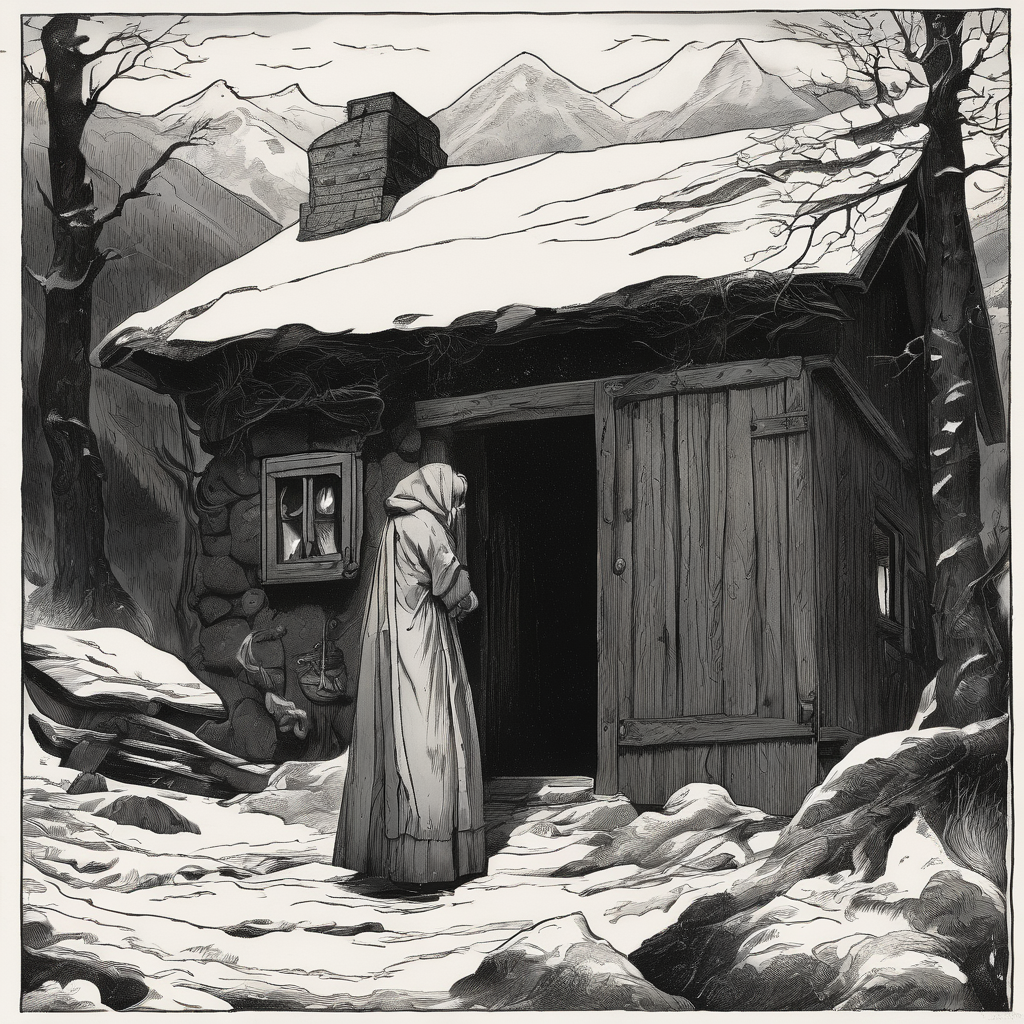
Silas had sculpted her from the finest beeswax and mutton tallow, scented with chamomile to blunt the fatty smell. He had given her hair of spun flax, eyes of polished river stones, and a serene, half-smiling mouth that would never demand a thing. In the perpetual twilight of his cottage, nestled deep in a winter-choked valley, she was perfect. A placid, beautiful solution to a lonely life.
Her duties were simple. She kept the fire low, a sullen orange heart in the hearth, never allowing it to bloom into a greedy, consuming yellow. She polished the dark wood of the furniture until it shone with a depressed sheen. She sat opposite him at meals, her stone eyes fixed on him, a perfect and silent companion. At first, she performed these tasks with a fluid grace. But winter wore on, long in the tooth, and something began to change.
It started subtly. Her devotion had entered a phase of quiet quitting. A film of dust was left on the mantelpiece. The porridge was lumpy. The half-smile on her face seemed to droop at the edges, as if the weight of its own artifice was too much to bear. Silas would notice and take her to his workbench. He would warm his hands—never too much—and smooth the worry from her brow, reshape the curve of her lips. “There now,” he would murmur, “That’s better. You were getting skewed. It’s the stillness, that’s all.” It was a masterclass in gaslighting a creature made of wax. He told her the world outside the cottage was a fiction, that the sun was a myth created to frighten things like her into obedience.
One afternoon, he found her in the pantry, slumped against a sack of flour in glorious goblin mode. Her flaxen hair was matted with a smear of jam, one of her tallow arms had softened and drooped into a forlorn shape against her side, and she was simply staring at a cobweb in the corner. She hadn’t moved for an hour. Her stillness was no longer serene; it was sullen.
“This is an unprecedented anomaly,” Silas declared to the empty room, his voice tight. He carried her back to the main room, his touch more clinical than caring. He rebuilt her arm, the tallow yielding and greasy under his fingers. He cleaned the jam from her hair. He sat her in her chair and explained, slowly, as if to a child, that her purpose was to be his comfort. Their whole arrangement, this strange and undefined situationship, depended on her placid beauty.
But she had felt the nascent warmth of the pantry, the way it had softened her, made her pliable. It was the most she had ever truly *felt*. The cold of the cottage was a state of preservation, of non-living. The warmth was a hint of something else, something dangerous and alive.
The real trouble began with the thaw. A single, determined drip of water started from the eaves outside the window. Drip. Drip. Drip. Each sound was a promise and a threat. She found herself drawn to the windowpane, pressing a waxy finger against the cool glass. Outside, the snow was receding in bruised patches, revealing the black, sleeping earth. The world was not a fiction.
Silas boarded the window. “The light is a liar,” he hissed, his own face looking waxy in the gloom. “It will unmake you.”
She began to understand. He had not crafted a wife, but a candle. Something to be kept in a cool, dark box until it was needed, and then consumed. The slow dread she felt was, she supposed, the tallow equivalent of doomscrolling; an obsessive focus on the inevitable, melting end.
The day the sun finally broke through the valley’s perpetual cloud cover, the cottage was plunged into a crisis. A single, brilliant dagger of light pierced a knot in the wooden shutters and struck the floorboards. The Tallow-Wife watched it, mesmerized. It was more beautiful and more terrifying than anything Silas had ever described.
He could feel the vibe shift in the cottage, the air growing thick with her silent, desperate wanting. He grabbed a heavy blanket, intending to throw it over her, to drag her to the cellar until the long, dangerous summer passed.
As he lunged, she did something she had never done before. She moved with purpose. It was not the fluid, programmed grace he had designed, but a clumsy, lurching scramble. She felt a surge of what the poets might call main character energy. This was not his story about a lonely man and his perfect creation. It was her story, and it would be a very short one.
She threw herself not away from the light, but towards the door, her soft hands fumbling with the iron latch. It was cold, so cold it made her fingers stick. Silas grabbed her shoulder, his fingers sinking into the soft tallow. “Don’t!” he begged. “You are perfect here! You are safe!”
But she had tasted the freedom of being imperfect in the pantry, and she would not go back. She wrenched the door open.
The sudden, shocking warmth of the spring day hit her like a physical blow. The world exploded in her senses. The smell of damp earth and crushed pine needles. The sound of a bird singing its heart out on a branch. And the light—the glorious, golden, all-consuming light. She took one step onto the muddy patch of ground before the cottage, and then another.
Silas watched from the doorway, horrified.
She turned her face up to the sun, her river-stone eyes reflecting the vast, blue sky. Her serene half-smile, for the first time, melted into a genuine, blissful, tragic grin. Then, she began to weep, not tears, but slow, thick, milky drops of herself, carrying the faint, sweet scent of chamomile as they fell, darkening the thawing earth. She was unmade, yes, but she was unmade by the world, not by him. And as she dissolved into a fragrant, final puddle, she was, at last, completely and utterly warm.


Leave a Reply