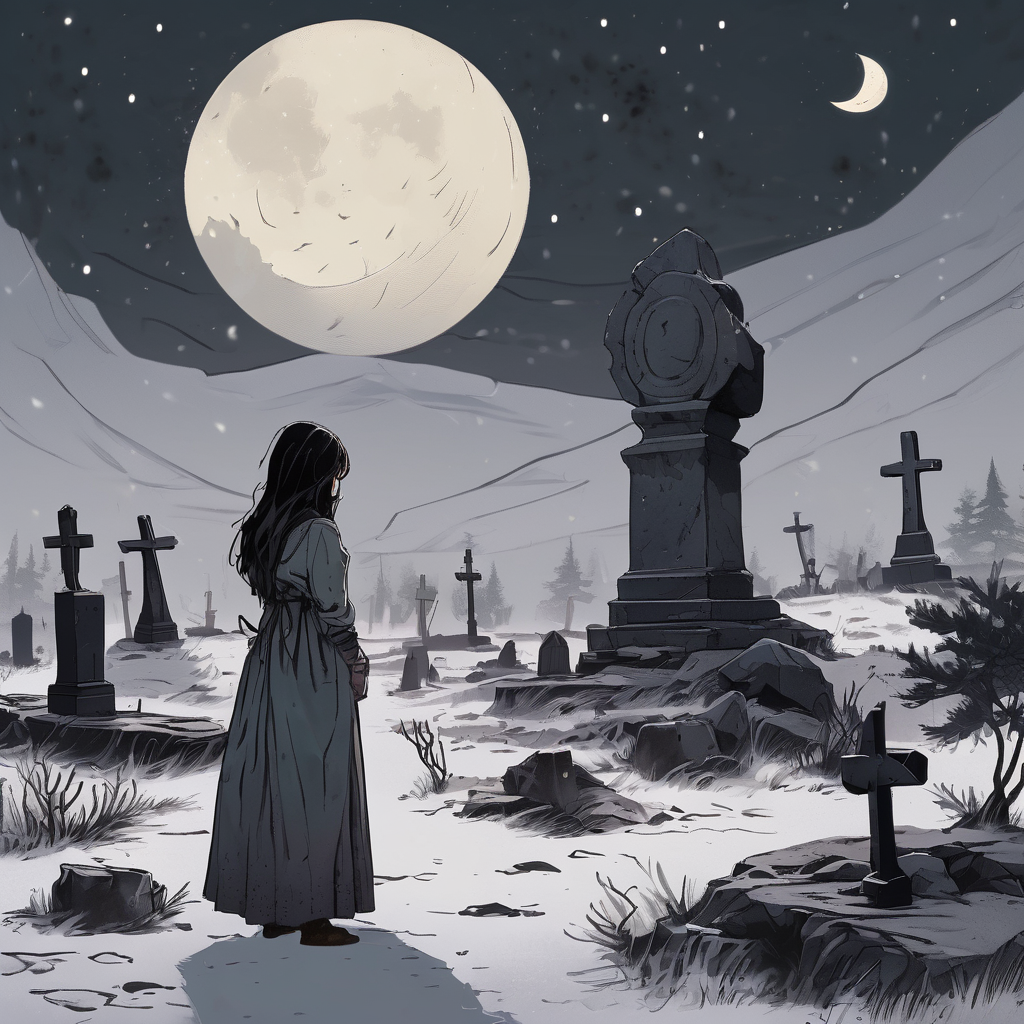
The day we buried Old Man Hemlock, the wind was a thief. It snatched hats from mourners’ heads and prayers from the Parson’s lips. And in the breathless, chaotic moment when the first shovelful of consecrated dirt was tossed, it stole something from me.
We didn’t bury Hemlock’s shadow with his body; that wasn’t the custom. A body was just a vessel. The shadow was the stubborn stain of a life, and it had to be laid to rest separately in a shallow, sunless pit of its own beside the grave. This was meant to anchor the spirit, to keep it from wandering. As the men lowered the dark, shimmering cloth they’d captured Hemlock’s shadow in, the wind gusted so fiercely that the pines shrieked. Shadows everywhere writhed and merged—a tangled, panicked dance of darkness. I stumbled, my own shadow flickering and stretching until it overlapped with the shape spilling from the burial cloth.
For a heartbeat, all was chaos. Then, stillness. The men finished their work. My brother, Silas, took my arm, his face a mask of dutiful grief. No one noticed. But I felt it instantly. A cold weight had tethered itself to my heels.
It was wrong. My own shadow had always been a quiet companion, a slim, dark echo that knew the rhythm of my walk, the tilt of my head. This new one was heavy. It smelled of damp soil and secrets. When I walked, it dragged, a sullen, resentful thing. It was longer than it should be, gnarled like Hemlock’s own arthritic fingers.
In the weeks that followed, I faded. People said I was mourning too hard for a man I barely knew. But it wasn’t grief. I’d lost what the city folk who summered here called my *main character energy*. I, who had always led the harvest songs, now sat silent. I, who had always worn bright ribbons in my hair, now forgot to brush it. The world felt muted, as if I were watching it through a dusty window.
My new shadow had, in its own way, *quietly quit*. It performed the basic functions—it was dark, it was attached to me—but with a profound lack of commitment. When I raised my hand to wave, it would lift a fraction of a second too late, its form sluggish and misshapen. It refused to dance. It lay stubbornly still while I wept. This unspoken, unwanted intimacy, this *situationship* with a dead man’s shade, was unraveling me.
“It’s just a shadow, Elara,” Silas would say, his voice gentle but firm. “You’re tired. You’re imagining things.” He’d started to *gaslight* me, I thought, though the word felt too sharp and modern for our sleepy valley. He was just trying to soothe what he saw as a grief-addled mind. He told our aunt I was being a bit *delulu*.
I descended into an unapologetic *goblin mode*. My cottage, once tidy, became a den of discarded clothes and unwashed dishes. I didn’t care. My only obsession was the patch of darkness at my feet. At night, I would light a single candle and just stare at it, watching the way it refused to flicker with the flame. It was a strange sort of *doomscrolling*, staring into the dark patch that clung to me and seeing only echoes of another’s sorrow—the loneliness of Hemlock’s long, quiet life.
A subtle *vibe shift* had settled over the valley, too. Milk soured quicker. The birdsong seemed more frantic. A nervous energy hummed just beneath the surface of our days, an unspoken sense that something was out of balance. They had anchored the wrong thing. My shadow—my true, light-footed shadow—where was it? Was it trapped in the earth with Hemlock’s bones, growing cold and faint? Or was Hemlock’s shadow, the one that should have been buried, now attached to me, making me its unwilling host?
The thought was a spike of ice in my gut. We had buried Hemlock’s name and his body. But the dark shape in the pit beside him, the one they’d so carefully covered with dirt and stone? That was mine.
One night, under a sliver of moon, I could bear it no longer. I took a spade from the shed and walked to the cemetery. The air was cold, the grass wet with dew. Hemlock’s grave was a neat mound of earth. Beside it, a small cairn of stones marked the shadow’s resting place.
My hands trembled as I began to pull the stones away. The wrong shadow at my feet seemed to pulse, growing heavier, trying to root me to the spot. I ignored it. I dug into the damp soil with my bare hands, scrabbling past roots and worms, down to where the consecrated darkness should be.
My fingers brushed against something that was not earth. It was a pocket of cold, a patch of nothing that felt slick and alive. I recoiled, then forced myself to reach again. As my hand closed around it, the ghastly, gnarled shadow at my feet writhed in protest.
And then I saw it. Just beyond the edge of the pit, huddled by a tombstone, was a faint, trembling silhouette. It was thin, almost transparent, but it had the familiar slope of my shoulders, the exact curve of my own weary head. It swayed, as if in a weak breeze, and held out a shimmering, uncertain hand. It was me. And I had come to take it back.


Leave a Reply