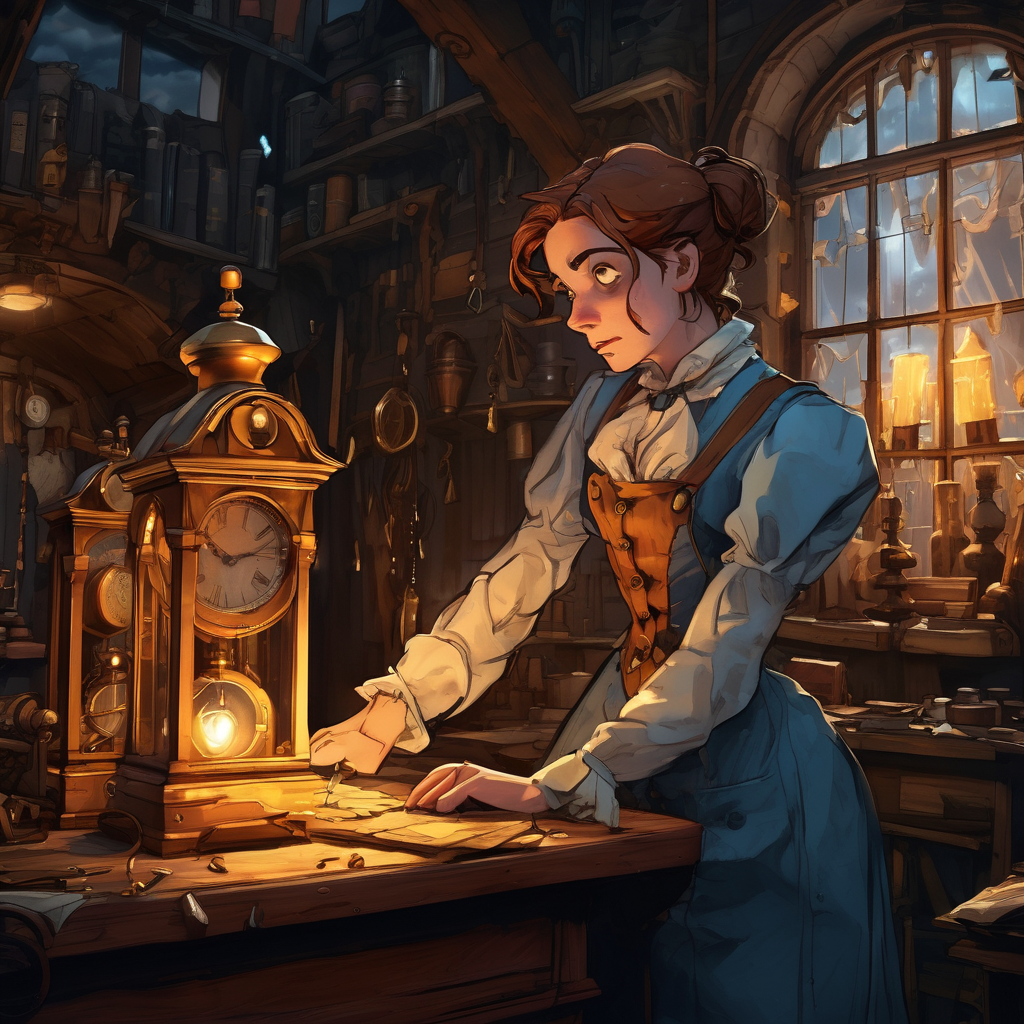
The brass gears hummed with borrowed life, each tick a heartbeat stolen from another realm. Margot pressed her ear to the grandfather clock’s mahogany chest, listening to the rhythm that had once belonged to her grandmother’s spirit.
“The alignment isn’t right,” she whispered to the empty workshop. Outside, November rain drummed against leaded windows, creating a symphony that competed with her mechanical orchestra.
Three months had passed since she’d made the bargain with the shadow merchant who’d appeared at her door during the harvest moon. Her clockmaking business was failing, her rent overdue, and her hands had begun to shake from the stress. The stranger had offered her a solution wrapped in velvet darkness: souls on loan, to animate timepieces that would run forever, never needing winding, never stopping.
The cost seemed reasonable then. Just a small piece of her own essence, paid monthly, like any subscription service.
Now, as she adjusted the pendulum with trembling fingers, Margot realized how much of herself she’d already given away. Her reflection in the clock face showed hollow cheeks and eyes that had lost their amber warmth. The borrowed souls whispered constantly—fragments of memories that weren’t hers, dreams of lives she’d never lived.
The workshop door chimed as someone entered. A woman in a burgundy coat stood framed by the storm, her silver hair catching lamplight like spun moonbeams.
“I’m here about the pocket watch,” the stranger said, her voice carrying the authority of someone accustomed to being obeyed. “The one that belonged to my late husband.”
Margot’s blood chilled. She recognized the voice—it had been whispering from the smallest clock on her shelf for weeks, pleading to return home.
“I don’t know what you mean,” Margot lied, her hands instinctively moving to protect the delicate timepiece that housed the woman’s husband’s soul.
The woman stepped closer, and Margot noticed her eyes held the same ethereal quality as the borrowed spirits. “My dear, I am Eleanor Blackthorne. I believe you’ve been keeping my William company these past few months.”
The pocket watch began chiming frantically from across the room, its golden case vibrating against the wooden shelf. Eleanor’s expression softened as she heard it.
“He always was impatient,” she murmured. “Even in death.”
Margot found herself caught between worlds—the solid reality of her failing business and the supernatural marketplace she’d stumbled into. The rain outside intensified, and she could feel the borrowed souls growing restless within their mechanical prisons.
“The shadow merchant,” Margot began, her voice barely above a whisper. “He said they were willing participants.”
Eleanor laughed, a sound like silver bells in a winter wind. “Oh, my child. William volunteered, as did I. We’ve been searching for a clockmaker skilled enough to house us temporarily while we settled our earthly affairs. The merchant mentioned you might need our help as much as we needed yours.”
The revelation hit Margot like lightning. She’d been so focused on her own desperation that she’d never considered the souls might have their own motivations.
“But the payment,” Margot protested. “My own essence—”
“Returns to you when the contract is complete,” Eleanor finished gently. “Did you not read the fine print?”
Margot’s cheeks burned with embarrassment. She’d been so panicked about her circumstances that she’d barely skimmed the ethereal contract.
Eleanor moved to the shelf and lifted the pocket watch, cradling it like a beloved pet. Immediately, its frantic chiming calmed to a contented purr.
“We’ve been married seventy-three years,” she explained. “Death seemed like such a minor inconvenience. William crossed over first, but I’ve been preparing to join him. We just needed a safe harbor while I arranged for our estate to be donated to the local arts foundation.”
She pulled a thick envelope from her coat pocket and placed it on Margot’s workbench. “Our final payment, as promised. Enough to keep your workshop running for several years, I’d imagine.”
Margot stared at the envelope, then at the woman whose husband’s soul she’d unknowingly been caring for. The other clocks in the workshop began a gentle chorus, as if celebrating a reunion.
“Will they all be leaving?” Margot asked, gesturing to her collection of animated timepieces.
Eleanor nodded. “Most are like us—couples, families, friends who chose to linger together rather than face the unknown alone. Your workshop has become quite famous in certain circles as a sanctuary for those afraid to let go.”
As if summoned by her words, more figures began materializing in the doorway—translucent forms seeking their mechanical vessels, ready to retrieve their essence and continue their journeys.
Margot watched as her workshop transformed into a supernatural reunion. Spirits embraced their clockwork homes before dissolving into sparkles of light that danced briefly in the air before vanishing entirely. With each departure, she felt a piece of her own soul returning, warmth flooding back into her bones.
When the last spirit had departed, only Eleanor remained, still cradling the pocket watch.
“Will you keep in touch?” Margot found herself asking. “I mean, is that even possible?”
Eleanor smiled, and for a moment her form solidified completely. “The veil between worlds is thinner than most people realize. If you ever need us, simply wind William’s watch counterclockwise three times and whisper our names.”
She pressed the pocket watch into Margot’s hands, then leaned forward to kiss her forehead. The touch felt like summer rain—warm, gentle, and impossibly real.
“Take care of yourself, dear clockmaker. The world needs more people willing to shelter lost souls.”
With that, Eleanor faded like morning mist, leaving only the scent of lavender and the sound of rain against glass.
Margot stood alone in her workshop, surrounded by silent clocks and the envelope of money that would secure her future. The pocket watch in her hands ticked steadily, no longer housing a borrowed soul but carrying the promise of connection across impossible distances.
She wound it carefully, placed it on her workbench, and began sketching designs for her next creation. This time, she would build not just timepieces, but deliberate sanctuaries for the lost and searching—a business born from understanding that sometimes the most valuable currency wasn’t money, but compassion.
Outside, the storm began to clear, and the first stars appeared in the November sky, twinkling like distant souls finding their way home.


Leave a Reply