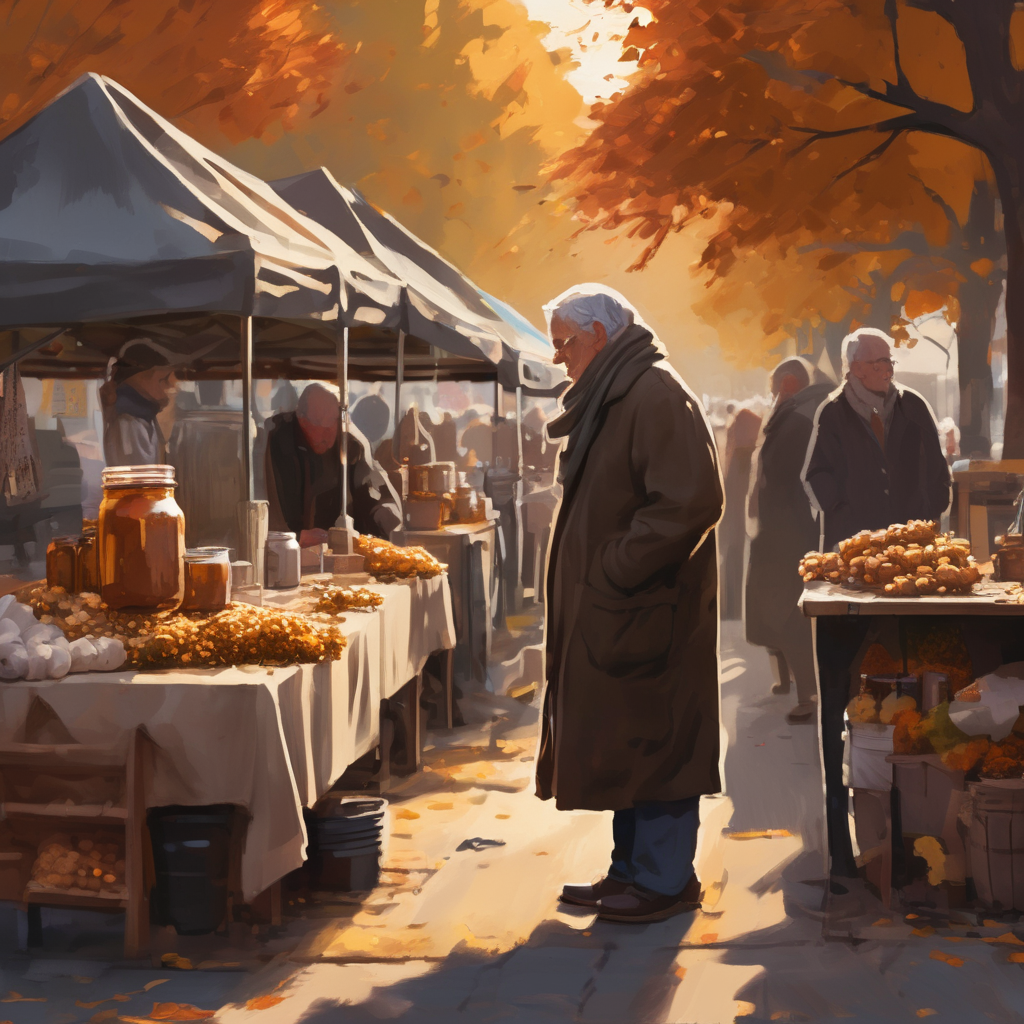
Margot first noticed the man at the farmer’s market on a Tuesday when the autumn leaves had turned the color of burnt copper and everyone seemed to be carrying mason jars filled with golden honey. He moved between the stalls with unusual purpose, not examining the organic kale or sampling the artisanal cheeses like the other customers. Instead, he lingered near the elderly vendors, the ones whose hands shook slightly as they made change, whose eyes held the distant look of people who had seen too many seasons pass.
She watched him approach Mrs. Chen, who sold hand-knitted scarves from a small folding table. The woman was coughing, a wet rattling sound that spoke of cigarettes and winter nights. The man leaned close, ostensibly to examine a burgundy scarf, but Margot saw him inhale deeply, as if breathing in something precious. Mrs. Chen’s coughing stopped abruptly, and she straightened with surprising vigor, her cheeks suddenly pink with health.
By the following week, Mrs. Chen’s table was empty. The market coordinator mentioned in passing that she had died peacefully in her sleep.
Margot began following the man. She told herself it was curiosity, the same impulse that made her slow down at accident scenes and linger outside houses where ambulances had parked. But deep down, she recognized something familiar in his careful, measured movements. She had worked in hospice care for fifteen years before burnout forced her into early retirement, and she knew the particular gravity that surrounded those who dwelt at the threshold between worlds.
The man—she learned his name was Edmund from overhearing a conversation at the coffee shop—had routines. Tuesdays at the farmer’s market. Wednesdays at the senior center where he volunteered to read aloud. Thursdays at the animal shelter, where he spent hours with the oldest dogs, the ones with cloudy eyes and labored breathing. Always, that same careful attention, that ritualistic inhalation.
She started timing her errands to coincide with his. The city felt smaller with this shared choreography, as if they were both part of some elaborate dance she didn’t yet understand. When she finally approached him outside the vintage bookstore where he’d been lingering near the owner—an ancient man who spoke in whispers about first editions—her heart hammered with nervous energy.
“Excuse me,” she said, her voice carrying more authority than she felt. “What exactly are you collecting?”
Edmund turned, unsurprised by her presence. His eyes were the color of winter storms, and when he smiled, she saw profound exhaustion mixed with something like relief.
“Their last exhale,” he said simply. “The breath that carries their stories, their accumulated wisdom, their final understanding. It would be such a waste to let it simply dissipate into nothing.”
She thought of all the people she had sat with during their final moments, how she had always felt there was something sacred in that last release of air, something that should be witnessed and honored. The families often missed it, too consumed with grief or disbelief. But she had been there, again and again, the keeper of those intimate transitions.
“What do you do with them?” she asked.
Edmund gestured toward the bookstore. Through the window, they could see the owner slumped peacefully in his chair, a slight smile on his face.
“I carry them until I find someone who needs what they offered. A teacher receives the breath of a scholar. A young mother gets the exhale of someone who raised seven children. An artist inherits the final sigh of someone who spent decades seeing beauty in ordinary things.”
Margot felt something shift in her chest, a recognition so profound it made her dizzy. “You’re dying,” she said, not a question.
“Six months, perhaps eight. Lung cancer, which the doctors find grimly ironic.” He laughed, a sound like wind through dry leaves. “I need someone to continue the work. Someone who understands the weight of last moments.”
That night, Margot dreamed of glass jars filled with silver mist, each one labeled with names and dates and essential truths. She woke with the taste of honey on her tongue and the certainty that her retirement had ended.
She found Edmund at the farmer’s market the next Tuesday, moving slowly between stalls that seemed less vibrant than she remembered. When he offered her his hand, she took it without hesitation, feeling the transfer of purpose pass between them like a current of warm air.
The first breath she collected belonged to Edmund himself, three months later. It tasted of dedication and solitude and the profound satisfaction of work completed. She carried it carefully until she found the right recipient—a young doctor who had begun to lose faith in the meaning of her profession.
After that, the city revealed its secret geography to her: the places where endings gathered like morning dew, waiting to be transformed into new beginnings. She learned to move through the world with Edmund’s patient grace, understanding finally that some forms of loss were actually preservation, and that the most essential stories were often told in the space of a single breath.


Leave a Reply