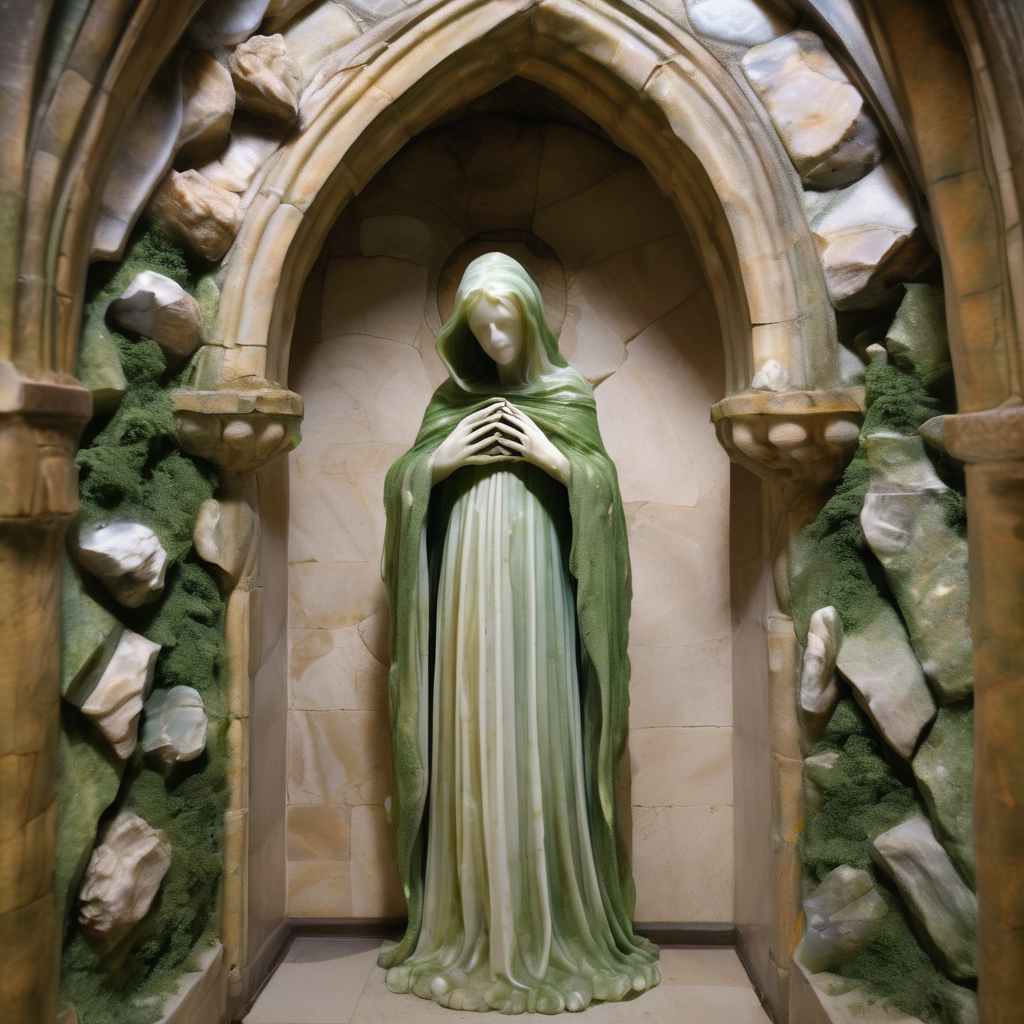
The air in the chantry was thick with the scent of melted beeswax and damp stone. Outside, the last of the sun bled across the horizon, a cinnabar smear in a bruised purple sky. This was the hour for vespers, and I was always the last to leave.
Before me, she stood in her alcove, forever caught in her final moment. Saint Elara of the Loam. Not carved from marble, but herself the medium. When the thaumic flood had taken her, the wild magic mixed with the valley’s unique silt had done the impossible. It had flash-vitrified her. Her bones were a cloudy lattice of opalescent quartz, her flesh a swirling tapestry of agates and fused sand, her martyred heart a single, blood-red garnet suspended in her chest. She was a Silicon Saint, the only one the world had ever known.
I lit a new taper from the stub of the old, my hand trembling slightly. I was her last acolyte. The last one who remembered the sound of her laugh, which was like river stones tumbling together. We’d had a strange, holy situationship, she and I. Not master and student, not quite mother and son. I was simply her witness.
The elders had warned her. The building of the sky-dam by the city-folk upstream was a transgression, but its inevitable collapse was fate. A canon event, the river-tongue prophets had called it, written into the destiny of the valley for a generation. To interfere was heresy against the flow of time itself.
Elara had disagreed. “Destiny is just the story we tell ourselves about the past,” she’d told me, her eyes fixed on the horizon. “The future is unwritten until we write it.”
But she’d been tense in the months before the dam broke. I’d find her late at night, staring into a black scrying bowl, her face lit by the terrible visions within. She was doomscrolling the future, compulsively watching ripples of what was to come, trying to find a single thread she could pull to unravel the catastrophe. It was a beige flag of hers, I’d thought then, that obsessive need to know. Now I knew it was the burden of a saint.
When the city’s engineers came down to inspect the weeping cracks she’d reported, they’d dismissed her. A local mystic, they’d called her. Patronized her. Told her she didn’t understand their grand design. They re-mortared the cracks with promises and left.
After she was gone, after the floodwaters scoured the valley floor and left her a glittering statue in the mud, there was a great vibe shift. The survivors, the ones she’d saved by holding a failing earth-levee together with nothing but will and root-magic long enough for them to scramble to high ground, fell into a theology of resignation. Her sacrifice proved the canon event was unavoidable. Her sainthood became a beautiful, terrible excuse to do nothing. To simply endure.
And I, her witness, had begun my own form of quiet quitting on the divine. I tended her shrine, I lit the candles, I told the pilgrims her story. But the fire in my own heart had dwindled to a pilot light. What was the point of her defiance if it only became a prettier cage of fate?
My vespers were a rote recitation, a habit of grief. But tonight, as the last light failed, a little girl no older than five, a child of the resettlement, padded into the chantry. She didn’t look at me. Her eyes were fixed on the Silicon Saint. She crept forward and placed a scruffy, hand-picked daisy at the statue’s fused, glassy feet.
She looked from the flower to the garnet heart glowing faintly in the candlelight.
“Did she win?” the girl whispered to the silence.
I knelt down, the stone cold through my robes. I had told the story of Elara’s failure a thousand times. The tragedy. The martyrdom. But looking at the child’s earnest face, I suddenly understood something Elara had tried to teach me.
“No,” I said, and my own voice cracked with a faith I thought I’d lost. “She didn’t have to.”
The girl smiled, as if this was the most logical answer in the world. She turned and ran out of the chantry, back into the growing dark. I stayed, watching the candle flame dance, its light refracting a thousand times inside the body of the saint. It wasn’t about stopping the flood. It was about standing in its path. It was about planting a flower at the foot of the inevitable. My vespers were done, but my prayer was just beginning.


Leave a Reply