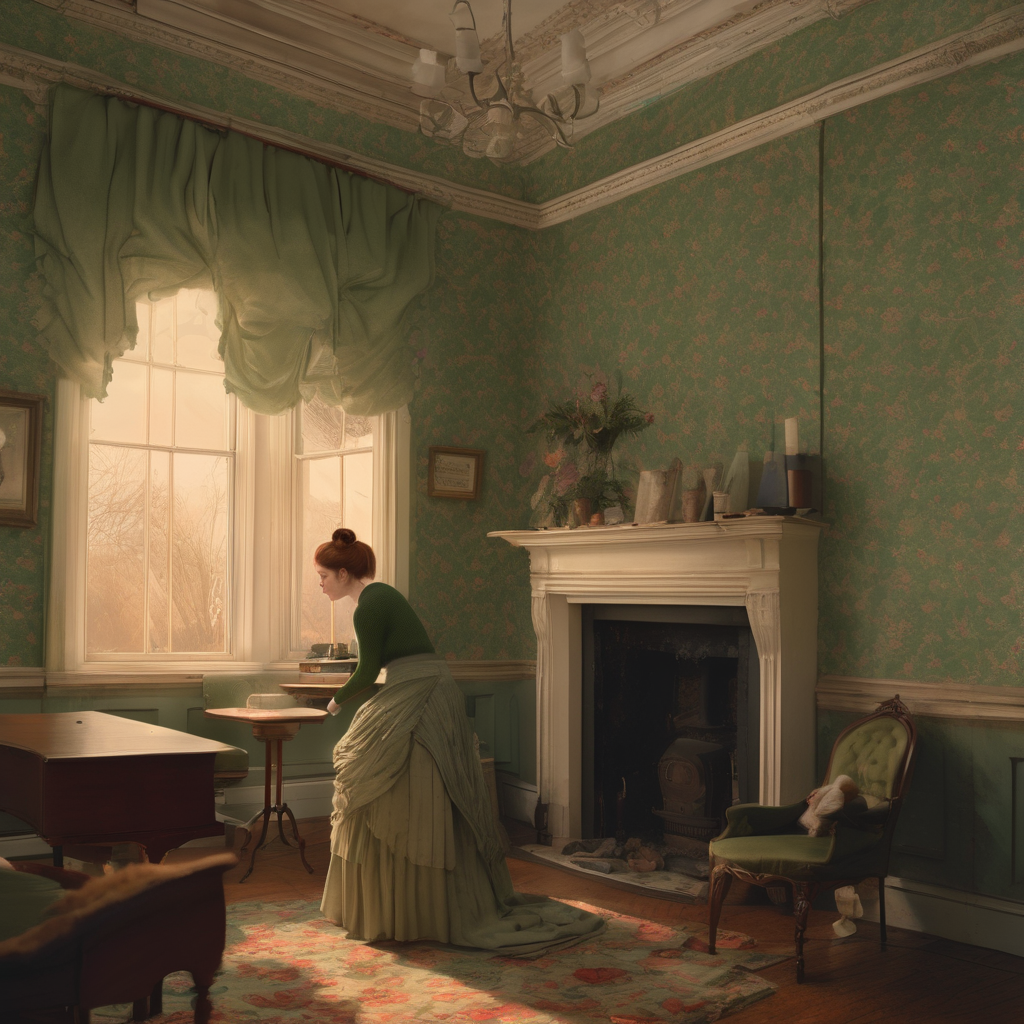
Margaret first noticed it during the hurricane watch, when the meteorologists on every channel spoke in hushed, urgent tones about the unprecedented storm bearing down on their coastal town. She’d inherited Millfield House just three months prior from a great-aunt she’d barely known, and now found herself alone in the sprawling Victorian mansion, watching the walls expand and contract like massive lungs.
At first, she attributed it to the dropping barometric pressure. Old houses settled differently during storms, didn’t they? But as she pressed her palm against the faded wallpaper in the front parlor, she could feel a distinct rhythm—slow, steady, almost meditative. The house was breathing.
Margaret had come to Millfield seeking what everyone seemed to be chasing these days: wellness, mindfulness, a chance to disconnect from the relentless pace of modern life. Her therapist had suggested a change of scenery might help with her anxiety, and inheriting a house by the sea had seemed like serendipity. She’d packed her crystals, her essential oils, and her collection of self-help books, determined to embrace what her yoga instructor called “radical self-care.”
But nothing had prepared her for this.
The breathing grew more pronounced as the storm approached. In the kitchen, the cabinets seemed to swell with each inhalation, their wooden doors creaking softly. The floorboards rose and fell beneath her feet like gentle waves. Margaret found herself synchronizing her own breathing with the house’s rhythm, and for the first time in months, her chronic anxiety began to ease.
She discovered the journal on the third day, wedged behind a loose baseboard in what had been her great-aunt’s bedroom. The pages were filled with spidery handwriting, documenting decades of conversations with the house. Her aunt had been practicing what she called “architectural empathy” long before such concepts became fashionable in wellness circles.
“The house remembers everything,” one entry read. “Every birth, every death, every moment of joy and sorrow within these walls. It breathes with the weight of memory, exhaling the old to make room for the new.”
Margaret learned that Millfield House had been built on land once sacred to the local indigenous tribe, a place where the boundary between worlds grew thin. Her aunt had spent years learning to listen, to understand that the house’s breathing was not supernatural but deeply natural—a response to the electromagnetic shifts of the earth, the gravitational pull of the moon, the collective unconscious of all who had dwelt within its embrace.
As the hurricane passed and the breathing gradually returned to its gentle rhythm, Margaret realized she no longer wanted to leave. She’d found something more valuable than any trending lifestyle philosophy: a genuine connection to something larger than herself.
She began documenting her own experiences, noting how the house’s breathing changed with the seasons, with her emotions, with the phases of the moon. When friends visited, she taught them to feel for the pulse in the walls, to breathe along with the ancient timber and stone.
Some thought her eccentric, but Margaret had discovered that true wellness wasn’t found in expensive retreats or influencer-endorsed products. It was here, in this breathing house that had taught her the most fundamental truth of all: that healing happened not through isolation, but through genuine connection—to the earth, to history, to the mysterious forces that bind all living things together.
The walls continued their eternal rhythm, and Margaret breathed with them, finally home.


Leave a Reply