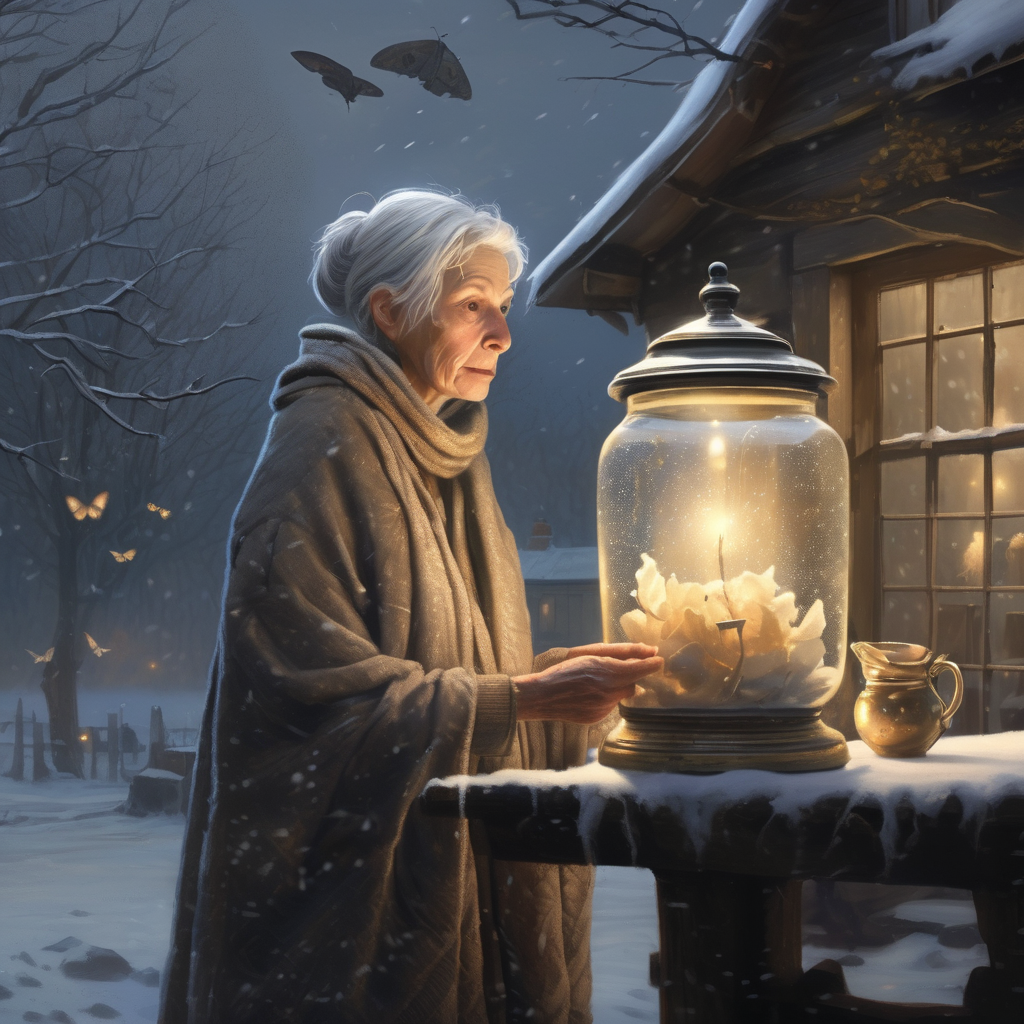
The moths came to Esther at twilight, drawn not by flame but by the dying breath of words never spoken aloud. She had been collecting them for sixty-seven years, ever since the fever took her voice as a child and left her with the peculiar gift of hearing what others could not say.
In her cottage at the edge of Millbrook, jars lined every shelf, each one glowing faintly with the amber light of captured utterances. The moths—delicate creatures with wings like tissue paper—carried these final words from deathbeds and accident scenes, from hospital rooms and quiet homes where people slipped away in their sleep.
Tonight, a particularly luminous moth fluttered through her open window, its wings heavy with the weight of something profound. Esther cupped her hands gently around it, feeling the familiar tingle of unspoken words against her palms. As she released it into an empty jar, the words materialized in golden script against the glass: “I never told you how proud I was.”
She labeled the jar with careful script—”Harold Finnegan, October 23rd, heart attack”—and placed it beside hundreds of others. The local newspaper would run his obituary tomorrow, but it would speak of his work at the hardware store, his love of fishing, his surviving family. It would never mention the words he’d been saving for his estranged son.
The next morning brought an unexpected visitor. A young woman with paint-stained fingers and desperate eyes stood at Esther’s door, clutching a wilted bouquet.
“My grandmother,” the woman said, her voice breaking. “Rose Carmichael. She died three days ago, and I keep thinking… we had a fight before she got sick. About selling her house, about the nursing home. I said terrible things.”
Esther nodded, gesturing for her to wait. She moved through her collection with practiced ease, running her fingers along the recent acquisitions until she found it—a jar that pulsed with soft pink light, like rose petals catching sunlight.
The words inside shimmered: “She’s stronger than she knows. Just like her mother.”
The woman read the script and wept, pressing the jar to her chest. Esther touched her shoulder gently, then pointed to herself and shook her head—she never charged for reuniting words with those who needed to hear them. Some gifts were too sacred for commerce.
As autumn deepened into winter, Esther noticed the moths arriving more frequently. The elderly man who fed pigeons in the park, the teacher who worked late every night, the teenager who walked alone—each departure left words floating in the ether until the moths gathered them home to her.
But one December evening, as snow began to fall, Esther felt an unfamiliar sensation. Her breath grew short, and her hands trembled as she reached for the latest jar. The words inside were her own mother’s, collected decades ago: “I should have told her the moths chose her for a reason.”
For the first time in sixty-seven years, Esther tried to speak. Her voice came as barely a whisper, rusty with disuse, but audible enough for the young moth perched on her windowsill.
“When I’m gone,” she whispered, “find someone who knows the weight of unspoken love.”
The moth’s wings fluttered once in acknowledgment before disappearing into the snowy night. Esther smiled, finally understanding that she had been both collector and collection all along—that her own last words would someday guide another to continue the work of capturing what the heart holds but the voice cannot say.
In the morning, they found her peaceful among her glowing jars, surrounded by the gentle hum of thousands of final words waiting to find their way home.


Leave a Reply