The music box arrived on Tuesday, wrapped in newspaper from 1847. Margot knew this because the headline screamed about a cholera outbreak in London, the ink still wet somehow, bleeding into her fingertips like fresh tattoo ink.
Her grandmother’s estate sale had yielded nothing but dusty romance novels and mismatched china until the auctioneer pulled this from behind a false panel in the wardrobe. Nobody else bid on it. They were too busy fighting over the vintage designer handbags and the collection of jade elephants that turned out to be resin.
The box was octagonal, made of wood so dark it seemed to absorb light. When Margot wound the key, it played a melody she recognized but couldn’t name—something between a waltz and a funeral dirge. Inside, instead of a dancing figure, there was a small glass vial filled with what looked like mercury, except mercury didn’t usually contain tiny floating words.
She tilted the vial. The words swam like silver fish: *sustainability*, *mindfulness*, *authenticity*. Modern words in an ancient vessel. They rearranged themselves as she watched, forming a message: “The swifties know where the mushrooms grow.”
Margot had to laugh. Her grandmother had been many things—a bootlegger’s daughter, a circus fortune teller, a woman who claimed to have kissed Jim Morrison in a Paris cemetery two years after his death—but never a Taylor Swift fan.
That night, she dreamed of forests where bioluminescent fungi spelled out song lyrics, where crowds of people in friendship bracelets wandered between the trees, searching for something they couldn’t name. She woke with dirt under her fingernails and a coordinates tattooed in henna on her wrist: numbers that faded even as she tried to write them down.
The internet, when consulted, revealed that “swifties” were also a type of moth. The kind that fed on mushrooms. The kind that had gone extinct in 1924, the same year her grandmother was born.
Margot drove north, following half-remembered numbers and the pull of the music box’s melody, which she now heard even when it wasn’t playing. She parked at a trail marked only by a rusted chain and a sign that said “Property of Tomorrow.” The forest beyond smelled of rain and something else—time, maybe, or the absence of it.
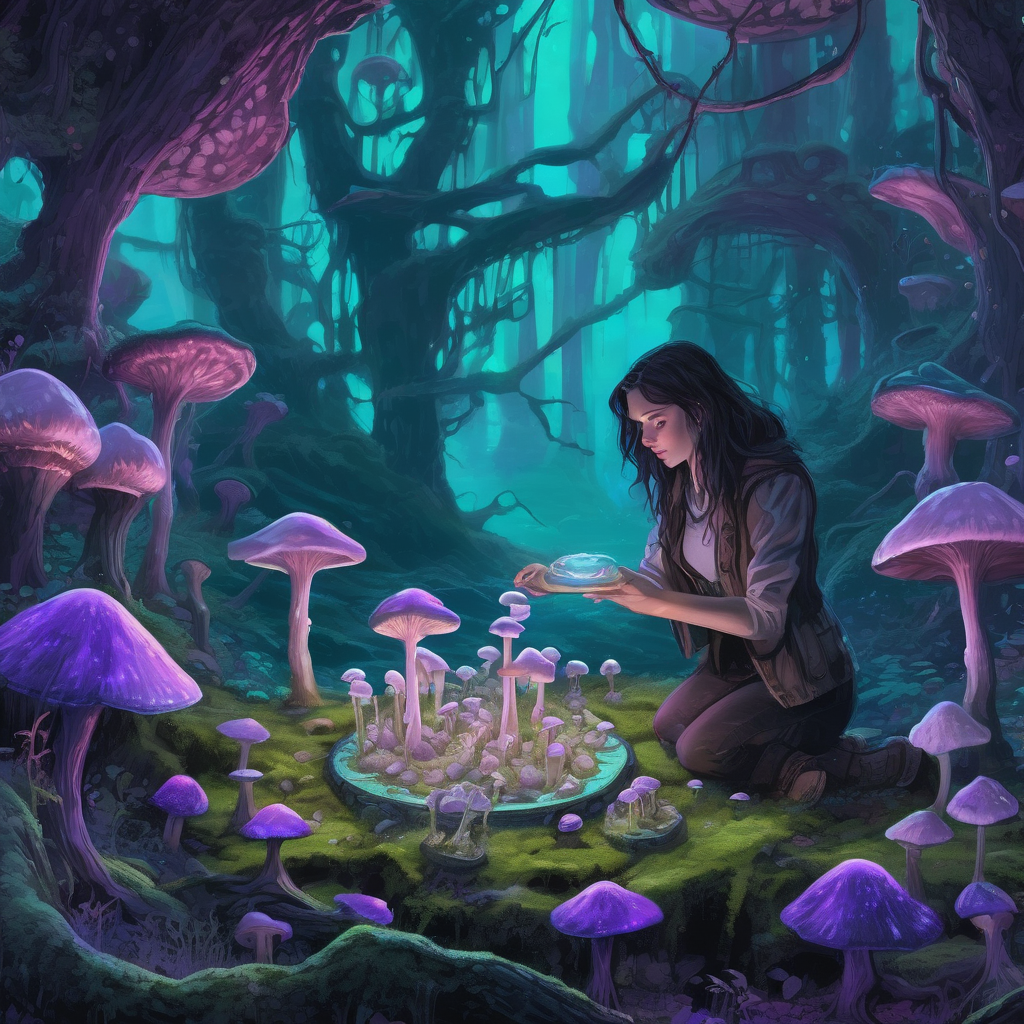
The mushrooms were there, just as the message promised. They grew in a perfect circle, each one the size of a dinner plate, their caps inscribed with what looked like cuneiform but read like modern English. Stories grew from their gills: tales of climate change refugees who traveled backwards through seasons, of influencers who turned into actual influences (the linguistic kind, changing the way people spoke with a single post), of a woman who collected discarded vape pens and turned them into flutes that could call rain.
In the center of the circle stood another music box, identical to hers but made of glass. Inside, instead of mercury, was a powder that looked like crushed pearls and smelled of tomorrow’s rain. A note was tied to the key: “For the next one. Love, Swift & Co., Temporal Sustainability Division, est. 1924, 2024, 2124.”
Margot understood then. Her grandmother hadn’t been a fan—she’d been a member. The swifties weren’t extinct; they’d just learned to hide in plain sight, spreading their spores of change through music boxes and mushroom circles, through vintage finds and viral trends, ensuring that what needed to survive would survive, even if it meant traveling sideways through time.
She took the glass music box and left the wooden one in its place. As she walked back to her car, she could hear it begin to play, calling to whoever would find it next. The melody was different now—something between a pop song and a protest chant, a tune that hadn’t been written yet but would be, someday, when the world was ready to dance to it.
The mercury in her vial had formed new words by the time she got home: “Meeting tomorrow. Bring kombucha. The revolution will be sustainable.”
Margot smiled and began to wind the glass key. Somewhere, in a time that wasn’t quite yesterday and wasn’t quite tomorrow, her grandmother was laughing, and the moths were singing, and the mushrooms were taking notes on everything.


Leave a Reply