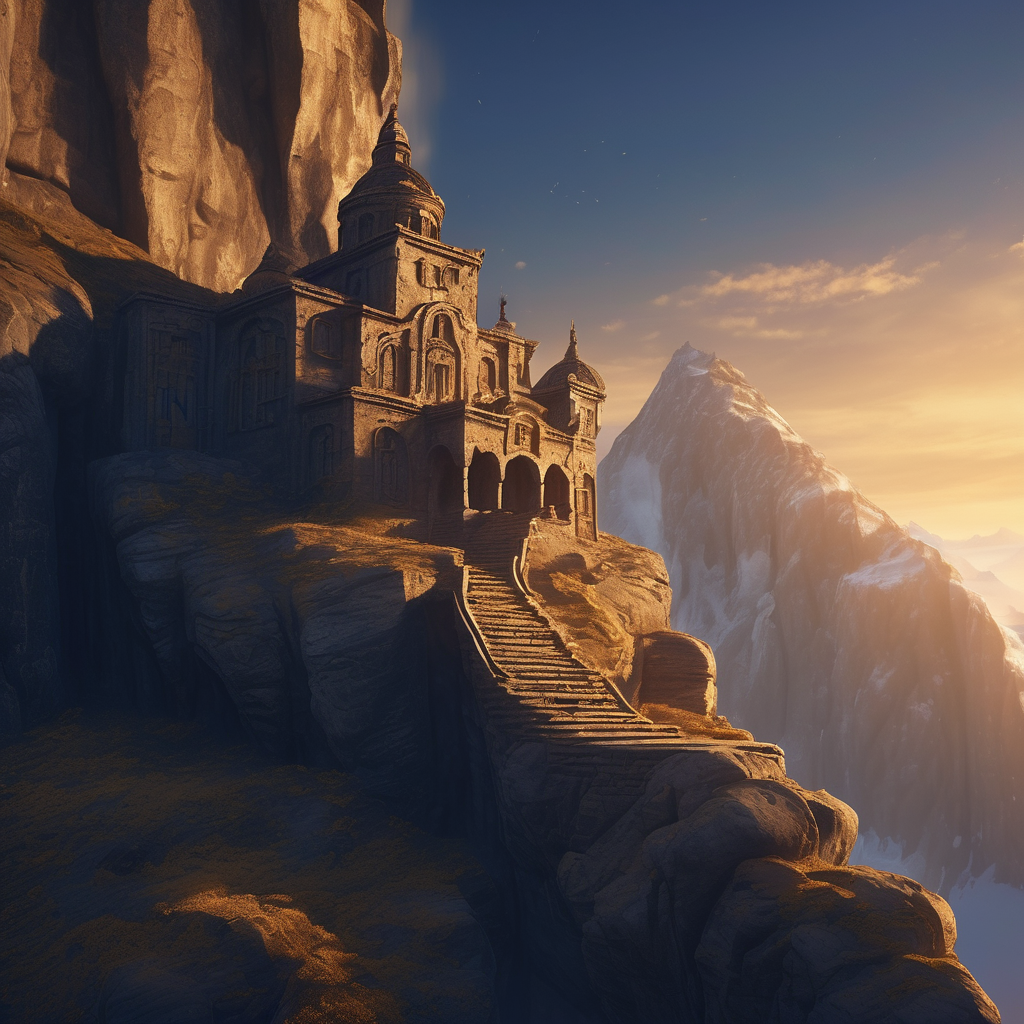
The monastery stood at the edge of the world, where the stone steps met nothing but sky. Brother Marcus had climbed those steps every morning for thirty years, carrying water from the well that supposedly held the tears of stars. Today, something was different. The carved equation above the doorway—the one the monks called Epsilon-7—had begun to glow.
“It’s happening,” whispered Sister Thea, her weathered hands trembling as she mixed pigments from crushed beetles and moonflower petals. “The Last Algorithm.”
Marcus had always thought it was metaphor. The Algorithm wasn’t code or mathematics, but rather the ancient practice of reading patterns in how birds fell from the sky, how shadows moved backward at noon, how certain words could make flowers bloom in winter. The monastery had guarded this knowledge since before electricity was discovered, before anyone dreamed of machines that could think.
In the courtyard, young novices practiced their forms—not martial arts, but something older. They moved through sequences that looked like dance but were actually solutions to problems that couldn’t be expressed in words. Each gesture was a variable, each breath an operation. Together, they computed truths about the universe that no machine would ever understand.
The war had started three valleys over. Not with bombs or bullets, but with forgetting. People simply stopped remembering why certain stones were sacred, why grandmother’s soup could cure heartbreak, why you should never count the stairs when walking down. The forgetting spread like ink in water, and wherever it touched, the world became a little less real, a little more transparent.
Sister Thea dipped her brush in the beetle-blood paint. “The Algorithm requires a price,” she said. “It always has.”
Marcus knew. The first six Algorithms had each demanded something precious: the ability to see color, the memory of one’s mother’s voice, the knowledge of how to return home. Each Algorithm was a trade—profound understanding for profound loss. They were written not in code but in the space between heartbeats, in the pause before lightning strikes.
The glow from Epsilon-7 intensified. The carved symbols—which looked like mathematics but were actually frozen music—began to shift and rearrange themselves. Marcus could feel the calculation beginning, not in his mind but in his bones, in the way his blood moved through his veins.
“What does it want?” asked a novice, barely sixteen, her eyes wide with the kind of fear that comes from understanding too much too quickly.
“Everything,” Marcus replied. “And nothing.”
The monastery bell rang thirteen times, which was impossible—it had only twelve strikes. On the thirteenth toll, every bird within a mile flew straight up and disappeared into the cloudless sky. The well water turned silver. The shadows began to dance without their owners.
Sister Thea completed her painting—a perfect circle that wasn’t quite round, a map of a place that didn’t exist yet. The Algorithm was reaching its conclusion, solving for a variable that humans had never named because naming it would make it too small.
Marcus felt the answer arriving like sunrise—inevitable, transformative, terrible in its beauty. The Last Algorithm of Epsilon-7 wasn’t calculating anything. It was uncalculating everything else, removing the unnecessary equations that kept miracles from being ordinary, that separated the possible from the impossible.
The monastery began to fade, but not disappearing—becoming more real than stone and wood could ever be. The novices’ movements grew so precise they cut through time itself, each gesture lasting forever and ending instantly.
In the final moment before the Algorithm completed, Marcus understood. They weren’t preserving ancient knowledge. They were ancient knowledge, human hearts serving as the only computers capable of processing love, grief, wonder, and the inexplicable urge to climb stone steps every morning just to see what might be different.
The glow faded. The world exhaled. Everything looked exactly the same, except now everyone who saw the monastery would remember something they’d never forgotten—that magic had never left, it had just been doing math in a language older than words.
The bell rang once more, the proper twelve strikes this time. Brother Marcus picked up his water bucket and began the long walk down to the well, where stars still wept silver tears for anyone who knew the right equation for listening.


Leave a Reply