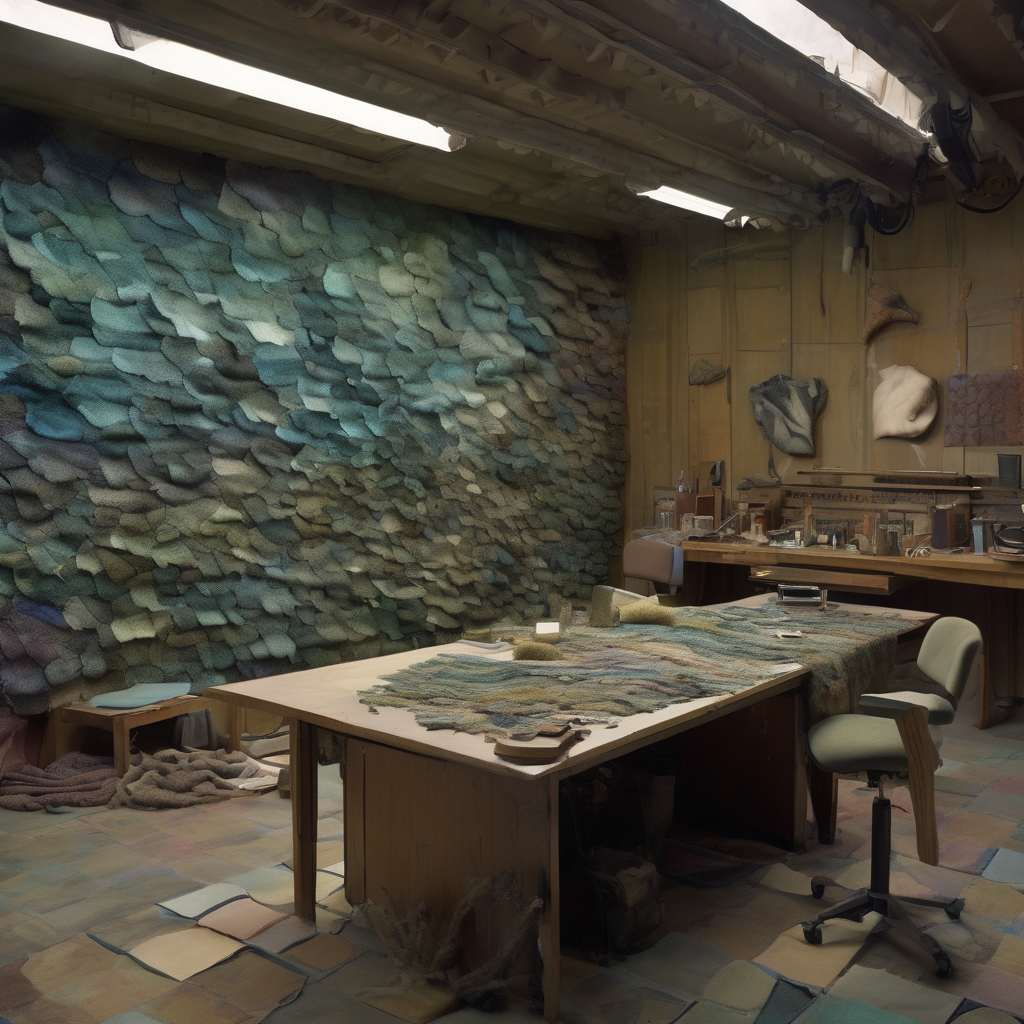
Elias was a polisher of silences. In his youth, he had been a Tuner, one of the last who could perceive the Resonances—the emotional residue that clung to objects and places like stubborn dust. A wedding ring thrummed with a half-century of devotion; a park bench groaned with the accumulated weight of a thousand lonely lunches. His was a world of deafening feeling, a constant, psychic cacophony.
Now, he lived here. The walls were clad in felted bismuth and woven sea-grass, materials that didn’t just block sound, but actively devoured emotional frequencies. It was the only truly quiet place left in his world. Here, he tended to the one Resonance he had saved from the clamor.
It was housed in a small, tin music box, its painted ballerina long since frozen mid-pirouette. He hadn’t opened it in years. Instead, he worked on its exterior, polishing the tin with a chamois cloth, keeping it free from the creeping entropy of the world. Inside was a moment of laughter. Not just any laugh, but Lena’s. It was the sound she’d made on the Calico coast, the day a brazen seagull stole the entirety of her sandwich. It was a sound of pure, unadulterated surprise, cresting into helpless, gut-aching mirth.
It was the most authentic thing he had ever known.
Outside his workshop, the world had embraced a different kind of quiet. Fearing the emotional overload, the psychological drain of living in a world saturated with second-hand feelings, people had begun to systematically erase them. They called it Emotional Sustainability. New architecture was designed to be null, new products manufactured to be inert. They stripped history from heirlooms and tore down old buildings, replacing them with sleek, sterile structures that held no story. They had achieved a global sense of mental wellness at the cost of their own echoes. Empathy became a theoretical concept, a word in old books. Connection was something you scheduled and curated, a pale imitation of the chaotic, involuntary thing it once was.
A tremor ran through his hand. He set the music box down. The Resonance within it was fading. He could feel it, a subtle weakening of its intricate structure. Laughter, he remembered Lena telling him, was not a stone. It was a bubble. It needed air.
He’d built this sanctuary to protect her memory, to keep that one perfect moment safe from the noise of the world and, later, from the encroaching, artificial silence. He saw it as the ultimate act of devotion. But Lena had never been one for preservation. She’d thrived in the mess. “What’s the point of a feeling if you don’t feel it, Elias?” she’d asked him once, during one of their gentle arguments. “These Resonances… they’re our shared core. A vulnerability we all carry. You can’t just put the ones you like in a box.”
He had thought she was wrong. Naive. He had sought to build a fortress around his grief, but he had only built a cage for a ghost.
His apprentice, a young woman named Kaelen with eyes that still held a flicker of the old world’s perception, had told him last week that Tuners were now treated as curiosities, like blacksmiths or court jesters. “People don’t want to feel anything that isn’t their own,” she’d said, her voice flat. “It’s not efficient.”
Efficiency. Sustainability. Wellness. They had become the cornerstones of a world without a heart.
Elias looked at the music box. The laughter inside was now just a whisper, a faint harmonic on the edge of oblivion. The perfect, soundproof room was smothering it. He realised, with a clarity that felt like a physical blow, that a memory, even a perfect one, isn’t a thing to be possessed. A feeling can’t be sustained in a vacuum. Its very nature is to connect, to ripple outwards, to brush up against other feelings and be changed by them.
His act of protection had been an act of profound selfishness. He hadn’t been preserving Lena’s laugh; he had been hoarding it.
Slowly, his joints complaining from disuse, he stood up. He picked up the music box, its cold tin a familiar weight in his palm. He walked to the heavy, triple-sealed door of his workshop, the one he hadn’t breached in a decade. He fumbled with the locks, his fingers clumsy. The wheel-handle was stiff, resisting his push.
He paused, his forehead pressed against the cool, dead material of the door. This was it. The moment he opened it, the silence would be broken. The pandemonium of the world—or what was left of it—would rush in. Lena’s laugh wouldn’t be his private treasure anymore. It would be thrown into the world, to be battered by the blank apathy of a passing hover-craft, to be diluted by the sterile void of the new plaza, to mingle with the faint, dying whispers of a world that had forgotten how to feel. It would be lost.
Or it would be free.
He shoved the wheel with all his strength. There was a groan of metal, a hiss of depressurization, and the door swung open.
A tidal wave of nothingness washed over him. The manufactured void from the street outside was a pressure against his skin. But then, beneath it, something else. A flicker. The desperate, lonely pang from an insomniac in the tower opposite. The faint, stubborn Resonance of joy from a weed pushing through a crack in the permacrete. They were weak, scattered, but they were there.
He looked down at the music box in his hands. For a dizzying second, he felt Lena’s laugh surge, pulling at the ambient loneliness and the defiant joy, weaving them into itself. It wasn’t pure anymore. It was… complex. It held a note of sorrow now, a hint of struggle. It was no longer a perfect, isolated artifact. It was alive.
It wasn’t a sound in a room. It was an echo, finally rejoining its world.


Leave a Reply