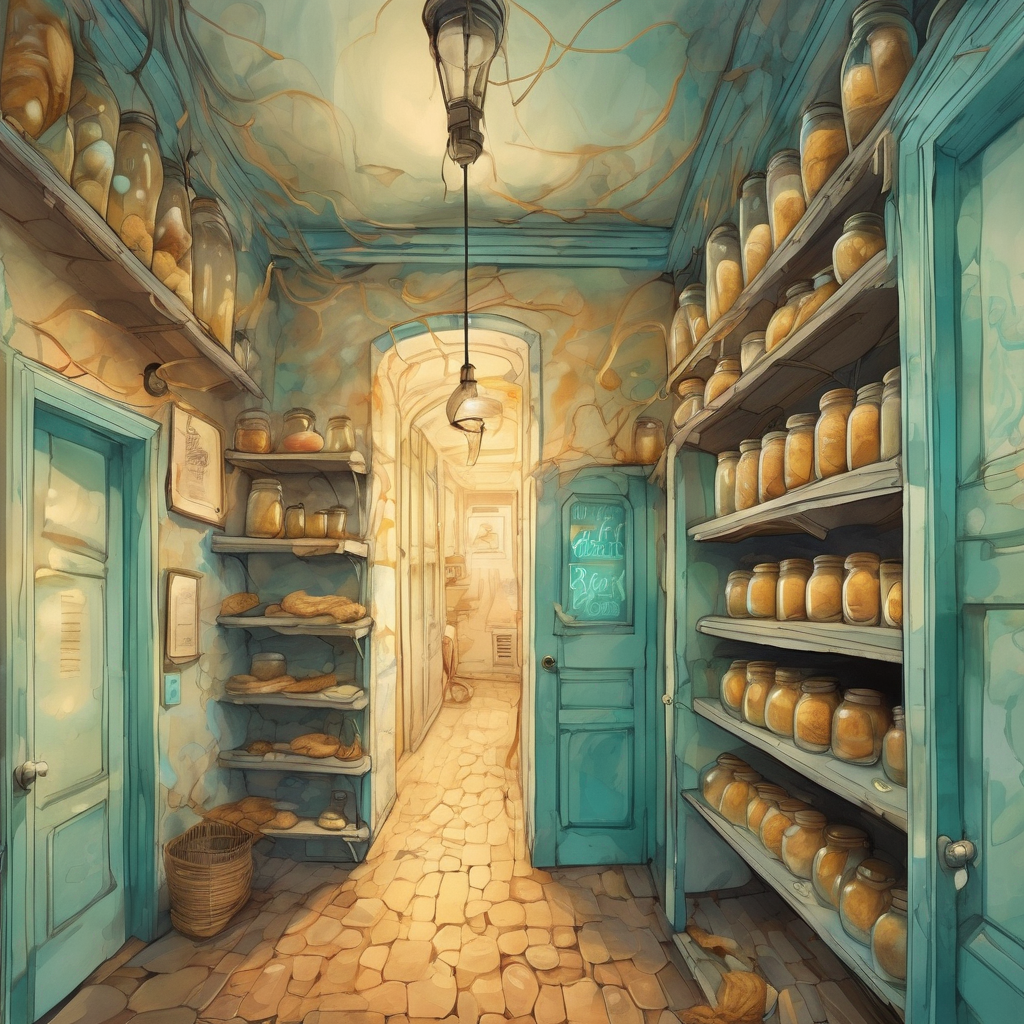
The house appeared only on Tuesdays, and only to those who had lost something irreplaceable.
Marcus found it after wandering the city for three hours, his daughter’s drawings clutched in his hand—the only things saved from the fire. The street sign read “Memory Lane,” though he’d walked these blocks a thousand times before and never seen it. The house stood at the end, painted in a color that shifted between seafoam and storm clouds depending on how he tilted his head.
A woman answered the door before he knocked. She wore a dress made entirely of pressed flowers and had eyes like old photographs, sepia-toned and slightly blurred at the edges.
“You’re here about the trade,” she said. It wasn’t a question.
Inside, the walls were covered floor to ceiling with mason jars. Each one contained something different—a child’s laugh floating like golden smoke, the smell of bread baking in someone’s grandmother’s kitchen, the exact sensation of diving into a lake on the first day of summer. Labels hung from twine: “Sarah M., age 7, 1987” or “Roberto, his wedding day, 2019.”
“I collect what people think they’ve lost,” the woman explained, leading him deeper into the house. “But everything has a price. A memory for a memory. A dream for a dream.”
They passed a room where a man sat at an empty table, moving his hands as if playing an invisible piano. “He traded the memory of his mother’s funeral for the ability to play her favorite song again,” the woman whispered. “He comes every Tuesday to practice.”
In the next room, a teenage girl stood before a mirror that showed no reflection, just swirling mist. “She gave me her first heartbreak,” the woman said. “In exchange, she can see herself the way her grandmother saw her—brilliant and brave and absolutely limitless.”
Marcus understood then. The drawings in his hand weren’t just paper and crayon. They were his daughter Emma’s entire world—her unicorn phase, her conviction that clouds were made of cotton candy, her belief that he could fix anything.
“What would you trade?” the woman asked.
He thought of Emma in the hospital, the doctors’ careful words about trauma and memory loss, how she’d looked right through him that morning like he was a stranger.
“I want her to remember being happy,” he said. “To remember… us.”
The woman led him to the last room, where the walls were covered in empty frames. “This is where we keep the futures that were never lived,” she said. “The paths not taken. They’re the most valuable currency here.”
Marcus saw it then, shimmering in one of the frames—himself, twenty years from now, successful but alone, the choice he’d make if he focused on rebuilding their life instead of rebuilding his daughter’s heart.
“That one,” he said, pointing to his solitary future. “For her memories of joy.”
The woman smiled sadly. “You understand the weight of this? You’ll never be able to choose that path now. Every decision will bend toward her happiness, even when it costs you everything else.”
“She’s already everything else,” Marcus said.
The trade was made with pressed palms and whispered words that tasted like autumn leaves. The woman handed him a small vial filled with light the color of Sunday mornings and birthday candles.
“Three drops on her pillow tonight,” she instructed. “She’ll dream her way back to you.”
As Marcus left, he noticed others arriving—a mother carrying a wedding dress, an old man with a box of love letters, a child holding nothing but cupped hands full of hope. The house served them all, this strange sanctuary where lost things waited to be found, or traded, or transformed.
That night, Marcus watched Emma sleep, the vial empty beside her bed. She smiled in her dreams, and when she woke, she looked at him with recognition that bloomed like sunrise.
“Daddy,” she said, “I had the most wonderful dream. We were drawing unicorns, and you said they were real if we believed hard enough.”
Marcus hugged her close, feeling the weight of his traded future lifting away like smoke. Outside their window, he could have sworn he saw the woman from the house walking past, collecting the morning’s discarded wishes from the sidewalk, tucking them into her pockets for next Tuesday’s visitors.
The last house on Memory Lane would be there for them, for all of them, standing at the intersection of what was lost and what could still be found, dealing in the only currency that truly mattered—the pieces of ourselves we’re willing to sacrifice for love.


Leave a Reply