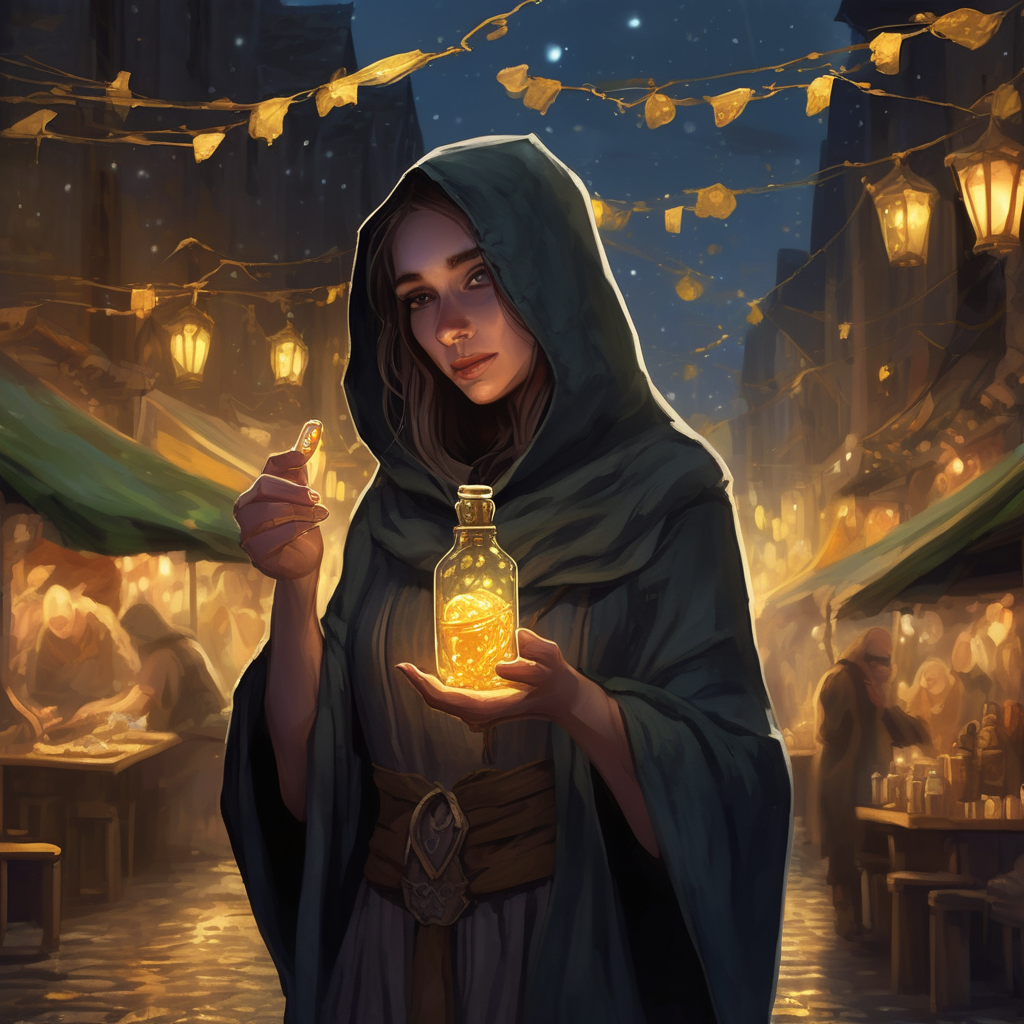
The cobblestones gleamed wet beneath Mira’s bare feet as she hurried through the night market, a glass vial clutched against her chest. Steam rose from food carts selling roasted chestnuts and honeyed bread, but she had no coin for such luxuries. What she carried was worth more than all the vendor stalls combined.
The memory inside the vial swirled like captured aurora—threads of gold and silver dancing in an endless waltz. It was the last one. After tonight, there would be no more memory vendors in the city of Thessan, perhaps in all the realm.
“Mira! Wait!”
She turned to see Kael pushing through the crowd, his healer’s robes disheveled. Dark circles shadowed his eyes. He’d been working double shifts at the hospice since the Forgetting Plague began claiming minds instead of bodies.
“You can’t do this,” he said, breathless. “That memory—it’s all you have left of her.”
Mira’s fingers tightened around the vial. Inside, her grandmother’s final memory pulsed with warmth: the two of them picking blackberries in summer meadows, laughing as purple juice stained their fingertips. Grandmother’s voice, rich as honey mead, singing old songs about brave queens and gentle dragons.
“The Duchess of Millhaven is dying,” Mira whispered. “Her mind is already half-gone to the plague. This memory—it could anchor her, give her family one more season together.”
“And leave you with nothing.”
But that wasn’t true. Mira touched the leather pouch at her hip, heavy with gold coins—more than she’d ever seen. Enough to buy passage across the Narrow Sea, enough to start fresh in the Southern Kingdoms where memory magic was just fairy tales.
“I’ll have a future,” she said. “Grandmother always said that was worth more than the past.”
Kael’s expression softened. “She also said memories make us who we are.”
A night wind swept through the market, carrying the scent of jasmine and distant rain. Mira had been selling memories since she was twelve—first the small ones, childhood afternoons and forgotten dreams. Then larger pieces as grandmother’s extraction skills grew legendary. Nobles traveled for days to purchase bottled joy, condensed courage, distilled wisdom.
But the plague changed everything. Now people hoarded their memories like grain before winter, and the Merchant Guild had banned the practice entirely. Too dangerous, they claimed. Too much risk of spreading the mind-sickness.
“The Duchess sent her carriage,” Mira said, nodding toward the black horses waiting at the market’s edge. “If I don’t go now—”
“Then don’t go at all.” Kael stepped closer. “Stay. Help me find another way to fight this plague. Your grandmother’s knowledge, combined with healing arts—”
“My grandmother is dead.” The words came out sharper than intended. “All I have left of her wisdom is in this vial, and it’s worth a fortune to someone who can actually use it.”
Kael fell silent. Around them, the market continued its nightly dance—merchants calling prices, children chasing fireflies between the stalls, lovers sharing wine beneath paper lanterns. Normal life, as if the world wasn’t slowly forgetting itself piece by piece.
Mira began walking toward the carriage, each step heavy as stone. The memory vendor’s trade was dying with her. Soon there would only be healers like Kael, fighting a plague they didn’t understand with herbs and hope.
She was almost to the carriage when she stopped.
In the distance, church bells began their midnight song. The sound triggered something—not a memory, but the ghost of one. Grandmother’s hands teaching hers to weave dreams into glass. The old woman’s voice: “We don’t sell memories, child. We preserve love.”
Mira turned back. Kael still stood where she’d left him, shoulders slumped in defeat.
“What if,” she called out, her voice barely audible above the market noise, “what if we could teach people to preserve their own memories? Before the plague takes them?”
Hope flickered in his eyes like candlelight. “You mean—”
“I mean maybe the last memory vendor doesn’t have to be the end of something. Maybe she could be the beginning.”
The carriage driver cleared his throat impatiently, but Mira was already walking back toward Kael, toward uncertainty, toward a future built on more than gold.
The vial in her hands caught the moonlight, grandmother’s memory still dancing inside like trapped stars. It would stay with her a little longer. Long enough, perhaps, to plant seeds of something new in ground that everyone else had given up for barren.


Leave a Reply